
How Does A Tablet Press Work? From Powder To Tablet
A tablet press turns a measured volume of powder or granules into a compact tablet. The basic sequence is easy to picture: fill a die cavity, compress the material between an upper and a lower punch, then push the tablet out. The useful details are in how the machine controls each stage. Filling affects tablet weight; compression affects its structure; ejection reveals whether the tablet can leave the die cleanly.
The Parts That Do The Work
The die is a cavity that gives the tablet its outline. An upper punch and a lower punch move within it. A feeder brings material over the opening, while cams and rollers guide punch movement in a rotary press. Once the tablet has been formed, the lower punch lifts it to the die surface and a take-off blade guides it toward the outlet.
The material matters as much as the tooling. A powder that bridges in the feeder or changes bulk density can produce variable weights even when the machine settings stay the same. That is why a press cannot be judged by its maximum force or speed alone.
How Does A Tablet Press Work Through One Cycle?
First, the lower punch descends, leaving space in the die. The feeder supplies material as the die passes beneath it. The lower punch then rises to a set level, displacing excess material. This metering step determines the effective fill volume. It does not guarantee an exact weight: bulk density, flow and filling efficiency also influence how much material remains.
Next comes compression. On rotary machines equipped for precompression, the punches apply an initial, lighter load before the main compression stage. This can help particles rearrange and let some trapped air escape. It is a useful process tool, but it is not present on every press and it cannot rescue an unsuitable formulation by itself.
At main compression, the upper and lower punches squeeze the powder bed as they pass between pressure rollers. The particles bond into a tablet. The resulting thickness and strength depend on more than peak force. Material compressibility, lubrication, punch movement and the time under pressure all play a part. More force is therefore not automatically better; a setting that increases hardness may also create other quality problems.
After the pressure is released, the tablet can expand slightly. The lower punch rises and pushes it out of the die. The take-off blade directs it into the discharge path, and the punches return to their starting positions. Excessive ejection resistance is a reason to check the formulation, lubrication and die surface rather than simply increasing compression force.
Single-Punch And Rotary Presses Follow The Same Idea
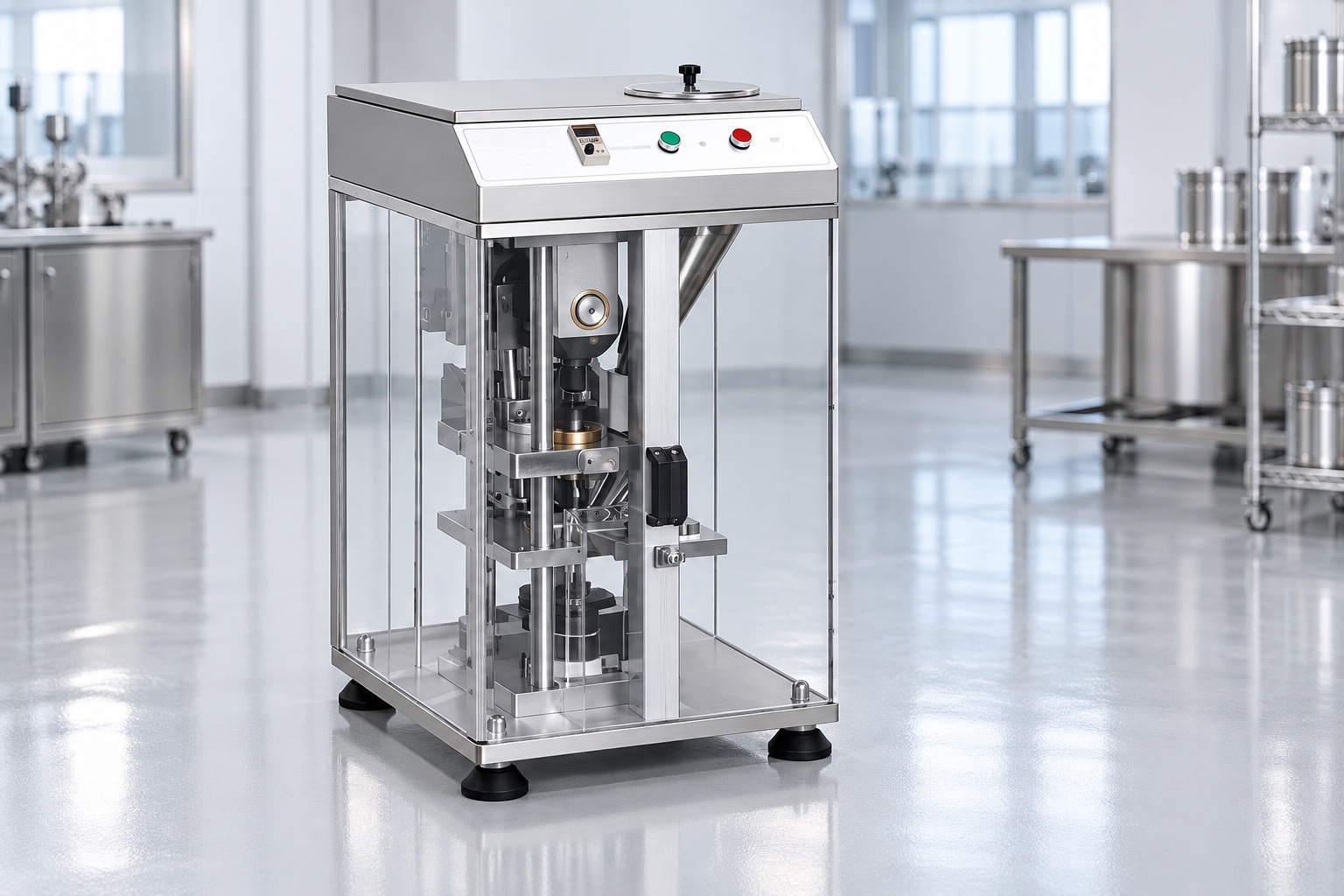
A single-punch press uses one set of tooling to make one tablet per cycle. Its distinct fill, compression and ejection movements make the process straightforward to observe and adjust. Fimachinery's FI-1STP is an example of a single-punch machine in its tablet equipment range.
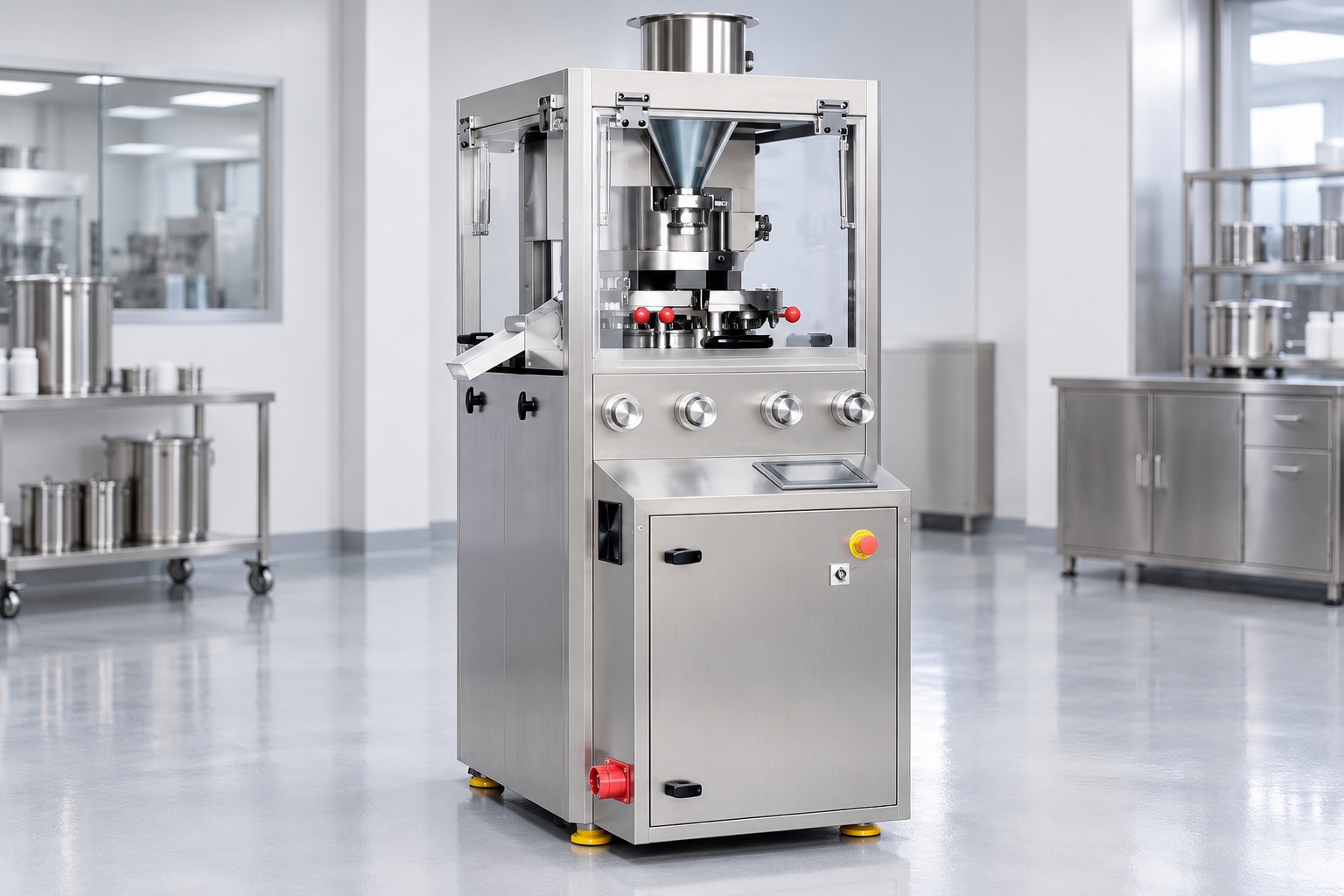
A rotary tablet press carries multiple punch-and-die sets around a turret. Each set passes through the same sequence as the turret turns, so tablets leave the machine in a continuing stream. Fimachinery lists the FI-226TP and FI-420TP as rotary tablet presses. Its FI-265HTP high-speed series is described with filling, metering, precompression, main compression and ejection during a turret rotation. These examples illustrate different machine layouts; the exact stations and controls should always be checked for the chosen model.
What Operators Adjust, And What Those Adjustments Change
Fill depth changes the die volume available for material. It is a practical starting point when setting tablet weight, but a stable weight also needs consistent material delivery. If weights drift, look at powder flow, feeder behavior, material level and turret speed before assuming the depth setting has moved.
Compression settings influence tablet thickness and mechanical strength. A good setting is one that produces tablets meeting the required quality checks, not simply the highest pressure the machine can deliver. If a formulation is sensitive to time under pressure, raising turret speed may alter the result even when the displayed force is similar.
The ejection stage is a useful final check. A rising ejection load can point to friction at the die wall or changes in lubrication, moisture or tooling condition. If tablets cap or split after leaving the press, review the fill and compression stages as well as the material; the defect may begin before ejection.
A Practical Way To Understand The Process
Follow one die cavity rather than the whole machine. Ask what enters it, how much remains after metering, how the two punches compress that material, and whether the finished tablet exits without damage. Then compare tablet weight, thickness and strength with the settings and material conditions. This makes a tablet press easier to troubleshoot because each observation has a place in the cycle.
In short, a tablet press works by repeating fill, meter, compress and eject. A single-punch machine repeats that sequence with one tooling set; a rotary machine repeats it across many sets as the turret moves. Reliable tablets come from controlling the full sequence and confirming the result with actual tablet checks.