
How To Fill Capsules With Powder In Production
A powder capsule can look simple from the outside, but repeatable production depends on several linked operations. The empty shell has to reach the filler in the right orientation, the cap and body must separate cleanly, the powder must enter the body at the intended mass, and the capsule must close without damage. If any one of those steps drifts, increasing machine speed will only produce defects faster.
For manufacturers asking how to fill capsules with powder, the useful starting point is the complete production path. It connects powder preparation, capsule handling, machine setup, in-process checks, and downstream inspection.
Match The Powder, Shell, And Machine Before The Run
Production equipment typically fills preformed, two-piece hard capsules. The longer body receives the powder; the cap is then fitted back over it. Hard capsules may use gelatin, HPMC, or another suitable shell material. Shell size, dimensional consistency, moisture condition, and locking design all affect how reliably a machine separates and closes them.
The powder matters just as much. Its flow, bulk density, cohesiveness, particle size, compressibility, and tendency to build static charge can change how consistently a dosing system delivers material. A formulation that enters a capsule during a slow trial may behave differently at the planned production speed. Confirm the target fill mass and the product's acceptance limits, then test with the actual formulation and shell—not a convenient substitute.
Before starting, verify the fitted capsule-size parts, product-contact cleaning status, powder feed path, and the setup recorded for this product. When changing shell size, the matching format parts and their alignment need another check. A prior recipe is useful context, but it does not replace a trial with the current material.
Follow The Machine's Filling Sequence
An industrial powder capsule filling cycle begins with empty capsules being supplied and oriented. The equipment separates caps from bodies, holds the bodies in position, meters powder into them, then brings caps and bodies together for locking and discharge. On a fully automatic line, these operations are coordinated within a continuous machine cycle. A semi-automatic machine divides the work across its stations while still using mechanical capsule handling and filling.
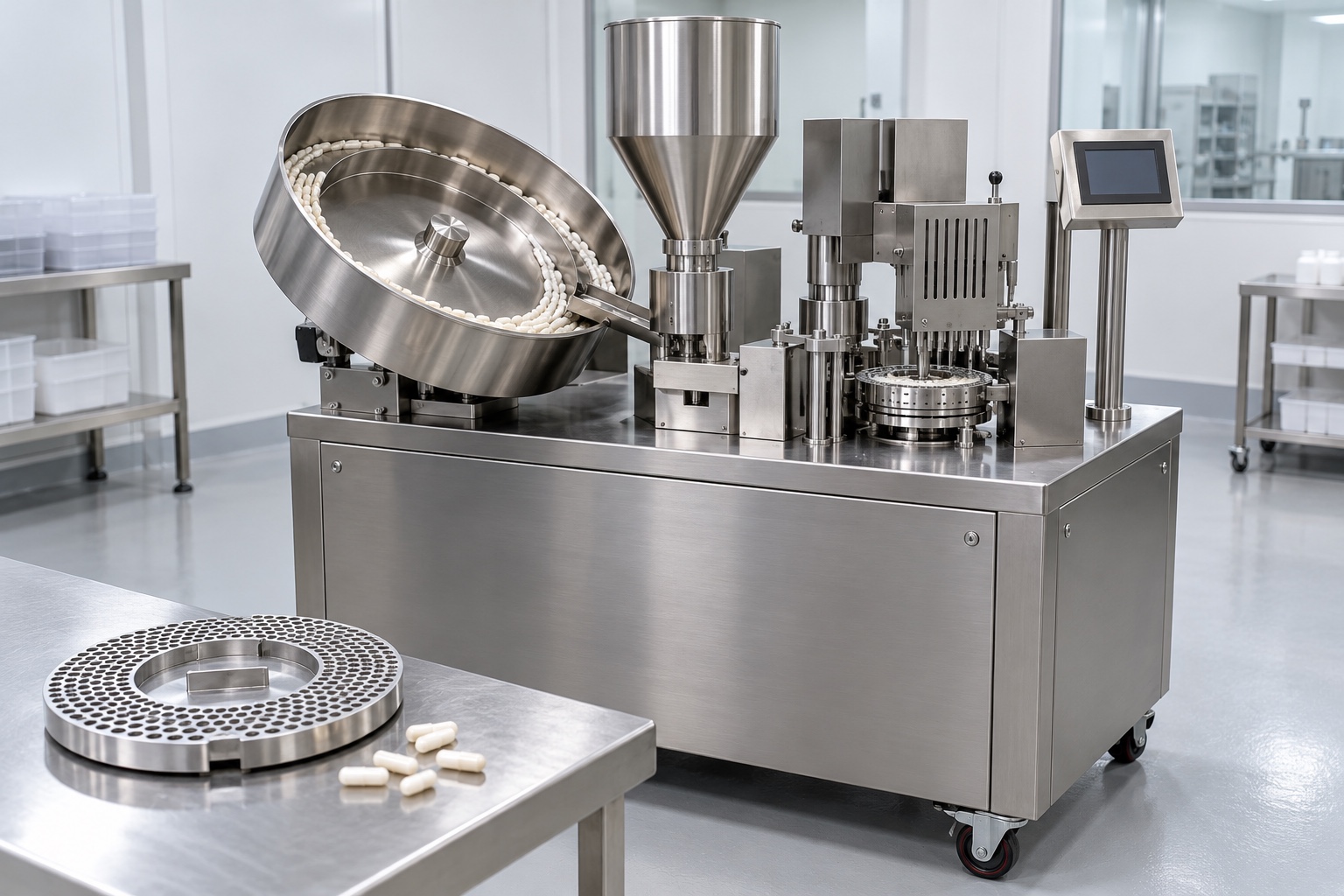
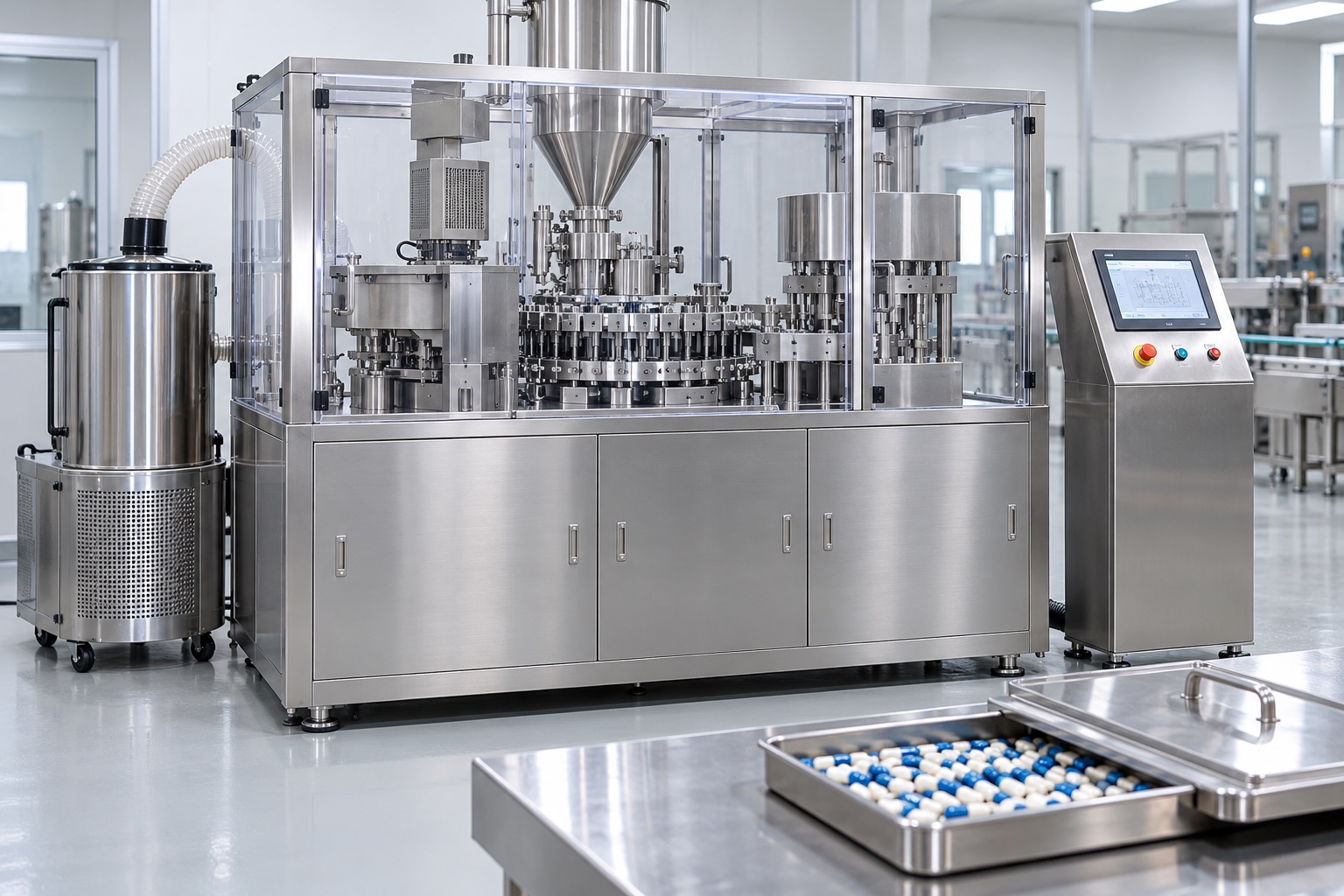
Fimachinery's FI-SCF series is a semi-automatic powder capsule filling machine designed around capsule positioning, separation, filling, and locking. Its layout is suited to production teams that need controlled batches and regular format or product changes. The FI-CF range includes fully automatic powder capsule fillers for a more integrated, higher-output production flow. The appropriate level of automation depends on the real powder, capsule format, batch plan, staffing, and downstream capacity.
The distinction matters when investigating defects. An empty or light capsule may point to powder supply or dosing, but a body that never separated from its cap cannot be filled correctly. A capsule can also meet its target mass and still be unacceptable if it cracks or fails to lock. Check the station where the problem begins instead of treating every reject as a dosing problem.
Establish Fill Settings With A Controlled Trial
Set up the machine using the approved procedure for the specific product, then run a representative trial. Watch capsule orientation and separation before judging dosing performance. Check that powder reaches the dosing area consistently and that no bridging, erratic feed, or excessive residual powder is developing. Use the machine's operating instructions for adjustments; there is no universal fill setting for every powder and capsule size.
Collect capsules across the trial, including startup and steady running. Determine net fill mass using a suitable method that accounts for empty-shell weight, then examine both average fill and variation between capsules. A single good sample does not show whether the process is stable. Also inspect the capsules for loose caps, cracks, deformation, visible residual powder, and incomplete closure.
If fill mass trends low or varies widely, examine powder supply, feed level, dosing components, and setup before increasing throughput. If separation is inconsistent, check the shell handling and the machine's vacuum or separation system where applicable. If caps are loose, investigate the locking station and the capsule format setup. Make one controlled adjustment at a time and verify the effect with fresh samples.
Monitor The Run, Not Just The First Acceptable Capsule
Once the trial meets the product's acceptance criteria, keep checking the process throughout the batch. Powder level, material behavior, machine speed, and shell handling can change during a run. Sampling at startup, after adjustments or interruptions, and during steady production gives a clearer picture than an end-of-batch check alone. Record the conditions alongside the results so a drift can be traced back to a specific change.
Fill-weight control is important, but weight by itself does not prove the distribution of an active ingredient. Where the formulation or product requirements call for it, content uniformity and other finished-product tests must be evaluated separately. Closure and appearance also need their own acceptance criteria. Filled capsules may then move to polishing, inspection, or packaging equipment according to the line design; those are distinct operations from filling.
Build A Repeatable Production Method
The practical answer to how to fill capsules with powder is to validate the whole sequence with the intended material: choose a compatible hard shell, prepare a powder that can feed and dose consistently, fit and align the correct machine parts, establish settings through a trial, and monitor net fill, capsule integrity, and closure during production. Fimachinery's semi-automatic and fully automatic powder-filling ranges provide different ways to organize that sequence. The right result is a stable batch of acceptable capsules at the required production rate, not a machine running at its fastest setting.