
How To Fill Capsules On Industrial Filling Machines
Filling a hard capsule is more than putting material into an empty shell. In production, the machine must orient the two-piece capsule, separate its cap and body, deliver a repeatable dose, close the shell, and discharge an acceptable unit. A problem at any one station can show up later as an empty capsule, an inconsistent fill weight, or a cap that does not lock.
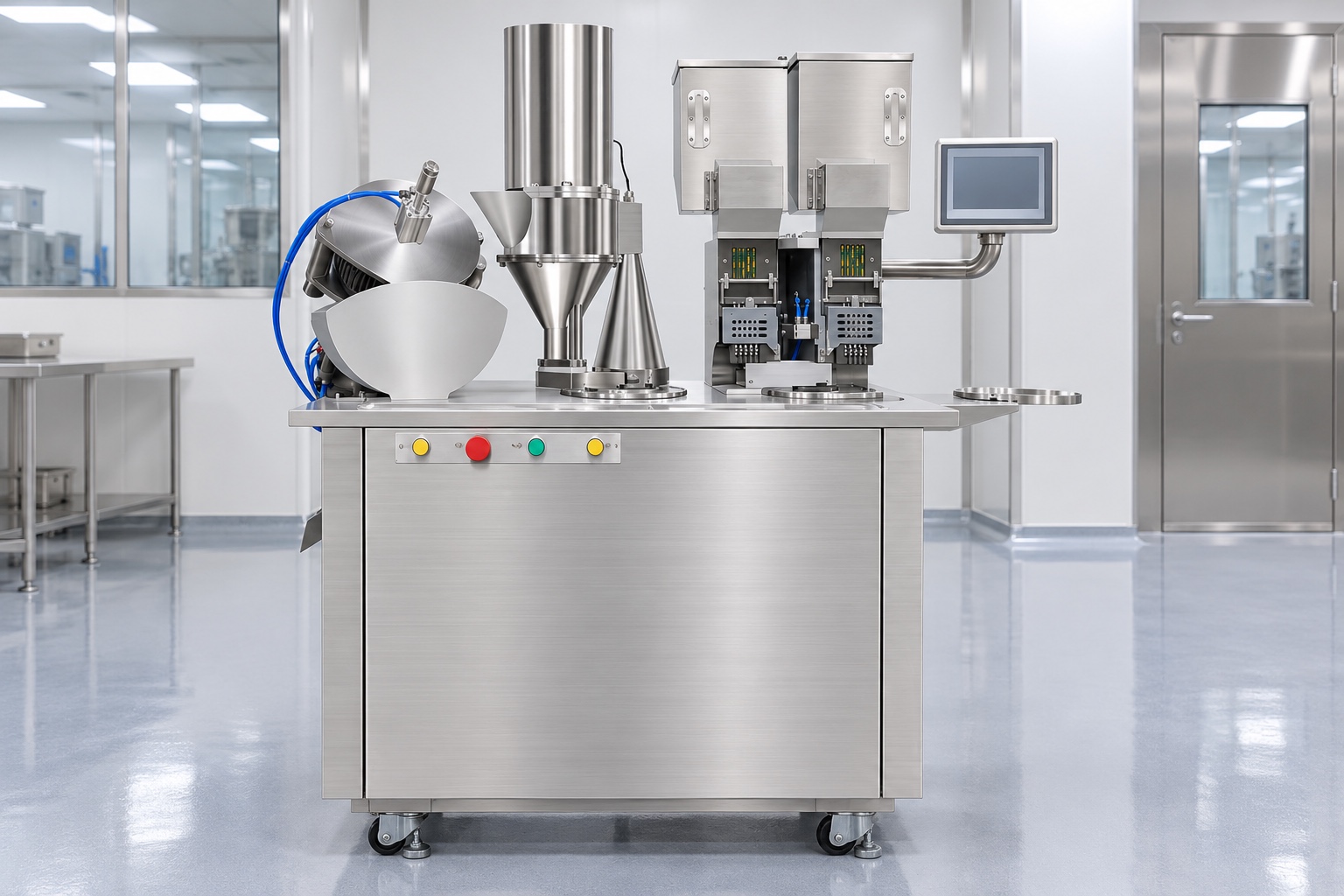
This guide explains how to fill capsules with Fimachinery's semi-automatic FI-SCF series and fully automatic FI-CF powder capsule filling machines. It focuses on powder-filled hard capsules in a controlled production setting. The approved product process and the instructions for the installed machine determine the actual settings, checks, and acceptance limits.
Match The Capsule, Material, And Machine Format
Start with the intended capsule size and the material to be filled. The FI-SCF series is listed for powder, granules, and pellets in capsule sizes 00–5. The FI-CF automatic powder range also handles these material forms, with model-dependent configuration. A listed material category does not establish that every formulation will run well: powder flow, particle behavior, and the amount required per capsule still need a trial on the intended equipment.
Check that every size-dependent part installed on the machine matches the capsule. On an automatic machine, the NJP-1200C operating manual identifies upper and lower capsule modules, orientation parts, a dosing plate, and filling rods among the components involved in a size change. An incorrect combination can disturb separation, dosing, or closure even if the shells appear to enter the machine normally. After changing format parts, cycle a small number of empty capsules and confirm that separation and transfer work before introducing product.
Establish A Clean Capsule Path Before Dosing
Empty capsules enter the machine through the capsule supply system. They must be oriented and placed into the machine's holding positions so that the cap and body can separate. On the NJP-1200C, the operating sequence uses capsule feeding and orientation parts, followed by vacuum-assisted separation of the two shell halves. A shell that remains joined cannot receive the intended dose.
Check the empty-shell run for missed positions, damaged shells, and incomplete separation. If a problem appears, inspect the shell condition, the installed format parts, the capsule path, and the vacuum system before changing the powder dose. The NJP-1200C manual also calls for regular cleaning of the vacuum filter. Treat the vacuum range and adjustments in that manual as specific to that model, not as universal settings for every Fimachinery filler.
Fill The Open Bodies With A Controlled Dose
Once the bodies are open and correctly positioned, the dosing station transfers material into them. The NJP-1200C powder process uses a dosing plate and filling rods that compress powder in successive stages before the charge reaches the capsule body. Its powder-level sensor starts and stops the feeder to help maintain the material level in the dosing area. That detail matters because a changing powder supply can change the amount transferred even when a mechanical setting has not moved.
Begin the product trial at a controlled machine speed. Allow the material feed to stabilize, then sample filled capsules and compare their net fill weights with the approved product limits. If weights drift, examine the feed condition and the dosing setup together. Changing several settings at once makes it difficult to determine what corrected the result. A satisfactory average weight also needs to be supported by acceptable variation among individual capsules.
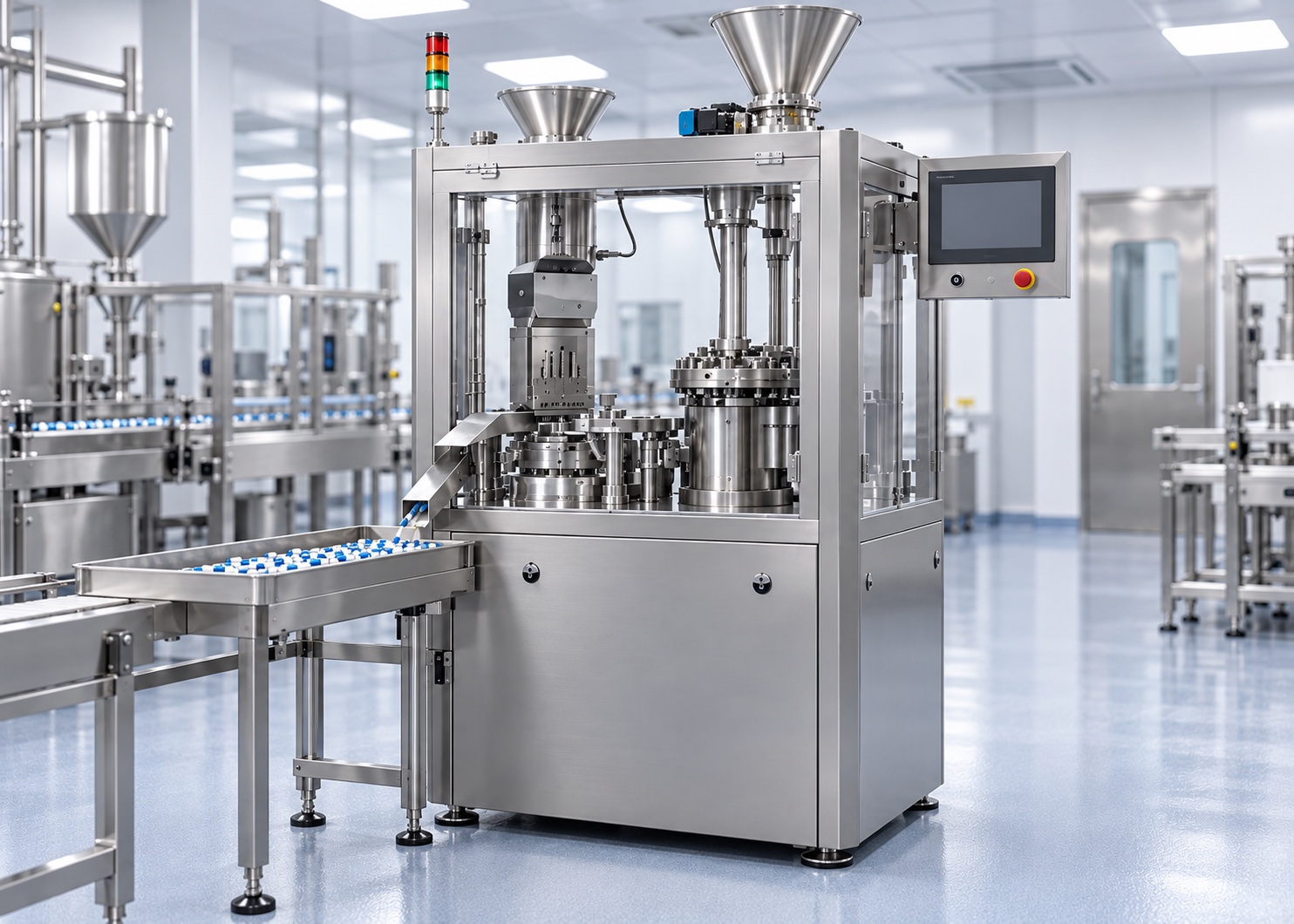
Fimachinery's FI-CF automatic powder machines coordinate capsule feeding, separation, filling, rejection, locking, discharge, and die-hole cleaning within the production cycle. The FI-SCF semi-automatic series also performs positioning, separation, filling, and locking, while an operator manages the transfer and pacing between its stations. In both cases, the dose must be established from measured output, rather than inferred from the appearance of a full capsule.
Close, Reject, And Inspect The Capsules
After dosing, the cap and body are brought back together and locked. The NJP-1200C sequence includes a station for defective-capsule removal, a locking station, finished-capsule collection, and cleaning of the module holes for the next cycle. These steps are part of filling: a correct powder charge is not useful if the shell is damaged or fails to close.
Inspect discharged capsules for loose caps, split shells, visible powder on the outside, and empty or incomplete units. Keep rejected units separate from accepted output according to the site's batch procedure. Check the reject stream as well as the good stream; a rising reject rate can reveal a feeding or separation problem before it becomes obvious at final inspection.
Keep The Process Stable Through The Run
The first acceptable sample does not settle the whole batch. Watch for changes after a powder refill, a short stop, a capsule-lot change, or an increase in speed. Recheck fill weight and capsule closure at the intervals required by the approved process. If the material level drops or the capsule feed becomes irregular, restore a stable supply before compensating with repeated dosing adjustments.
At the end of production, account for remaining material and capsules, then follow the equipment-specific shutdown and cleaning procedure. The NJP-1200C manual calls for cleaning parts that contact the product, particularly when changing powder or leaving the machine unused for an extended period. A clean dosing path, clear vacuum system, and correctly installed format parts make the next setup easier to verify.
For an industrial line, the practical answer to how to fill capsules is a controlled sequence: match the shell and format parts, prove separation with empty capsules, stabilize material feeding, set the dose from measured capsules, verify closure and rejection, and keep checking the run. The useful output is the number of acceptable capsules produced consistently—not simply the machine's nominal speed.