
How To Press Pills With A Tablet Press
Pressing a powder blend into a tablet looks simple from the outside: fill a cavity, apply pressure, and remove the finished piece. In practice, a tablet press can only repeat a good result when the material fills consistently, the tooling is appropriate, and the compressed tablet survives ejection and handling. If you want to know how to press pills for a legitimate manufacturing or development project, begin with those conditions rather than a pressure setting.
Here, “pills” means compressed tablets made on a tablet press. A capsule filling machine places material inside a preformed shell; it does not carry out the same compression process. The operating sequence below describes industrial equipment, not a method for making tablets by hand. Site procedures, product specifications, and the instructions for the installed machine govern any actual run.
Start With A Material That Can Be Pressed
A tablet press receives a prepared powder blend or granules. The material must enter the die cavity reliably and form a compact that can be ejected intact. A blend that bridges above the feeder may leave some dies underfilled. Material that separates while moving through the hopper can give tablets of similar weight but different composition. And a compact that sticks to the punch face or breaks at ejection will not be fixed by simply making more of it.
Before a trial, define the intended tablet shape, size, target weight, thickness, strength, and appearance. Record what material will enter the press and how it was prepared. Some formulations need an upstream granulation step; others may be suitable for direct compression. The choice belongs to the formulation and its tests, not to the machine name.
Match The Tooling And The Press To The Tablet
The die forms the tablet's outer profile. An upper and a lower punch compress material inside it. Tooling dimensions, punch tip design, working length, and permitted load must match the specific press and the intended tablet drawing. Similar-looking punches and dies should not be assumed interchangeable.
A single-punch press forms one tablet per cycle. It makes the separate fill, compression, and ejection movements relatively easy to observe, so it is useful for development work and small runs. A rotary press carries many punch-and-die sets around a turret, letting each station repeat the cycle as the turret turns. Fimachinery's FI-1STP is a single-punch example; its FI-420TP series illustrates the rotary category. Model names identify a machine family, while the actual tooling and available controls still need to be checked for the quoted configuration.
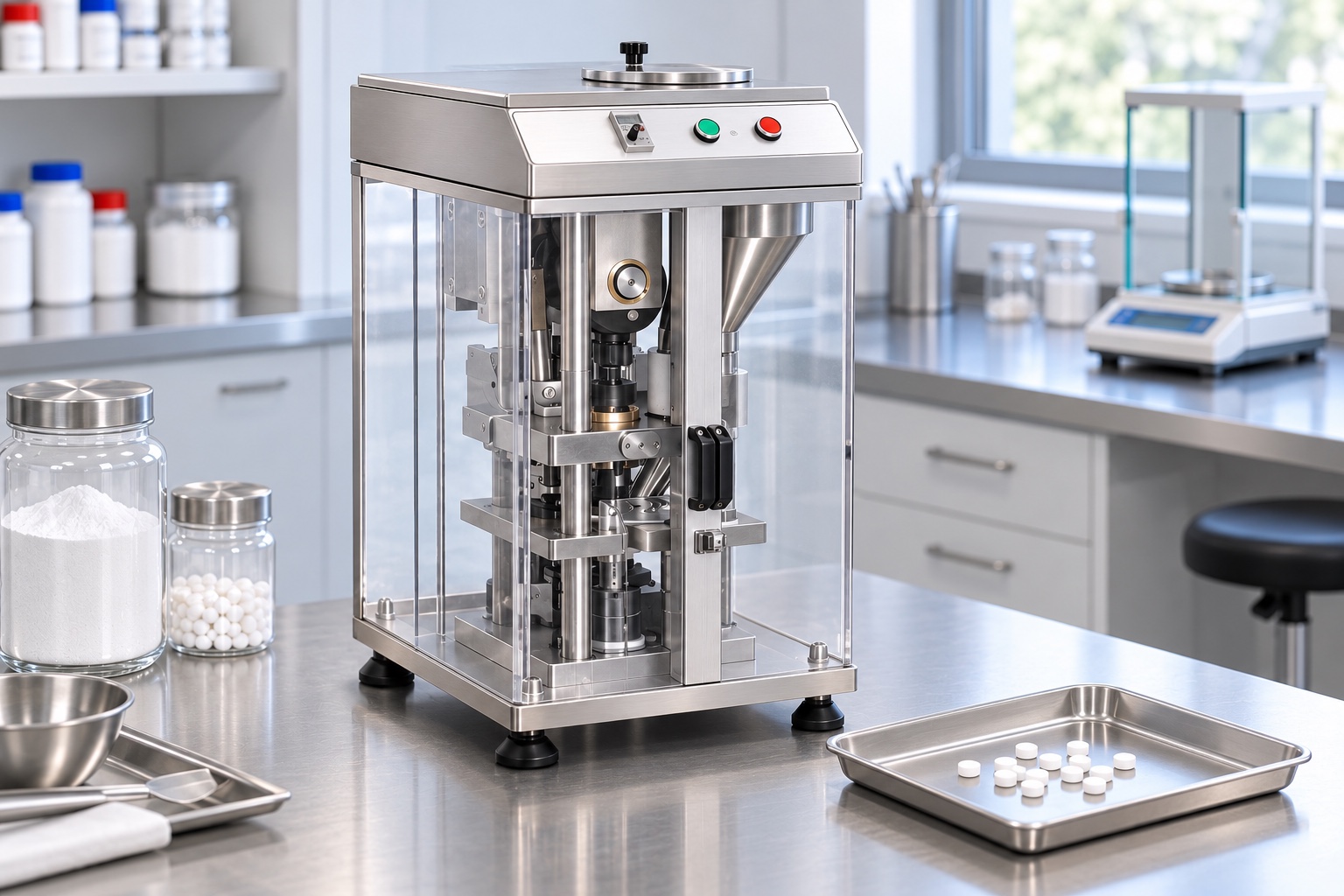
Follow The Tablet Through One Press Cycle
First, the lower punch sits below the top of the die, leaving room for material. The feeder brings the prepared blend over that opening. The press then meters the fill by adjusting how much material remains in the cavity. This setting influences tablet weight, but weight also depends on bulk density, flow, and how completely the die fills at the chosen speed.
Next, the upper punch enters the die and the powder bed is compressed between the two punches. Some rotary presses provide a lighter precompression stage before main compression. It can help the bed settle and release air, but its presence and adjustment depend on the particular machine. During main compression, force and time under load work together with the material's compressibility. More force is not a universal cure for a weak or flawed tablet.
After the load is released, the upper punch withdraws. The lower punch raises the tablet to die level, and a take-off device directs it to the discharge path. Ejection deserves close attention: excessive resistance, chipped edges, sticking, or split tablets can signal a problem with the material, tooling, lubrication, or press setup. Investigate the pattern before changing settings.
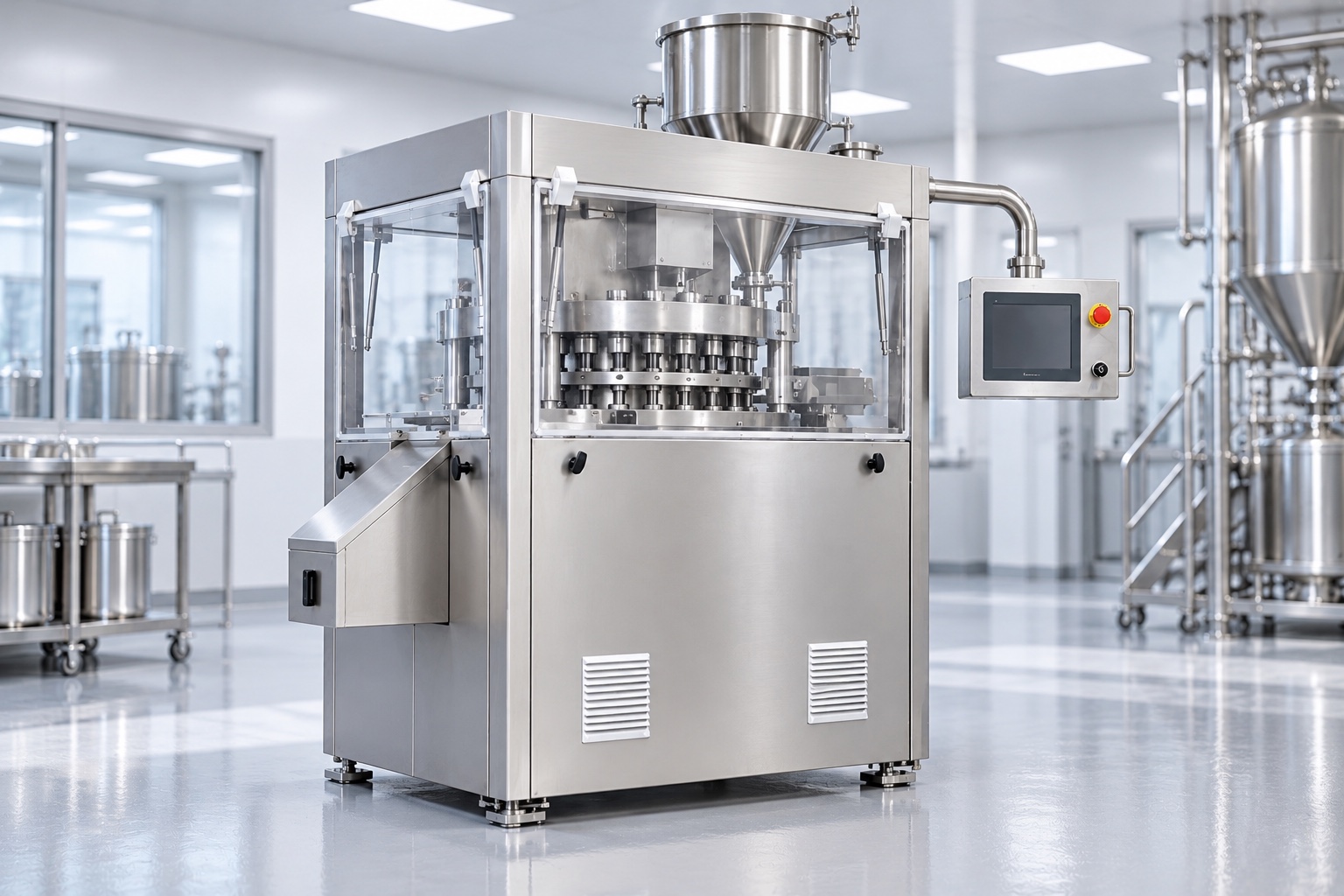
Adjust One Cause At A Time During A Trial
A practical trial starts at a controlled speed with representative material and the intended tooling. Note the fill, compression, and ejection conditions that produced each sample. If tablet weight varies, inspect feed behavior and die filling before assuming compression force is the cause. If tablets cap, laminate, or crumble, look at material behavior and the compression sequence as well as force. If they stick or show damaged edges, inspect the punch faces, ejection path, and formulation conditions.
Changing several settings at once may produce a better-looking tablet without explaining why. Small, recorded adjustments make the result easier to interpret and repeat. A good tablet from a slow trial is only an initial result; feeding and compression can behave differently as speed increases or a longer run continues.
Check The Tablets, Not Just The Machine Display
Sampling should reflect the product's approved quality requirements. Common observations include tablet weight, thickness, strength, friability, and appearance. Depending on the product, further tests may be needed for content uniformity and performance after manufacture. A stable average weight alone cannot prove uniform active content, especially if the blend segregates during feeding.
Compare samples from startup, steady operation, and restart. Track rejected tablets and stoppages alongside press speed. The useful output is the number of acceptable tablets the full process can sustain, including its feeder and downstream handling. A headline tablets-per-hour figure does not account for sampling, rejects, cleaning, or changeovers.
For a discussion with Fimachinery, bring the tablet drawing, representative material information, target net output, and the checks your product must pass. That gives the equipment team a concrete basis for recommending a press and planning a trial. The goal is a repeatable process that produces tablets meeting the product specification, not a single convincing sample.