
What Is A Pill Press? How It Makes Tablets
A pill press is a machine that compresses powder or granules into solid tablets. In equipment catalogs, tablet press or tablet compression machine is the more precise name. “Pill” can also describe a capsule or another oral product in everyday speech, so it is worth identifying the dosage form before discussing a machine.
The distinction matters on a production floor. A tablet press forms material into a compact. A capsule filling machine puts material into a preformed shell. A tablet counter handles tablets after they have already been made. If your goal is a compressed tablet, a pill press is the machine at the forming step.
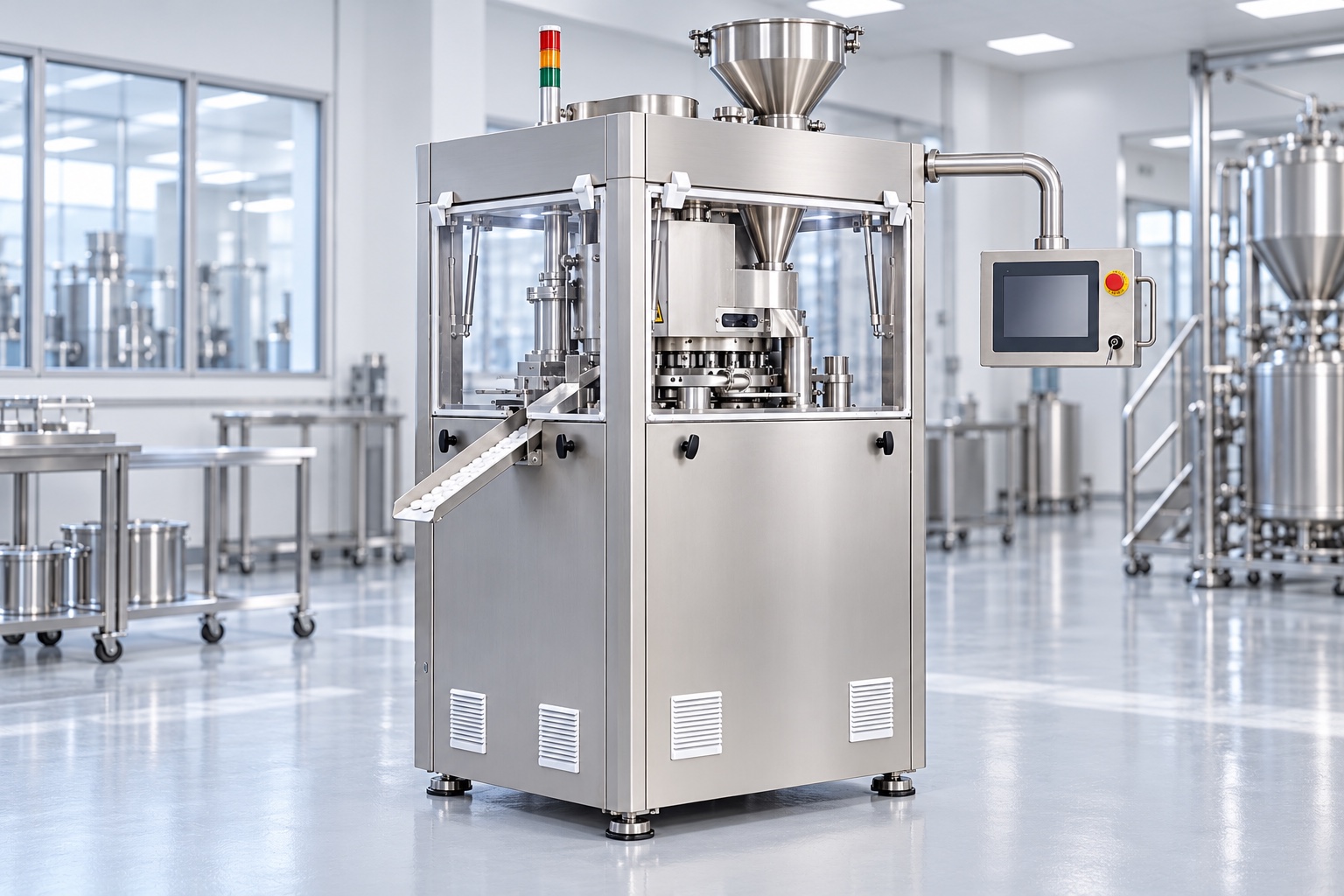
What Happens Inside A Pill Press?
The forming tool consists of a die and two punches. The die provides the cavity that gives the tablet its outline. Powder or granules enter that cavity above the lower punch. The machine meters the amount retained, the upper and lower punches compact it, and the lower punch raises the tablet so it can leave the die.
That description sounds simple, but each part of the cycle affects the result. If the material does not enter the die consistently, tablets can vary in weight. If it does not compact or release well, the tablet may be weak, damaged, or difficult to eject. The press supplies a repeatable motion; the material and settings determine whether that motion produces acceptable tablets.
Some rotary presses include a lighter precompression stage before main compression. It can help the powder bed settle and release trapped air. It is a machine feature to verify for the particular model, not something to assume from the words “pill press.”
Single-Punch And Rotary Presses
A single-punch press has one punch-and-die set working through each cycle. Its compact mechanism makes the forming action easier to observe during early trials, development, teaching, or low-volume work. It is useful when the immediate task is to see whether a proposed tablet can be formed and to learn how the material behaves.
A rotary press carries multiple punch-and-die sets on a rotating turret. Each set passes through filling, compression, and ejection in sequence, creating a continuous stream of tablets. Rotary models span research and production scales. The word “rotary” alone tells you little about the usable output, tooling, controls, or cleaning access of a particular machine.
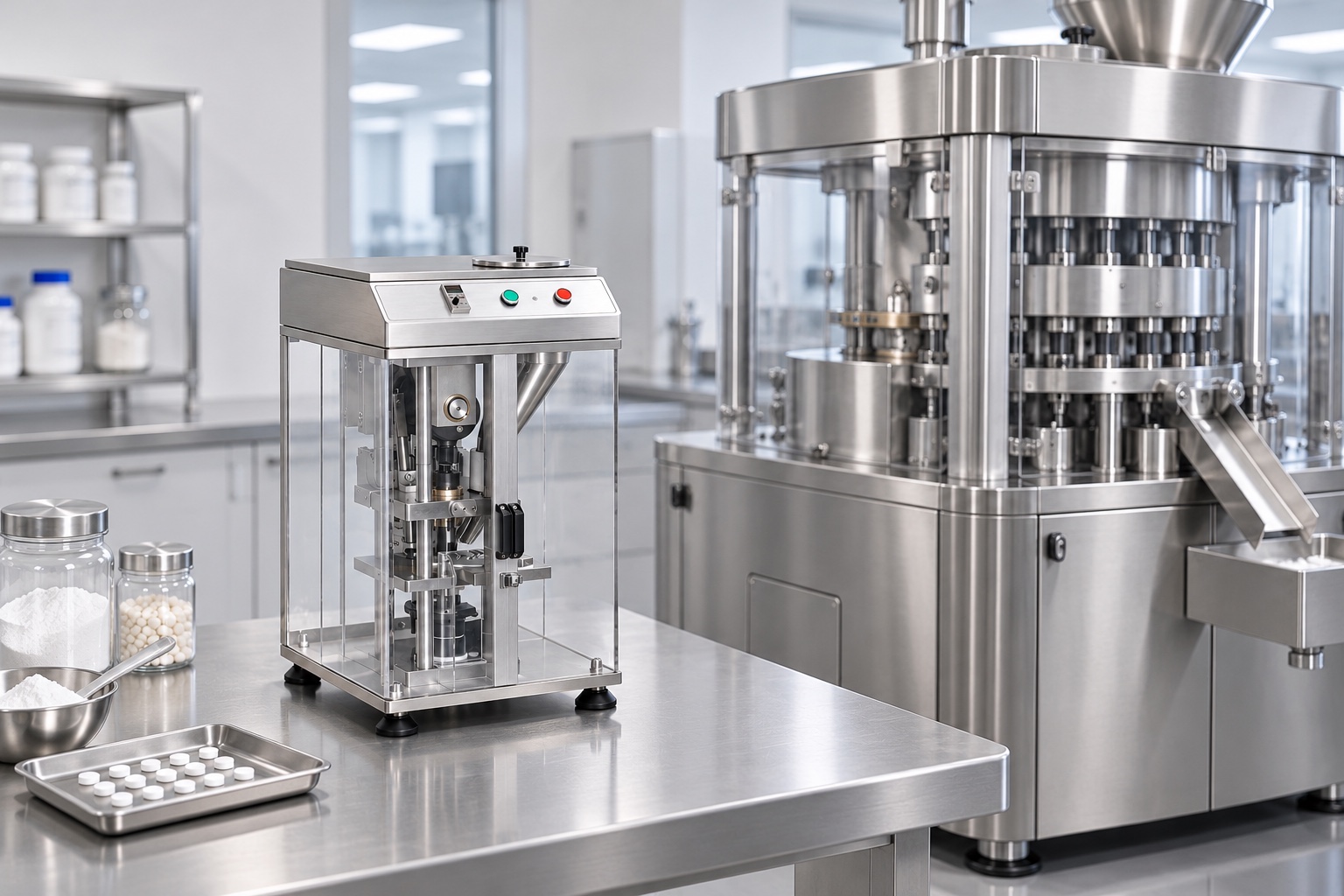
The choice is not simply “small or fast.” A single-punch trial can show whether a blend forms a tablet, but it does not prove that the same blend will fill and compress consistently at rotary production speed. On a rotary machine, available filling time, feeder design, and the material's flow behavior become especially important. A realistic comparison uses the proposed material and tablet tooling at the intended operating rate.
What Can A Pill Press Make?
A press can make tablets in shapes and sizes allowed by its tooling and machine limits. Punch tips and the die cavity define the form; the prepared material, fill setting, and compression conditions influence the tablet's weight, thickness, strength, and appearance. A scored or embossed tablet needs the appropriate tooling, and its result should be checked with the actual formulation.
The machine does not turn every loose powder into a usable tablet. Some formulations can be prepared for direct compression; others need more work upstream before they feed and compact reliably. That is why a product description should include the material entering the press, not just a picture of the desired tablet.
The press also does not perform every later operation. Depending on the product, formed tablets may go through dedusting, inspection, coating, counting, or packaging. Those steps can be connected to the press, but they should be specified as separate parts of the line.
How Do You Tell Whether A Press Fits Your Project?
Start with a drawing or sample of the tablet you want to make. Record its shape and dimensions, target weight, and the quality checks it must pass. Then describe the powder or granules you will feed, including any observed problems with flow, sticking, or ejection. These details are more useful than asking for the “strongest” machine, because compression force alone cannot fix every material problem.
Next, define the required number of accepted tablets over a shift or batch. A machine's maximum tablets-per-hour rating is a mechanical figure. It does not include setup, sampling, rejected tablets, stops, cleaning, or the pace of the equipment before and after the press. A lower steady speed can sometimes yield more acceptable product than a higher speed with frequent interruptions.
Finally, check the exact configuration being offered. Confirm tooling compatibility, allowable tablet size and fill range, feeder design, access for cleaning, guarding, dust handling, and the process data your team needs. Terms such as “automatic” or “high speed” do not tell you whether a model has feedback control, individual tablet rejection, or the records required by your operation. Ask to see those functions demonstrated on the proposed machine.
If you are discussing equipment with Fimachinery, share the tablet drawing, representative material information, target batch or shift output, and required checks. A trial using that material can then show how the proposed press performs under conditions that resemble the real job.
A Useful Way To Remember The Answer
What is a pill press in practical terms? It is the machine that repeatedly fills a die, compresses the material between punches, and ejects a solid tablet. The right press is the one that can carry out that cycle with your material and tooling while producing tablets that meet the checks your product requires.