
What Is Capsule Filling Machine? Types And Functions
A hard capsule has two pieces: a longer body that holds the material and a shorter cap that closes it. A capsule filling machine opens the empty capsule, puts a measured amount into the body, joins the two pieces again, and releases the finished capsule. In an automatic machine, those actions happen at separate stations as the capsule moves through the equipment.
This is the simplest way to understand what a capsule filling machine does: it handles the shell as carefully as it handles the fill. If the cap and body do not separate, there is no open body to fill. If they do not close correctly afterward, the capsule is not ready for discharge.
How does an automatic capsule filling machine work?
The diagram shows a capsule traveling around a series of stations. Read it as a cycle: align the empty shell, separate it, fill its body, remove faulty shells, close and discharge good capsules, then clean the tooling for the next pass. The pellet or tablet stations marked 3 and 5 are optional configurations.
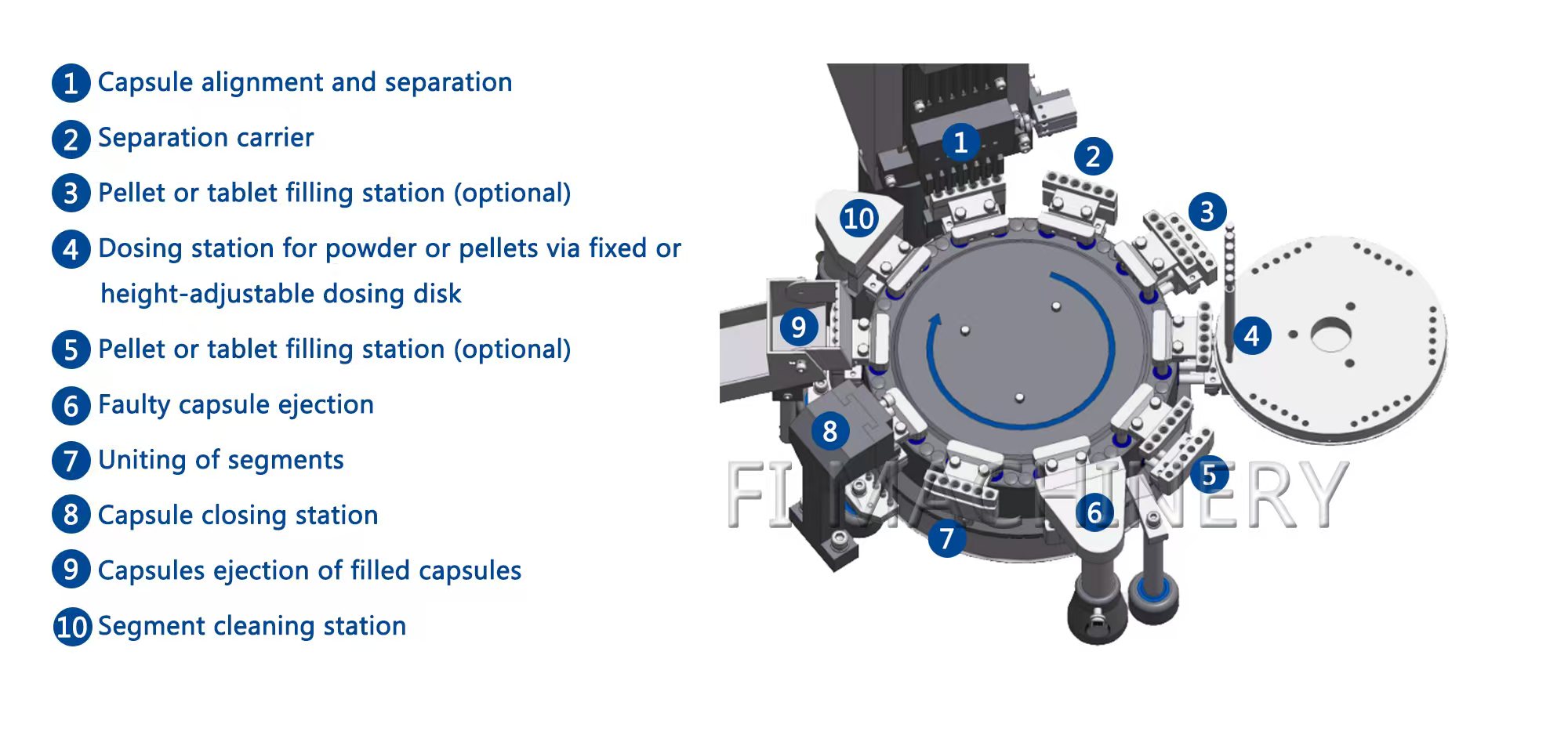
1. Align and open the capsule. Empty capsules are fed into the machine and placed in carriers in a consistent direction. The cap is separated from the body. The body remains in position under the filling system, while the cap is held for closing later. A shell that fails to open cannot move through the process as a normal filled capsule.
2. Measure and add the fill. At the dosing station, the machine meters material into the open capsule bodies. The dosing disk and its tooling are part of the mechanism that controls the amount delivered. Powder is one common fill; pellets or small tablets may need a different or additional filling station. The machine must be configured for the actual material and capsule size.
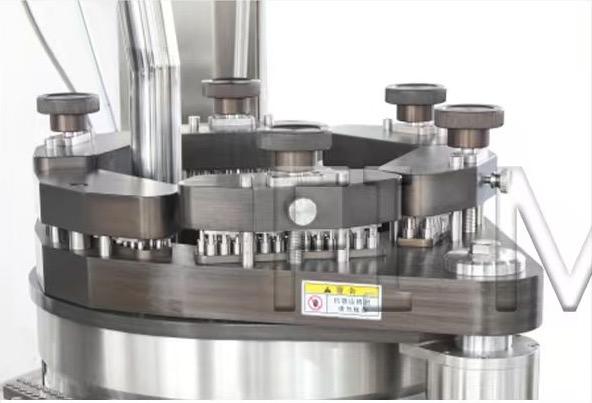
3. Remove capsules that did not separate. A capsule that stays closed cannot be filled correctly. The rejection station takes these faulty shells out of the path of good capsules before finished units leave the machine. This is a separate quality-control action within the cycle, not the same step as discharging filled capsules.
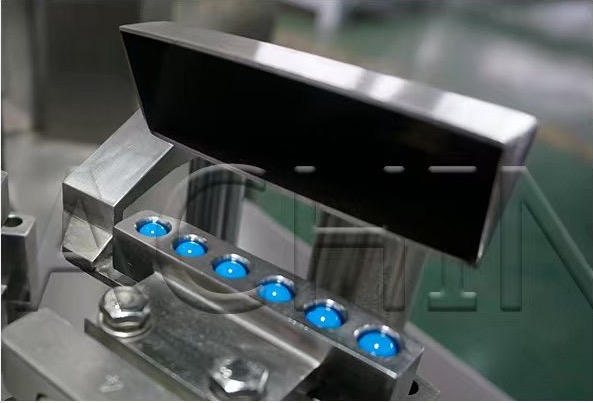
4. Join, close, and discharge. After filling, the cap and body are brought back together and locked. The finished capsule is then ejected from the carrier. During a trial, check both that the capsule closes properly and that it leaves the machine without damage.
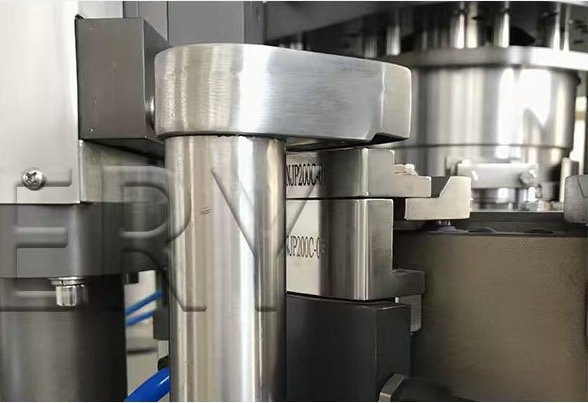
5. Clear the tooling. The empty carrier or segment reaches a cleaning station before it is used again. The pictured FI-CF system uses compressed air to help remove material that can cling to the segment, especially sticky or moisture-absorbing powder. Cleaning during the cycle helps the next capsule enter the tooling consistently; the machine still needs routine cleaning between products and after use.
What does the operator control?
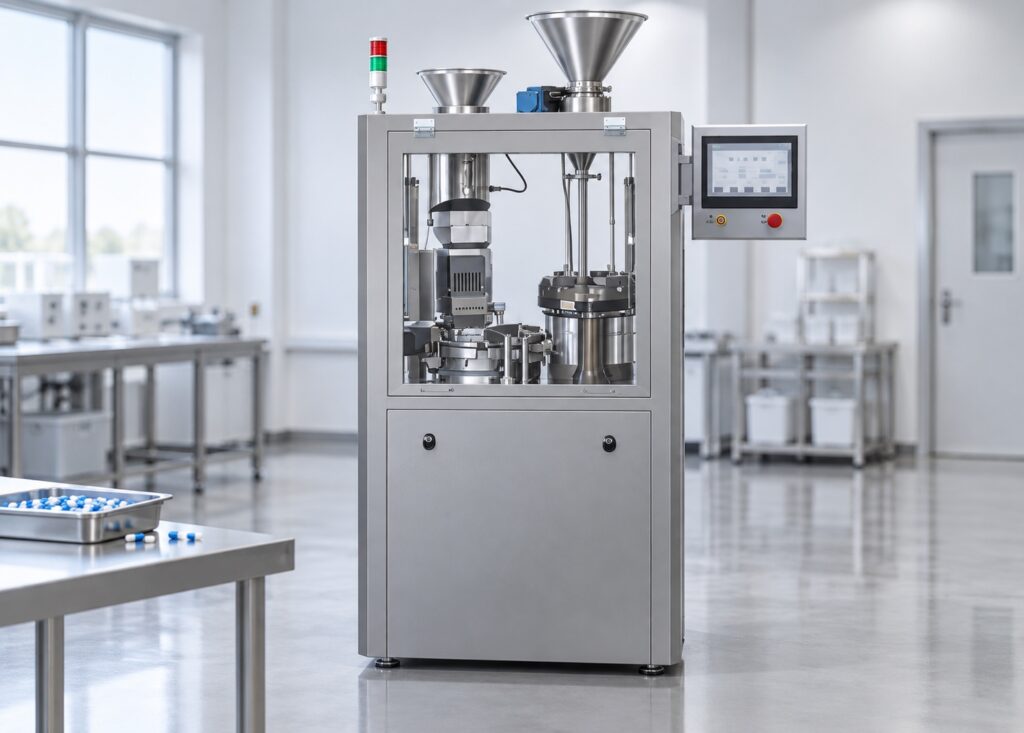
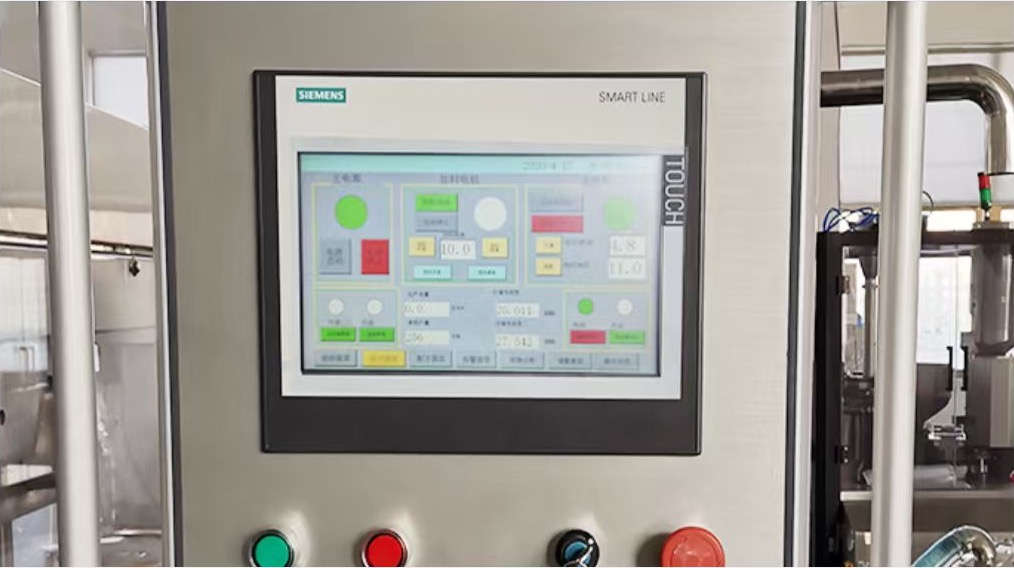
The operator sets up the machine for the capsule and formulation, monitors its running state, and checks the capsules it produces. The FI-CF photo shows a PLC with a Siemens touch panel for machine control. The screen is a way to operate and monitor the equipment; it cannot make an unsuitable fill material, damaged shell, or incorrect tooling work reliably. A trial with the real product remains essential.
What can be filled, and where is the machine used?
Fengtian Technology's FI-CF powder capsule filling series lists powder, granules, and pellets. The application diagram also illustrates small tablets and liquids, but these do not all run through the same standard powder-filling setup. Pellets or small tablets can require optional stations. Liquid formulations need a dedicated liquid capsule filler; Fengtian Technology lists the FI-300CFL and FI-300CFLS, with the latter also sealing the filled capsule. Match the fill form to the exact model and installed system.
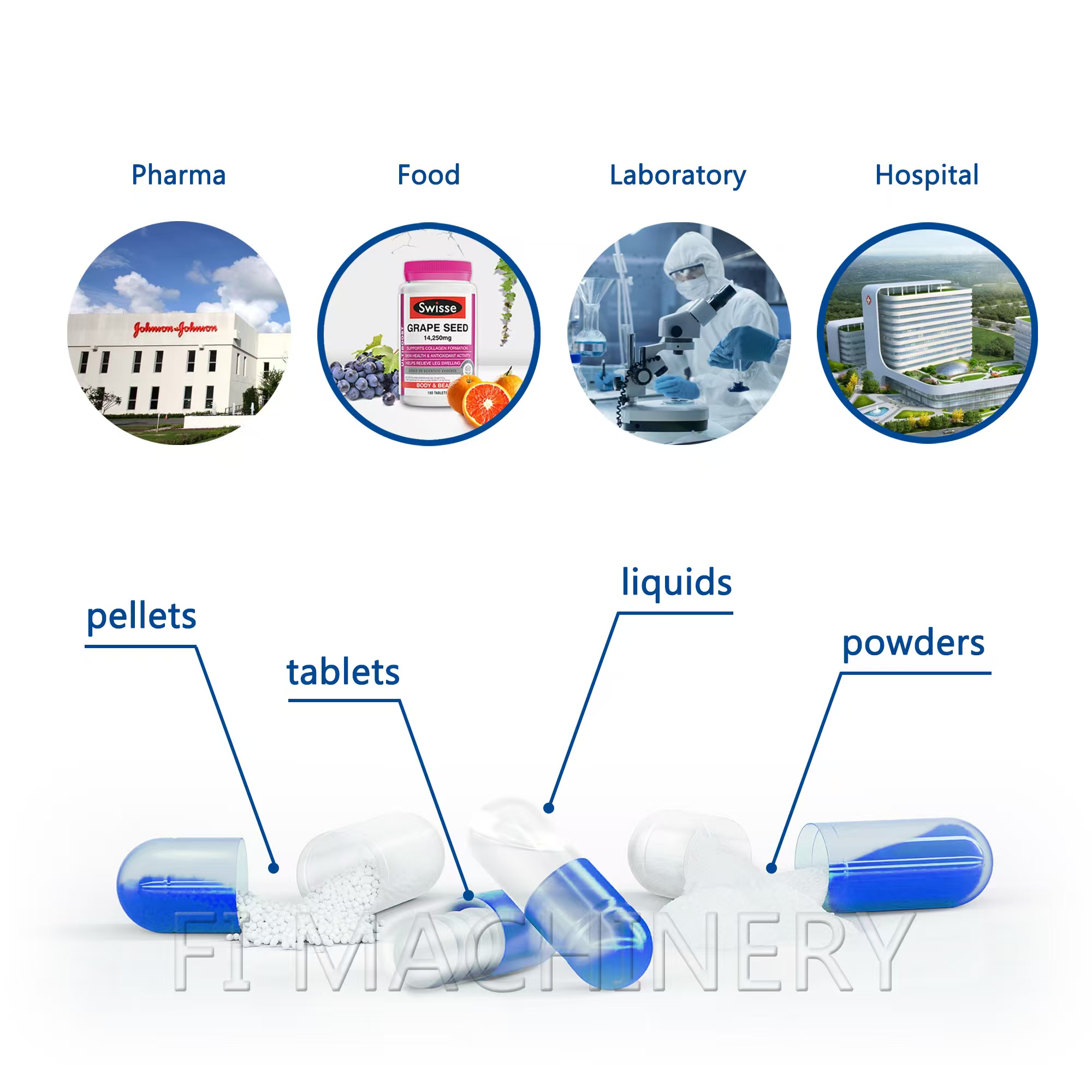
Capsule filling machines can be used in pharmaceutical and food or nutrition production, laboratory trials, and suitable hospital preparation settings. A compact model may suit a small research batch, while a larger automatic model may serve a production line. The industry label alone does not tell you which model to choose: batch size, capsule size, material behavior, and cleaning needs matter more.
Semi-automatic or fully automatic?
Both machine types need to open, fill, and close hard capsules. A semi-automatic setup leaves more handling and transfer work to the operator. An automatic FI-CF model carries capsules through feeding, separation, filling, rejection, closing, discharge, and segment cleaning as a continuous machine cycle. Fengtian Technology's range includes the small-batch FI-200CF as well as higher-output models, so “automatic” does not by itself tell you the production rate.
Before choosing a model, ask the supplier to run your capsule shells and intended fill. Watch the whole path: do capsules separate, receive a consistent fill, pass the rejection station correctly, close, and discharge without damage? Confirm the required tooling for each capsule size, the supported fill form, the air and vacuum supply, and how long cleaning and changeovers take. Those observations show whether the machine fits the product you actually need to make.