
Automatic Capsule Filling Machine Parts: What Each Does
An automatic capsule filler can look like one enclosed machine, but the quality of each capsule depends on a sequence of separate parts doing their jobs in the right order. Empty shells must arrive correctly oriented, the cap must separate from the body, a measured amount of material must enter the body, and the two halves must close without damage. Understanding that path makes it easier to discuss a new machine, troubleshoot a fault, or order the right replacement part.
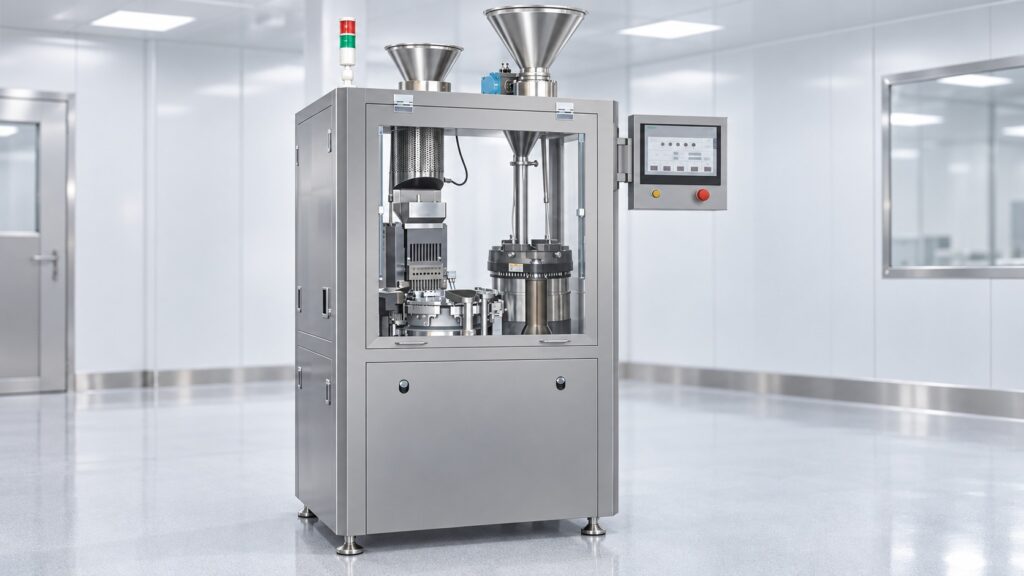
The overview below concerns two-piece hard capsules. A particular machine may use different mechanisms, and its parts list should always be checked against its model and configuration.
From Empty Shell To Open Capsule
The empty-capsule hopper holds shells before they enter the machine. A feeding and orientation assembly then guides each shell into position. If the feed is uneven or the orientation pieces do not match the capsule size, empty positions and jams can appear before any material is filled.
At the next stage, upper segments hold the caps and lower segments hold the bodies. A vacuum separation system helps pull the two halves apart. Its pump, lines, valves, filters, and separation interface all matter: poor vacuum can leave capsules unopened, while excessive vacuum or misalignment can damage the shells. The segment holes must also be clean, correctly aligned, and suited to the capsule being run.
How The Filling Parts Meter Powder
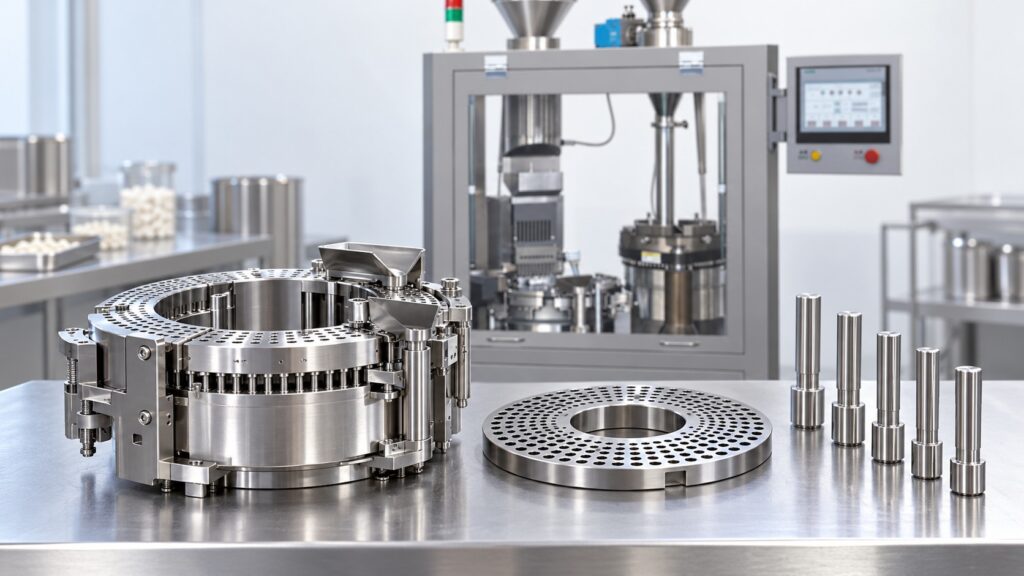
Many automatic powder machines use a dosing disc and tamping pins. Powder enters holes in the disc, and the pins compact it in stages to form plugs that can be transferred into the capsule bodies. The product hopper, feed tube, powder bed, disc, support plate, scraper, pins, and plug ejection mechanism each affect this transfer.
The disc hole geometry, disc thickness, powder-bed level, pin penetration, and powder behavior can all change the resulting fill. A dosing disc is therefore more than a plate with holes, and tamping pins are more than interchangeable rods. A change in fill weight should be investigated together with the powder and the machine settings, not attributed to one part by appearance alone.
Other machines may use a dosator, which forms a powder plug inside a hollow tube with an internal piston. Granules, pellets, tablets, and liquids can require different feeding and metering modules. The term “filling part” is too broad for an order unless the material, dosing principle, and exact machine configuration are specified.
Closing, Rejecting, And Discharging
After filling, the cap and body segments realign. A locking pin, plate, or pusher brings the two halves to the intended closed length. Poor alignment or an incorrect locking setting can leave loose caps or deform the shell. Finished capsules then leave the segments through an ejection or discharge mechanism. Cleaning of the empty segment holes prepares them for the next cycle.
Reject systems keep defective or unseparated capsules away from acceptable output. Their exact sensors and timing vary by machine, so a parts drawing should show both the detection point and the reject mechanism. A downstream polisher or checkweigher may be connected to the line, but it is separate equipment rather than an inherent part of every capsule filler.
Which Parts Change With Capsule Size?
Change parts are format components selected for a capsule size or filling setup. They can include orientation and feed pieces, upper and lower segments, guide forks, alignment pieces, locking and ejection pieces, and sometimes a dosing disc with matching pins. On the NJP-1200 described in the available product manual, a capsule-size change calls for replacing the upper and lower segments, horizontal and vertical forks, alignment block, filling rods, and dosing disc as a matched setup.
That example is useful, but it is not a universal kit for every automatic capsule filler. Whether the disc and pins must change also depends on the target fill, dosing holes, and machine design. Before buying, compare the proposed kit with the approved parts drawing and the full list for the intended capsule size. A missing guide or locking component can make an otherwise complete-looking set unusable.
Spare Parts Are A Different Purchase
Spare parts are kept to replace worn or failed items. Depending on the machine, these may include seals, hoses, filters, scrapers, springs, plastic inserts, vacuum components, or ejection springs. They are not automatically the same items as change parts. A seal that looks similar to another model’s seal may still differ in material or fit.
For a reliable inquiry, provide the manufacturer, model, serial number, part or drawing number, mechanical or software revision where relevant, quantity, and a clear photo of the installed component. State whether you need a complete changeover set, a single format piece, or a maintenance spare. Dimensions and material should be confirmed before treating any alternative as compatible.
A Practical Inspection Sequence
When a machine starts leaving capsules unopened, begin with the shell feed and orientation, then check segment alignment and the vacuum path, including its filter. If closed capsules are loose or crushed, inspect the locking alignment and setting for the capsule size. If fill weight changes, examine the powder supply, dosing components, and material behavior together. These checks narrow the problem before a part is ordered.
After a size change, the NJP-1200 manual calls for turning the main machine by hand for one or two cycles and stopping if unusual resistance is felt. That check helps reveal interference from a misinstalled or misaligned format part before powered operation. Follow the procedure and safety controls for the actual machine in use.
The most useful automatic capsule filling machine parts list follows the capsule’s path through the equipment. It identifies what each component does, which pieces change with the format, and which pieces are stocked for wear. With the machine identity and part numbers in hand, maintenance and purchasing teams can discuss the same component without guessing from a photograph.