
The Semi Automatic Capsule Filling Machine Working Principle
A semi automatic capsule filling machine separates empty two piece hard capsules, fills the bodies, and closes them in batches. The operator connects those actions by moving a ring or tray between stations. Understanding the semi automatic capsule filling machine working principle starts with that handoff, because real output depends on more than the speed of the motor.
The principle is easiest to follow through one tray of capsules, from empty shells to finished units. The exact sequence and level of automation vary by machine, so a product demonstration should confirm which transfers, inspections, and adjustments an operator actually performs.
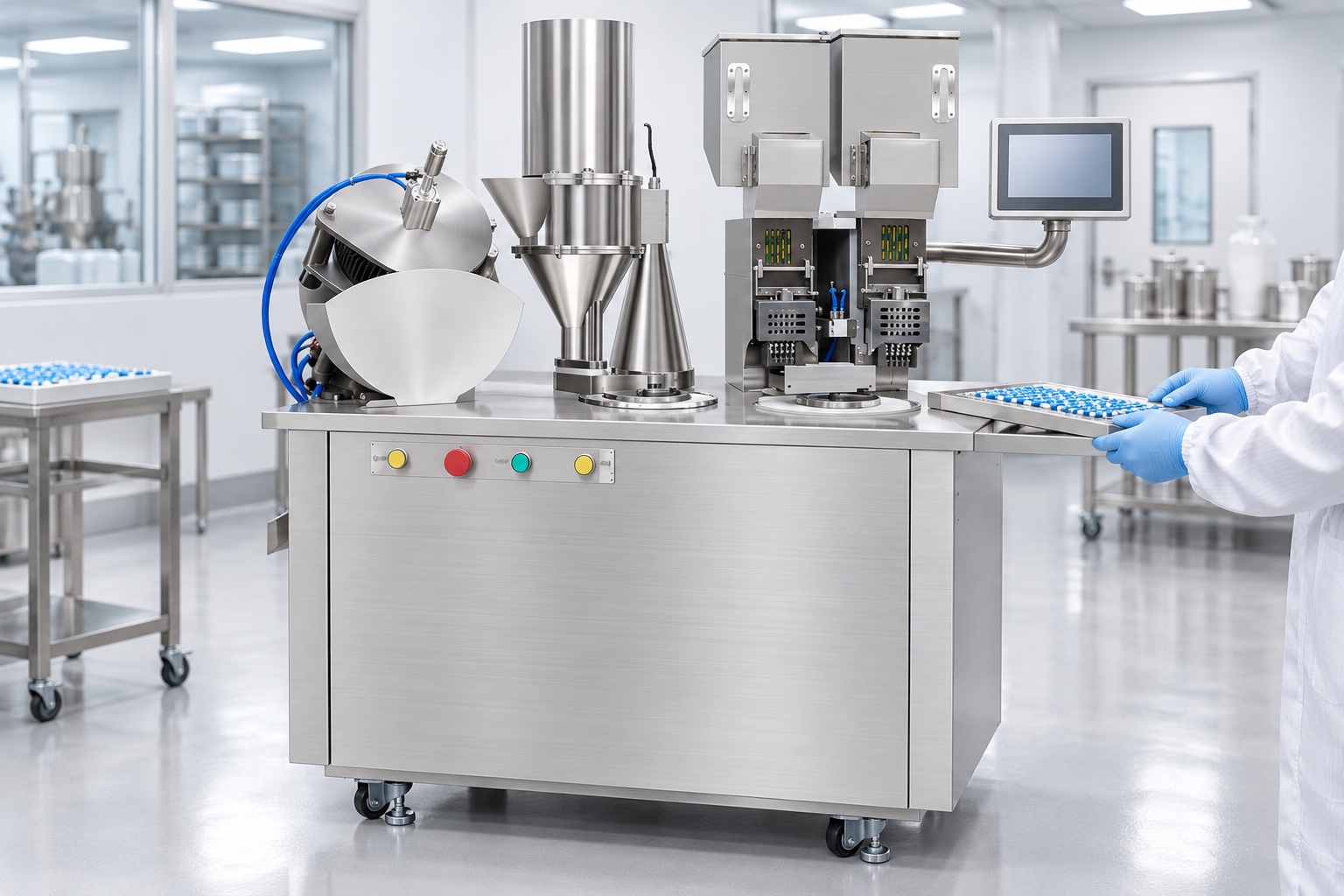
How the stations work together
First, empty hard capsules are oriented and loaded into matching positions in an upper and lower ring or tray. The cap must remain associated with its body throughout the batch. A separation mechanism, commonly using vacuum, holds the two pieces apart. The body section can then move to the filling station while the caps are retained for reassembly.
Next, material is delivered to the open bodies. On a powder machine, the filling mechanism and its settings must be suited to the powder’s behavior and the target fill. A change in powder flow, bulk density, or feed level can change the amount entering each body even when a mechanical setting stays the same. Filling is therefore a process to check with samples, rather than a guarantee provided by the tray geometry alone.
After filling, the operator brings the body and cap sections back into alignment. A locking station closes the capsules as a batch, using a mechanical, pneumatic, or electric action according to the machine design. Finished capsules are discharged and checked for incomplete closure, damaged shells, empty units, and visible powder residue before the tray is used again.
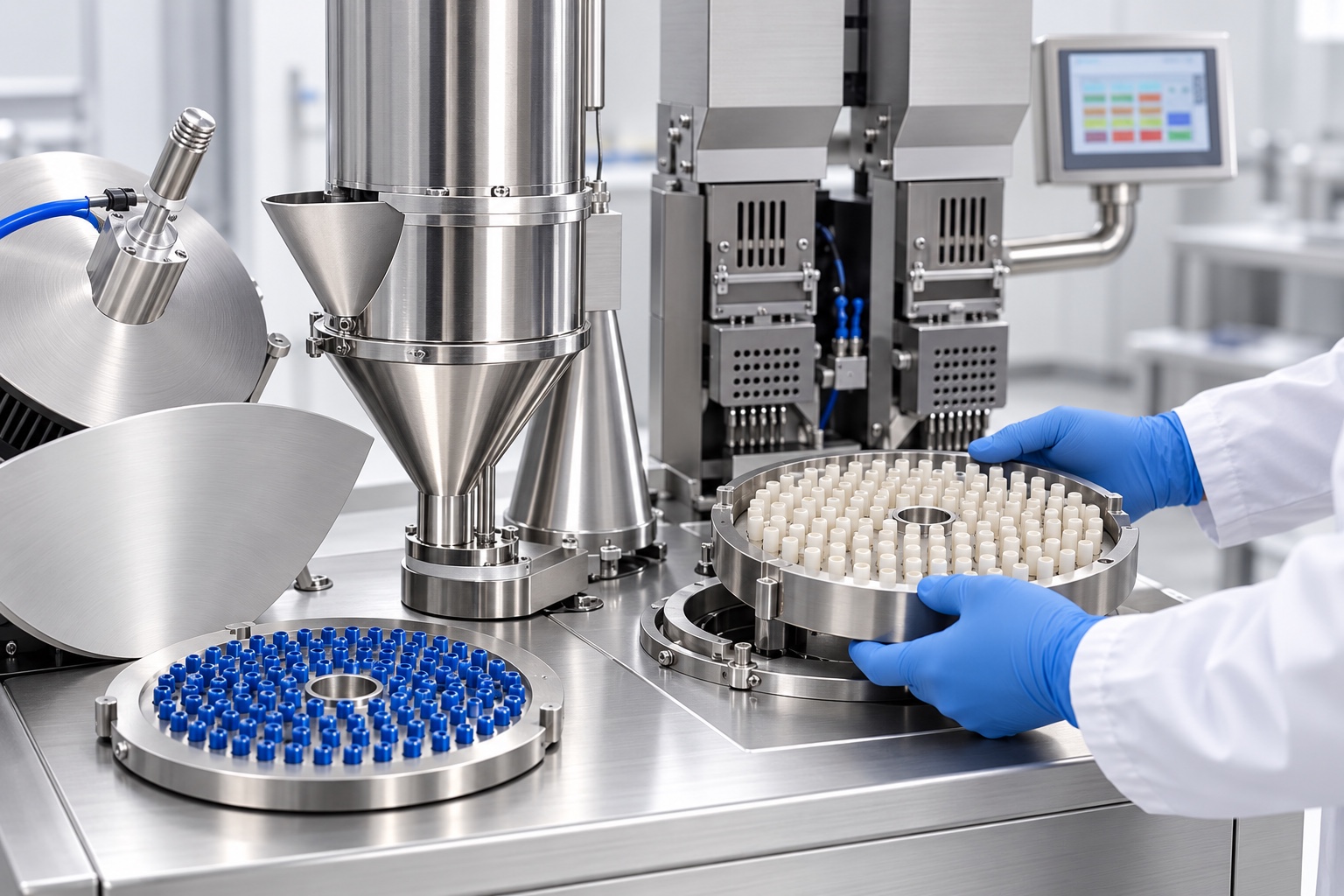
What “semi automatic” means in practice
The term describes a division of work, not a fixed percentage of automation. One machine may automate loading and filling but still require a person to move trays. Another may need more manual handling around separation or locking. To understand a specific semi automatic capsule filling machine diagram, trace the path of the cap tray and body tray separately, then mark every point where an operator lifts, turns, aligns, or checks a part.
That distinction also separates a semi automatic system from a manual capsule board. A manual board relies on the operator for most loading, spreading, tamping, and closing actions. A fully automatic filler links feeding, separation, dosing, rejection, locking, discharge, and cleaning within a synchronized machine cycle. The semi automatic arrangement sits between them, with powered stations and manual transfers working together.
Where dose consistency can change
The filling station is only one part of the result. Poor shell orientation or incomplete cap and body separation can leave a position unfilled. An uneven powder feed can alter fill weight across a tray. Misalignment during reassembly can produce a loose cap or damaged shell. Residue in a tray opening can interfere with the next cycle.
Practical checks follow those points in the process: confirm that the correct capsule size and matching change parts are installed; observe separation before filling; keep material feeding stable; sample fill weight according to the product’s control plan; and inspect closure and visible defects after discharge. If a result drifts, change one relevant setting at a time and recheck. Increasing station speed without checking transfer and inspection time can simply move the bottleneck to the operator.
Reading the machine’s actual capacity
A quoted hourly output is useful only when its conditions are clear. Capsule size, fill material, tray capacity, number of trays, operator skill, station balance, replenishment, short stops, and cleaning all affect the number of accepted capsules produced over a shift. A realistic trial should time the whole loop: loading, separating, moving, filling, reuniting, locking, discharging, and checking.
Fimachinery’s FI-SCF series is presented in the available product material as a semi automatic powder capsule filling line for smaller batch applications. The material confirms positioning, separation, filling, and locking as its basic functions. It does not establish a universal operator count or cycle time for every FI-SCF configuration, so those details should be confirmed against the exact equipment and formulation being considered.
For a buyer or production team, the most revealing demonstration uses the intended capsule shell and material, not an empty machine running at top speed. Watch each tray transfer, record accepted output after inspection, and examine filled and locked capsules. That makes the working principle visible as a complete production cycle—and makes the machine’s fit for the job much easier to judge.