
Capsule Filling Machine Change Parts: A Practical Guide
A capsule size change can look simple on a production schedule. In practice, the shell has to travel through feeding, orientation, separation, filling, closing, and ejection without losing alignment. That is why capsule filling machine change parts should be treated as a matched set rather than a box of interchangeable metal pieces.
The first useful distinction is between a change part and a spare part. A change part adapts the machine to a different capsule size, shell format, or filling configuration. A spare part replaces a component because it is worn or has failed. The same purchase request may include both, but their selection criteria are different. For a size change, the question is whether every contact and transfer point fits the new capsule. For a repair, the question is whether the replacement matches the machine's exact revision and function.
Where The Change Parts Sit In The Process
An automatic hard capsule filler first presents empty shells in the required orientation. Its upper segment holds the caps while the lower segment holds the bodies. Vacuum separates the two halves. The open bodies then pass the filling station before the machine brings the caps and bodies back together, closes them, and ejects finished capsules.
Each transfer depends on geometry. A guide or fork that presents the shell incorrectly can disrupt loading before the dosing system ever operates. Segments with unsuitable bores or poor alignment can affect separation and closing. Locking and ejection components also have to suit the finished capsule's dimensions. This is why a set that appears complete at the filling station may still be unusable at another station.
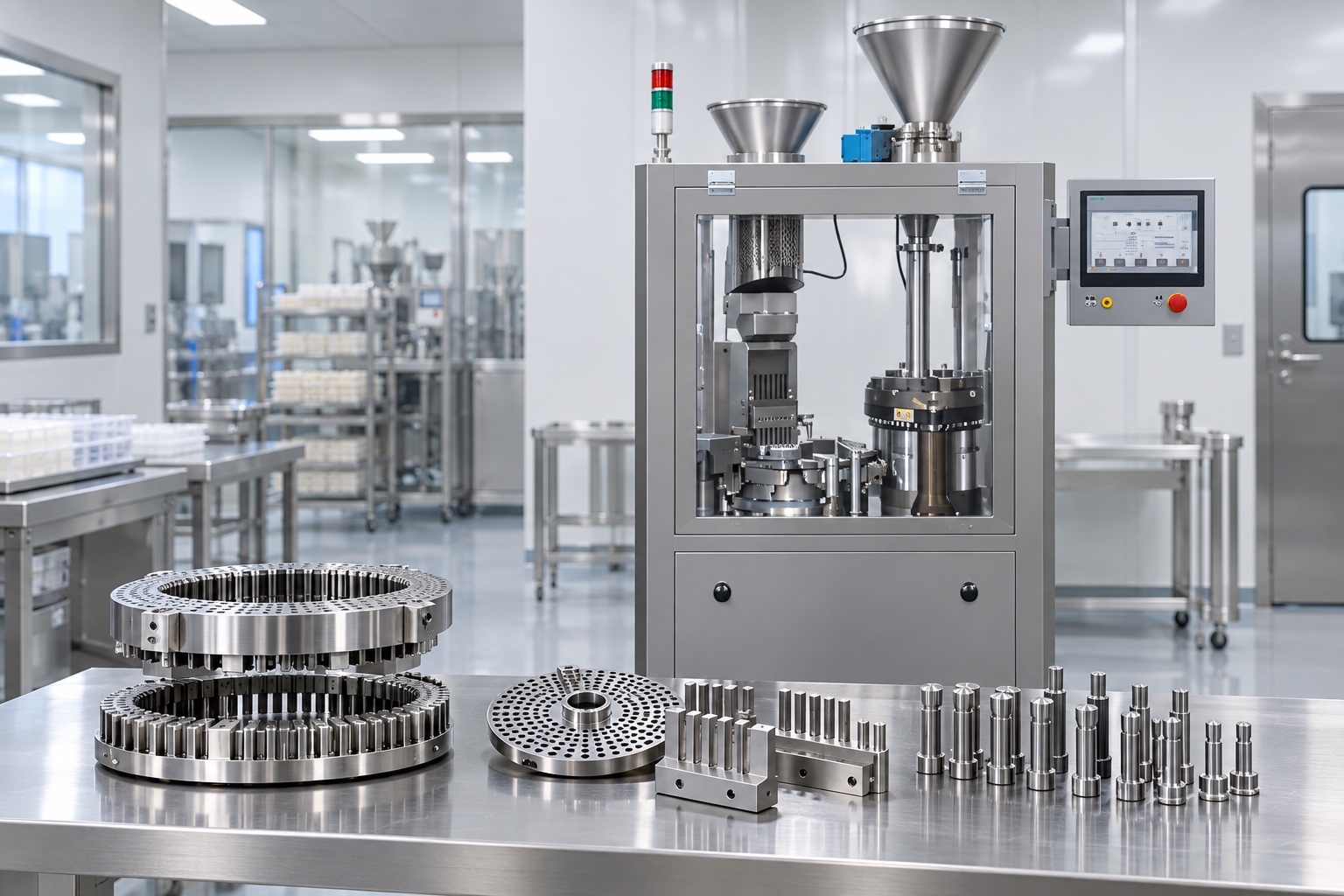
Typical automatic machine change parts include capsule orientation and feed pieces, upper and lower segments, horizontal and vertical forks, guides, locking pieces, ejection pieces, and parts of the dosing system. The exact list is machine specific. It should come from the equipment's approved changeover documentation, not from a generic capsule size chart.
What Changes At The Dosing Station?
Capsule size is only one part of the dosing decision. In a powder filling system, the dosing disc and tamping pins work together to form and transfer a powder plug. Whether either component must change depends on the target fill weight, dosing hole, powder behavior, and the design of the machine. A new shell size therefore does not automatically mean that every dosing component needs replacement. Equally, retaining an old disc solely because it fits physically does not establish that it will deliver the required fill.
Other materials may use different filling modules. Fimachinery's NJP-1200 documentation describes hard capsule filling with powder, granules, or tablet-like material, while the client catalog lists a range of automatic powder capsule fillers. A buyer should identify the actual machine and material path before ordering a format kit. A powder dosing assembly should never be assumed to cover a pellet or tablet application just because the capsule size is the same.
A Changeover Check That Prevents Missing Pieces

Start with the current machine identification: manufacturer, model, serial number, and mechanical version. Then record both the old and new capsule specifications, including shell size and supplier. If the new shell has a different locking style or dimensional tolerance, include that information in the request. The format kit must be matched to the actual machine build, since parts that look alike may differ in dimensions, material, or function.
Next, follow the shell through the complete process. Confirm the feed and orientation parts, the upper and lower segments, the separation path, the filling setup, the closing parts, and the ejection path. Check each item against the manufacturer's parts list or drawing. Keep paired components together and identified as a kit. A missing fork, guide, or locking element can stop the whole changeover even when the major segments are present.
Before installation, inspect the cleaned parts for damage, residue, and mix-ups. Record their identification and condition. Follow the machine manual for shutdown, energy isolation, cleaning, fitting, and adjustment. After the new parts are installed, check alignment and clearance under the manufacturer's permitted conditions before returning to production. For the NJP-1200, the operating material calls for manually turning the main mechanism through one or two cycles after a capsule size change; unusual resistance is a signal to stop and investigate, not to increase drive force.
What To Verify Before Making Product
The first trial should establish that shells feed consistently, caps and bodies separate cleanly, the intended material enters the bodies, capsules close to the required length, and finished units eject without damage. These observations are connected: poor separation may leave an empty or malformed capsule that later appears to be a filling problem. A closing fault may come from an incorrectly adjusted locking component rather than the dosing station.
For the NJP-1200, product material points to vacuum condition and separator position when cap and body separation is poor. It also directs the operator to recheck segment concentricity, alignment parts, and change part installation if manual turning meets abnormal resistance. Loose or overly tight closing calls for adjustment to the capsule's overall length. These are diagnostic directions for that machine, not universal settings for every capsule filler.
Once the mechanical path works, verify fill performance and finished capsule quality against the approved process requirements. Any dosing or format adjustment should be captured in the changeover record so the next run begins from a known configuration. Cleaning and storage matter just as much: keep each kit complete, inspect it after use, and protect it from damage or mixing with parts for another size.
Buying The Right Kit
A useful inquiry does more than ask for “capsule filling machine parts.” Provide the machine model and serial number, the current and target capsule details, the material to be filled, and the identification numbers or photos of existing parts. Ask the supplier to confirm the exact kit contents and compatible machine revision. If a dosing disc or tamping pin set is included, have its application confirmed against the planned fill, rather than assuming capsule size alone determines it.
For a Fimachinery project, this information helps separate a planned format conversion from a maintenance parts order. It also gives the team a practical basis to check every station before the machine is committed to a new batch. A complete change parts set supports a controlled changeover; its value is measured at the machine, where feeding, dosing, closing, and ejection all have to work together.