
Types Of Capsule Filling Machines: How To Choose
A capsule filling machine is easier to choose once you separate two questions: who moves the capsules between steps, and what goes inside each shell? A manual plate, a semi-automatic workstation, and a fully automatic machine may all fill two-piece hard capsules, but they require different levels of operator involvement. Powder, pellets, tablets, and liquids can also call for different dosing systems. Looking at both dimensions prevents a machine name from hiding a mismatch with the product or the production routine.
Manual Plate Fillers For Very Small Batches
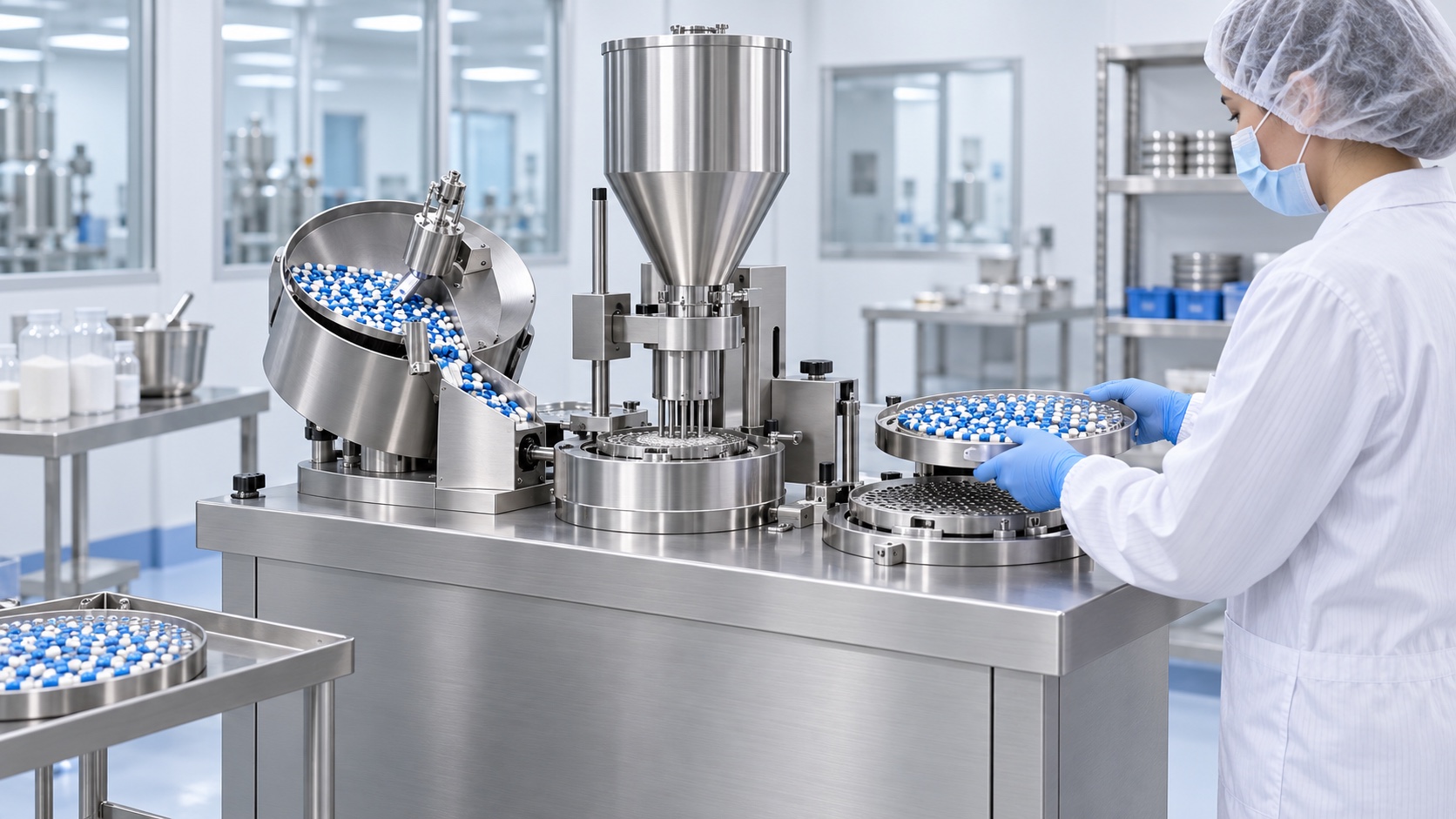
A manual plate filler holds empty capsule bodies and caps in matching trays. The operator loads and separates the shells, distributes the fill material, tamps it if the process calls for it, and joins the caps to the bodies. The equipment is simple to see and handle, which makes it useful for early formulation work and very small batches.
The trade-off is that filling, transfer, and closure depend heavily on the person running the process. A manual plate does not become a production-grade automatic machine because it has an electric accessory. If a project needs repeated batches with defined output, documented changeovers, and routine in-process checks, assess the complete workflow rather than the plate’s nominal number of holes.
Semi-Automatic Machines For Operator-Led Transfer
A semi-automatic capsule filler uses powered mechanisms for some operations while the operator still links the stations. Depending on the machine, these operations may include orienting and separating empty shells, filling, and locking the capsules. The operator may carry a tray, ring, or module from one station to another. This movement is the practical distinction to watch during a demonstration.
Fimachinery’s FI-SCF series is a semi-automatic powder capsule filling option. It covers capsule positioning, separation, filling, and locking, and is aimed at smaller batch settings such as small pharmaceutical plants and hospital preparation rooms. That does not mean every intermediate transfer happens automatically. Ask to see a complete run, including shell loading, tray movement, rejected capsules, and cleaning between products.
Semi-automatic equipment can make sense when batch size and staffing allow these transfers, particularly if products change often. Its real output will depend on capsule size, material behavior, operator rhythm, and the time spent replenishing and checking the machine. Compare usable capsules per shift, not just the filling station’s cycle rate.
Fully Automatic Machines For A Connected Cycle
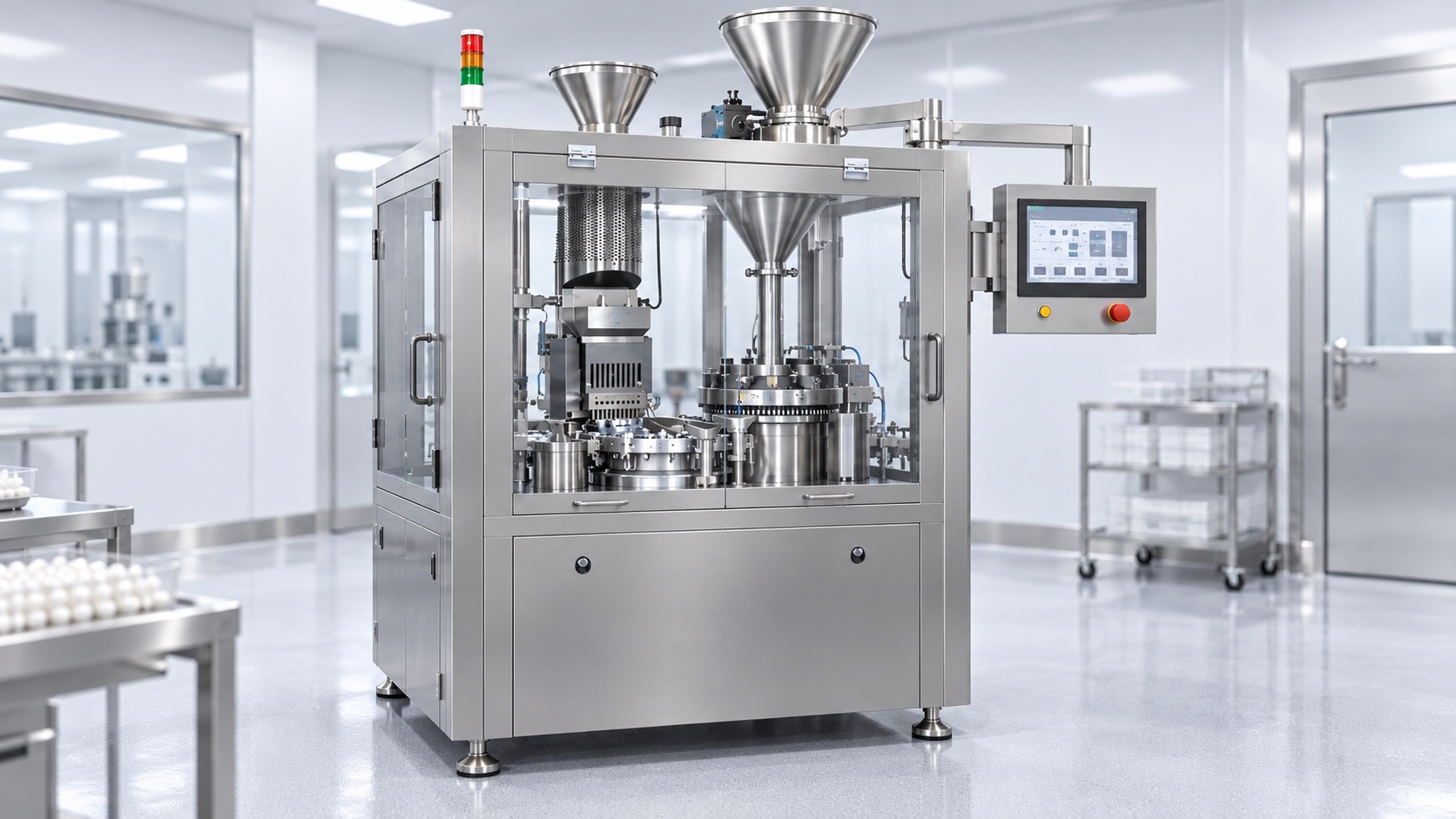
A fully automatic hard capsule filler carries capsules through linked stations for shell feeding, orientation, separation, dosing, rejection, locking, discharge, and cavity cleaning. Operators still prepare materials, monitor the run, take samples, change format parts, and clean the equipment. “Automatic” describes the connected filling cycle, not an unattended production line.
Fimachinery lists the FI-200CF through FI-7800CF family as fully automatic powder capsule filling machines. Its NJP-1200 is another fully automatic hard capsule model. The NJP-1200’s process includes capsule feeding and separation, powder filling, defective capsule rejection, locking, discharge, and mold-hole cleaning; an optional pellet unit is described separately. These examples show why a model name alone is not enough: confirm the exact material, capsule size, dosing parts, and installed options for the proposed machine.
Powder Is Not The Only Filling Category
Automation level is only the first axis. A powder system may use a dosing disk and tamping pins to form a measured powder plug before transfer into the capsule body. The available mechanism and settings matter when powder flow or compactability changes. Pellets, granules, small tablets, and combinations may require other feeders or dosing modules. A machine that can accept such a module is not necessarily delivered with it.
Liquid-filled hard capsules form another category. Fimachinery’s FI-300CF/L is intended for solutions, suspensions, and microemulsions in hard capsules. The FI-300CF/LS combines liquid filling with sealing at the cap-body joint and can also address hot-melt materials within its stated application. For a liquid project, establish the fill material’s properties and the need for sealing before treating a powder capsule filler as an interchangeable option. Locking a capsule and applying a leak-resistant band at its joint are different operations.
Softgels belong to a different process family. They are formed and filled as part of a soft-capsule process, whereas the hard capsule machines discussed here fill preformed two-piece shells. Confirm the capsule format at the start of a project; the word “capsule” by itself does not settle the equipment type.
How To Narrow The Choice
Begin with the dosage form and filling material. Confirm whether the shell is a preformed two-piece hard capsule, then provide representative powder, pellet, tablet, or liquid samples. State the target capsule sizes, fill range, batch size, and acceptable variation. The supplier can then identify the dosing system and change parts that the actual product needs.
Next, map the hands-on work. Watch how empty shells enter the machine, how material is supplied, which transfers require an operator, how rejects leave the process, and how finished capsules reach inspection or polishing. This makes the difference between manual, semi-automatic, and fully automatic equipment visible in operational terms.
Finally, test the whole shift rather than a short uninterrupted run. Allow for setup, sampling, replenishment, cleaning, and changeover. Check the utilities, dust handling, access for cleaning, and downstream capacity against the proposed configuration. A faster main machine will not deliver faster finished batches if supply, inspection, or packaging cannot keep pace.
The right type is the one whose capsule format, dosing method, operator workload, and complete batch flow fit the product. Fimachinery’s semi-automatic powder, fully automatic powder, and liquid hard capsule lines provide different starting points; the final configuration should be confirmed with the material and process requirements of the specific project.