
What Is Capsule Filling Machine? Process And Scope
The word “filling” can refer to two quite different jobs in a solid-dose facility. One machine puts material into empty capsules. Another counts finished capsules into bottles. If a purchasing brief simply asks for a capsule filling machine, it should also say what enters the machine, what must come out, and which steps are handled elsewhere.
A capsule filling machine works with preformed, two-piece hard capsules. It orients the empty shells, separates each cap from its body, places a measured portion of material into the body, closes the capsule, and discharges it. It does not manufacture the empty shell, and it does not automatically take care of downstream counting or packaging.
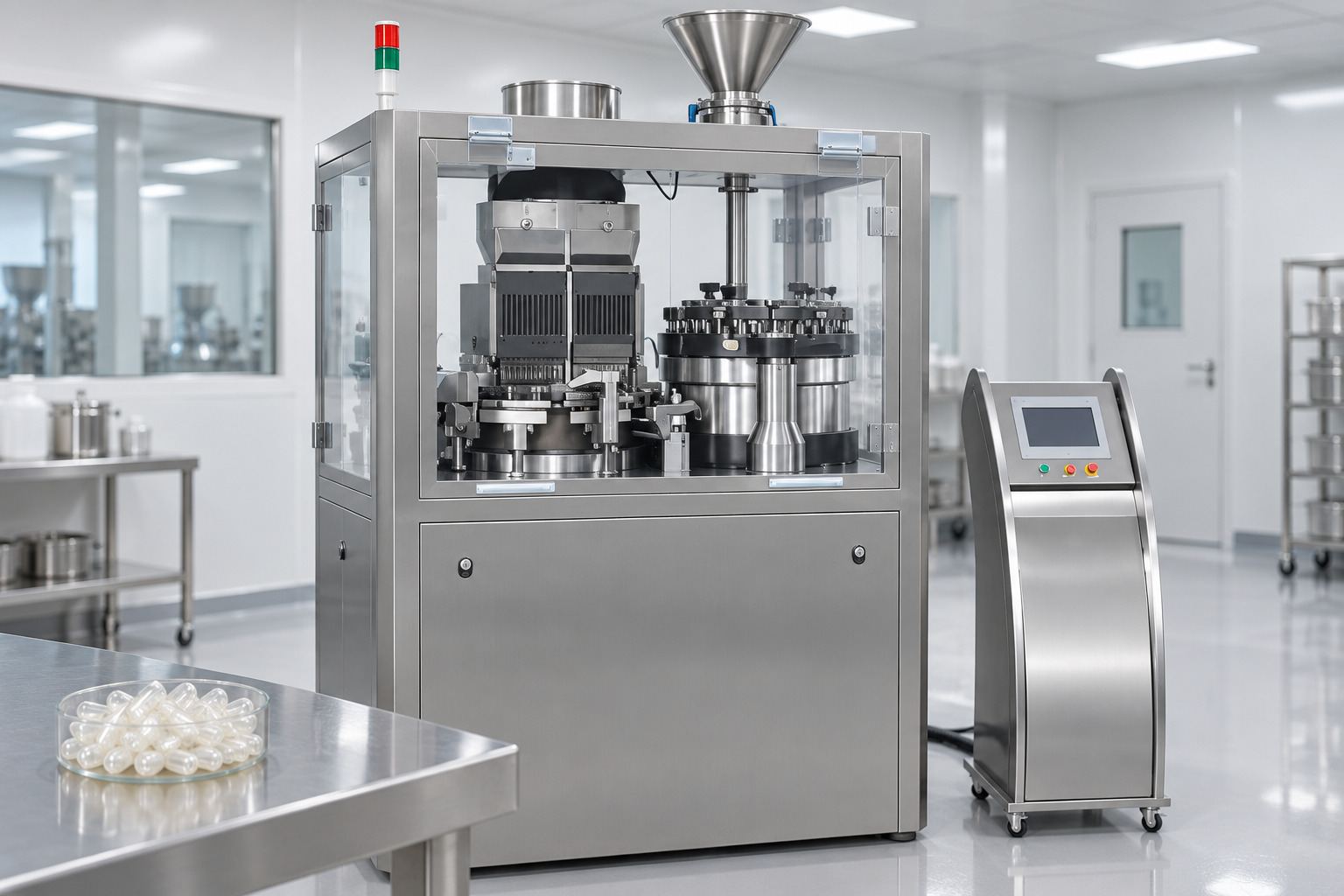
Where The Filling Process Begins And Ends
Empty capsules enter an orientation system so that their caps and bodies reach the appropriate machine positions. The two halves are separated, leaving the body ready to receive material. After dosing, the cap and body meet again at the locking station. The filled capsule is discharged, and the holding position is prepared for another cycle.
This sequence matters more than a simple “capsules per hour” figure. A shell that fails to separate cannot be filled properly. A capsule that receives the intended amount of material but does not close correctly is not a satisfactory output. The documented NJP-1200 process, for example, assigns positions to capsule feeding and separation, powder filling, rejection of faulty capsules, locking, discharge, and cleaning of the capsule holes. Watching that complete path during a trial is more informative than watching the filling station alone.
The Material Determines The Dosing System
Powder, granules, pellets, tablets, and liquids are not interchangeable from a machine-design point of view. A powder dosing disc forms portions in its cavities with the help of tamping pins before transferring them into capsule bodies. Granules or pellets may use a different portioning arrangement. A tablet-filling application needs to account for individual units rather than treating them as free-flowing powder.
The NJP-1200 documentation lists powder, granules, and tablets among the materials it can handle. That statement describes a documented machine and still leaves room for a material-specific trial. Flow behavior, the target fill amount, capsule-shell condition, and the installed dosing parts all affect what can be achieved in practice. A catalog category by itself cannot establish a working dose range for a new formulation.
Liquid filling calls for a dedicated arrangement. The FI-300CF/L is listed as a hard-capsule liquid filling machine; the FI-300CF/LS combines liquid filling with sealing at the cap-body joint. A liquid project should therefore ask about the actual filling path, the material's handling characteristics, the need for sealing, and how seal integrity will be checked. Powder-machine specifications are not a substitute for those answers.
How Semi-Automatic And Fully Automatic Machines Differ
Both types perform the essential operations of separating, dosing, and closing hard capsules. In a typical semi-automatic process, an operator moves a capsule ring or tray between stations. Its practical output depends on those transfers as well as the machine cycle, the material, and the number of available trays. The FI-SCF series is documented as a semi-automatic powder capsule filling range intended for smaller-batch settings.
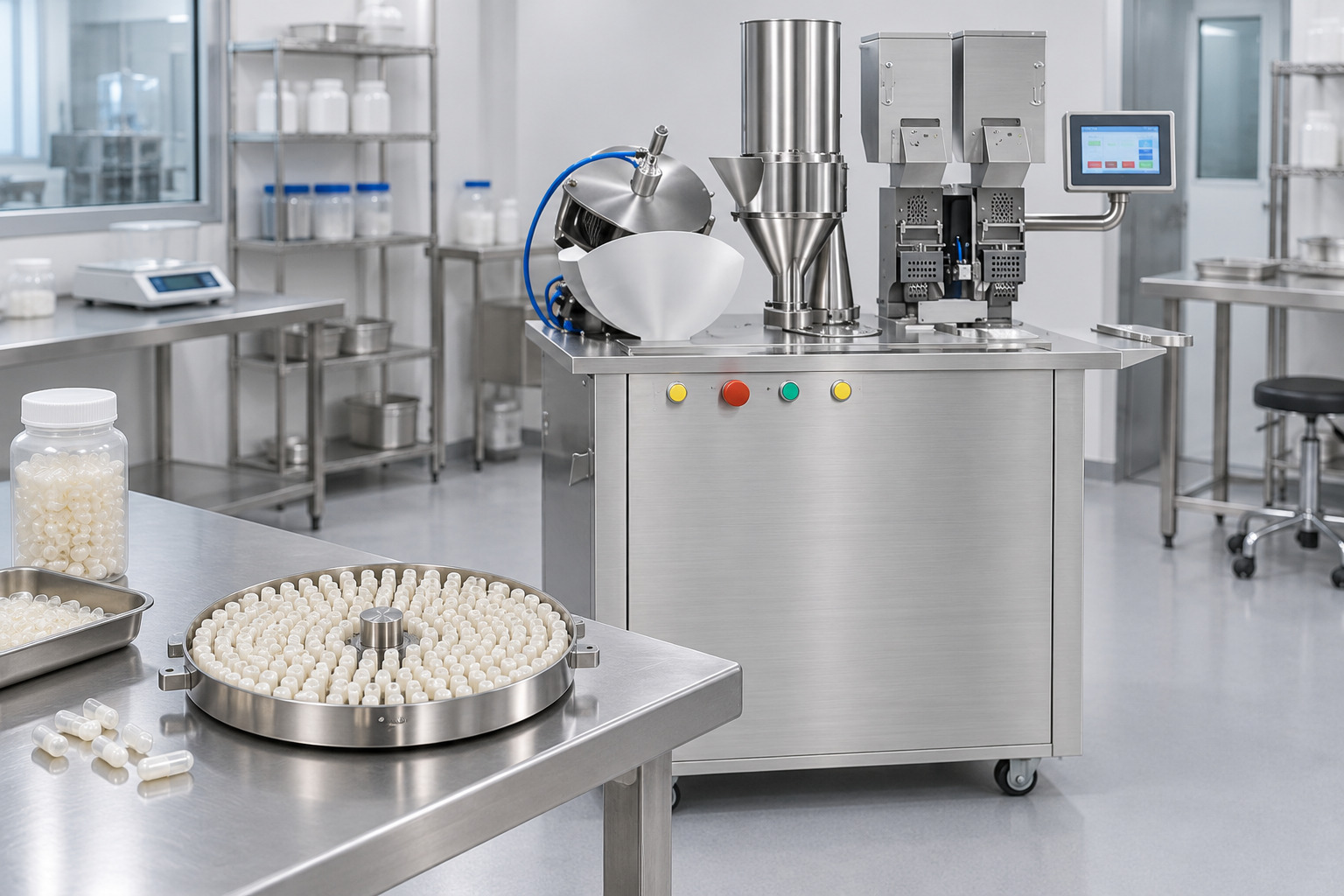
A fully automatic machine links capsule feeding, separation, dosing, locking, and discharge in one operating cycle. “Fully automatic” does not tell you which inspection systems, cleaning functions, or downstream machines are included in a particular offer. Rejection, sampling, and line connections need to be checked against the specific configuration. When comparing equipment, record the hands-on tasks, changeover time, cleaning time, and acceptable net output for the product at hand.
What Happens After A Capsule Leaves The Filler
A capsule filling machine delivers individual filled capsules. Bottling is a separate stage: finished capsules must be counted and conveyed into containers. For example, the CBPS-D16 in the product documents counts tablets, capsules, or pills for bottle filling. It does not open empty capsules or meter material into capsule bodies. Blister packaging is another downstream operation with its own forming, loading, and sealing steps.
This distinction is useful when planning a line. If the intended result is “filled capsules in bottles,” the specification must cover both capsule filling and the chosen packaging route, including the handoff between them. A single shared word, “filling,” should not hide a missing machine in the process plan.
A Practical Check Before Choosing A Machine
Bring representative capsule shells and material to a trial. Confirm the supported capsule size and identify the change parts needed for that size. Observe shell orientation and separation, fill consistency, closure, rejection of abnormal capsules, and discharge. Ask which product-contact parts must be removed for cleaning, and verify the site's vacuum, compressed-air, and other utility conditions against the proposed configuration.
The right capsule filling machine is the one that can repeatedly take the specified empty shell and material through to an acceptably filled, closed capsule. Once that boundary is clear, it becomes much easier to compare machine types and to identify the separate equipment needed afterward.