
DQ, IQ, OQ, And PQ: What Is Each Stage Really Meant To Prove?
In pharmaceutical manufacturing, equipment qualification often comes down to four familiar abbreviations: DQ, IQ, OQ, and PQ. Four protocols are prepared, four reports are approved, and the records are filed away.
Yet a puzzling pattern sometimes appears on the shop floor. IQ and OQ cover much the same ground. OQ and PQ repeat many of the same tests. All four reports are signed off, but once the equipment goes into service, important functions still fall short.
The issue may not be that a qualification stage was skipped. It may be that nobody clearly defined what each stage was supposed to demonstrate.
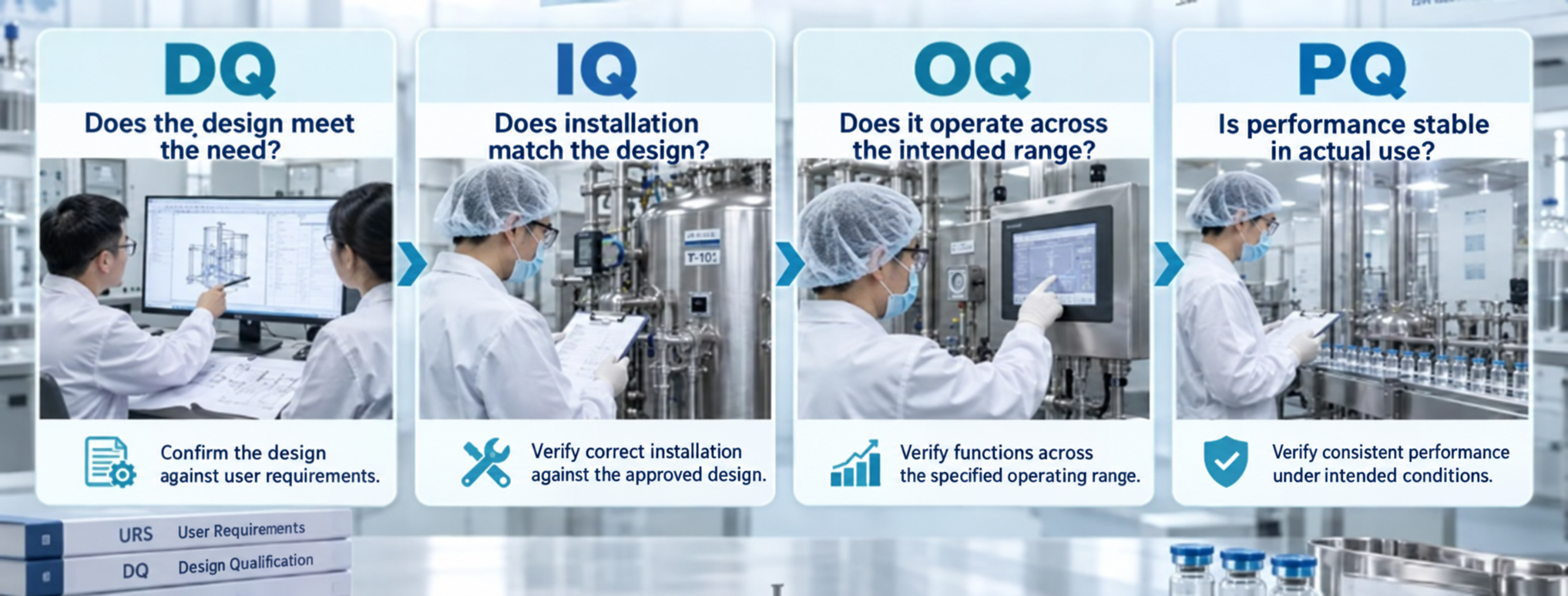
Under China’s GMP Annex on Qualification and Validation, these four stages are design qualification (DQ), installation qualification (IQ), operational qualification (OQ), and performance qualification (PQ). Their purpose is easier to grasp as four questions:
- DQ: Does the proposed design meet our user requirements?
- IQ: Does the installation match the approved design?
- OQ: Does the installed equipment operate as intended across its expected operating range?
- PQ: Does it perform effectively and consistently under its intended conditions of use?
The questions sound similar, but each calls for a different kind of evidence.
DQ Asks Whether The Design Meets The User’s Needs
DQ does not ask whether a machine looks sophisticated. It asks whether the design is right for the job.
For new or modified premises, facilities, and equipment, the GMP Annex calls for approved user requirements based on intended use, GMP, and applicable regulations. Design qualification then demonstrates that the design meets those requirements. That makes the user requirements specification (URS), rather than the supplier’s brochure, the starting point for DQ.
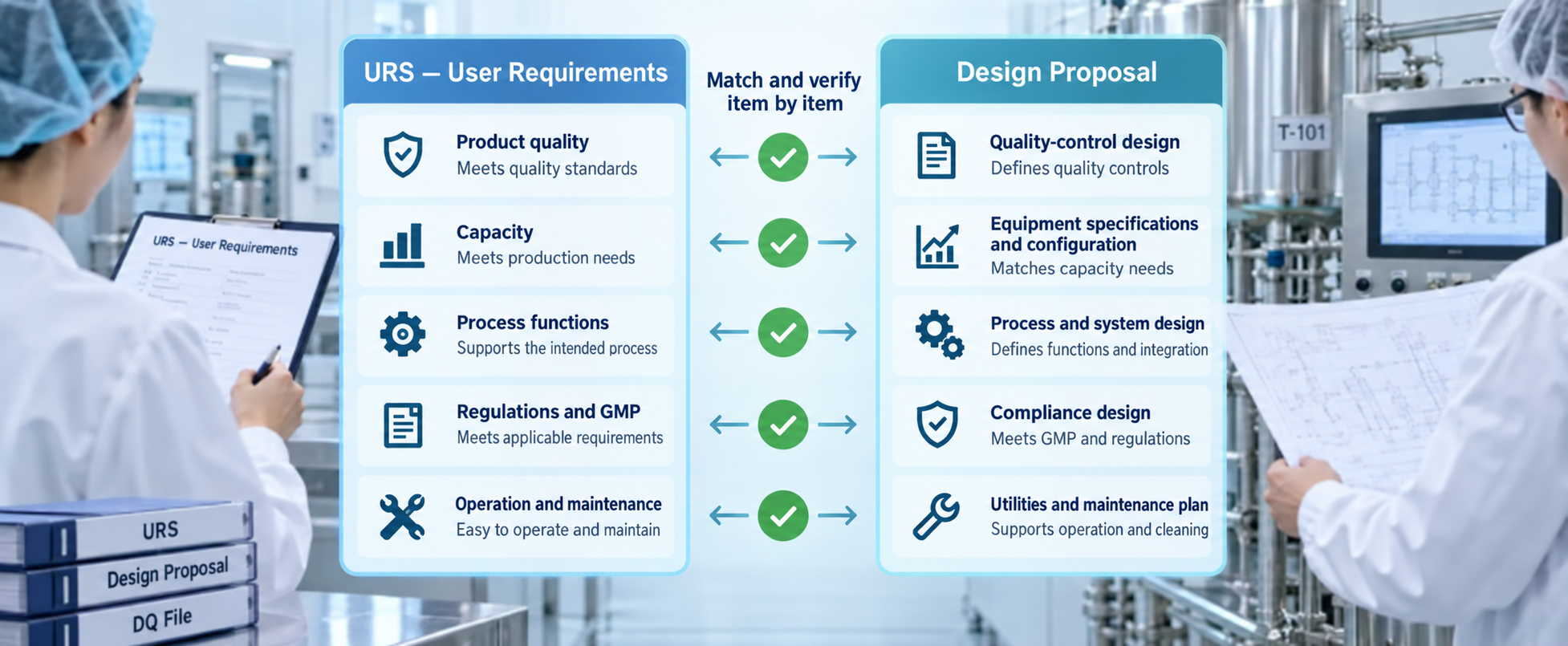
Before reviewing a supplier’s proposal, the company needs to answer practical questions: What will the equipment be used for? What capacity and operating range are needed? What materials may contact the product? What are the cleaning, maintenance, calibration, automation, and data requirements? How must the equipment connect to the facility, utilities, and upstream and downstream operations?
Only then can the proposed design be assessed against those needs. DQ is the comparison between what we need and what the design will deliver.
Signing a technical agreement is not, by itself, design qualification. If that agreement was never grounded in reviewed user requirements, both parties can sign it and still leave important design questions unanswered.
IQ Asks Whether The Installed Equipment Matches The Approved Design
After DQ, the design may work on paper. Once the equipment is on site, the question changes: Is what was actually installed the system we approved?
That is the role of installation qualification. The GMP Annex calls for acceptance and documentation against the user requirements and the technical requirements established during DQ. At a minimum, IQ covers checks against current engineering drawings and specifications, collection and filing of supplier operating and maintenance manuals, and necessary instrument calibration.
In practice, IQ may check the equipment model and specifications, approved critical components, piping and utility connections, instrument ranges and installation, calibration status, and the completeness of as-built drawings and operating documents.
Put simply: DQ checks the equipment on the drawing; IQ checks the equipment installed on the shop floor.
OQ Asks Whether The Installed System Works Across Its Intended Operating Range
Correct installation does not prove that a system will operate as intended. Operational qualification addresses that gap.
OQ demonstrates that the premises, facilities, or equipment operate in line with their design standards. Tests should be derived from those standards and performed under one or more operating conditions. They should cover the relevant upper and lower limits, with worst-case conditions used where needed.
Depending on the equipment, OQ might challenge temperature, pressure, speed, flow, alarms, interlocks, control logic, or automated functions. The point is not to test every parameter from one extreme of the manufacturer’s advertised range to the other. The scope and depth of testing should reflect risk and provide enough evidence that critical functions are controlled.
More test cases do not automatically mean better OQ. The key is whether critical operating capabilities have been meaningfully challenged and demonstrated.
PQ Asks Whether Performance Holds Up Under Intended Use
Passing functional tests leaves one final question: What happens when the system is used as intended?
Performance qualification examines whether the installed and connected facilities, systems, and equipment perform effectively and reproducibly under approved production methods and product specifications. Its focus is actual performance under representative conditions of use.
PQ does not automatically require three consecutive batches of real product
The GMP Annex says a PQ protocol should draw on existing knowledge of the process, facilities, and equipment. Testing may use production materials, suitable substitutes, or simulated product, as appropriate to the equipment and the risks being assessed.
The familiar expectation of three consecutive successful batches appears in the Annex’s process validation provisions. For process validation, batch count and sampling plans are set using quality risk management, and the Annex says companies should normally complete at least three consecutive successful validation batches.
That process validation provision should not simply be copied into every equipment PQ protocol. The evidence needed for PQ depends on what is being qualified and how it will be used.
How Does PQ Relate To Process Validation?
If PQ tests equipment under intended conditions of use, why is process validation still needed? Because the two address different questions.
PQ focuses on whether facilities, systems, and equipment perform effectively and consistently in their intended setting. Process validation goes further: it demonstrates that a manufacturing process, run within its defined parameters, can consistently produce a product that meets its intended use and registered requirements.
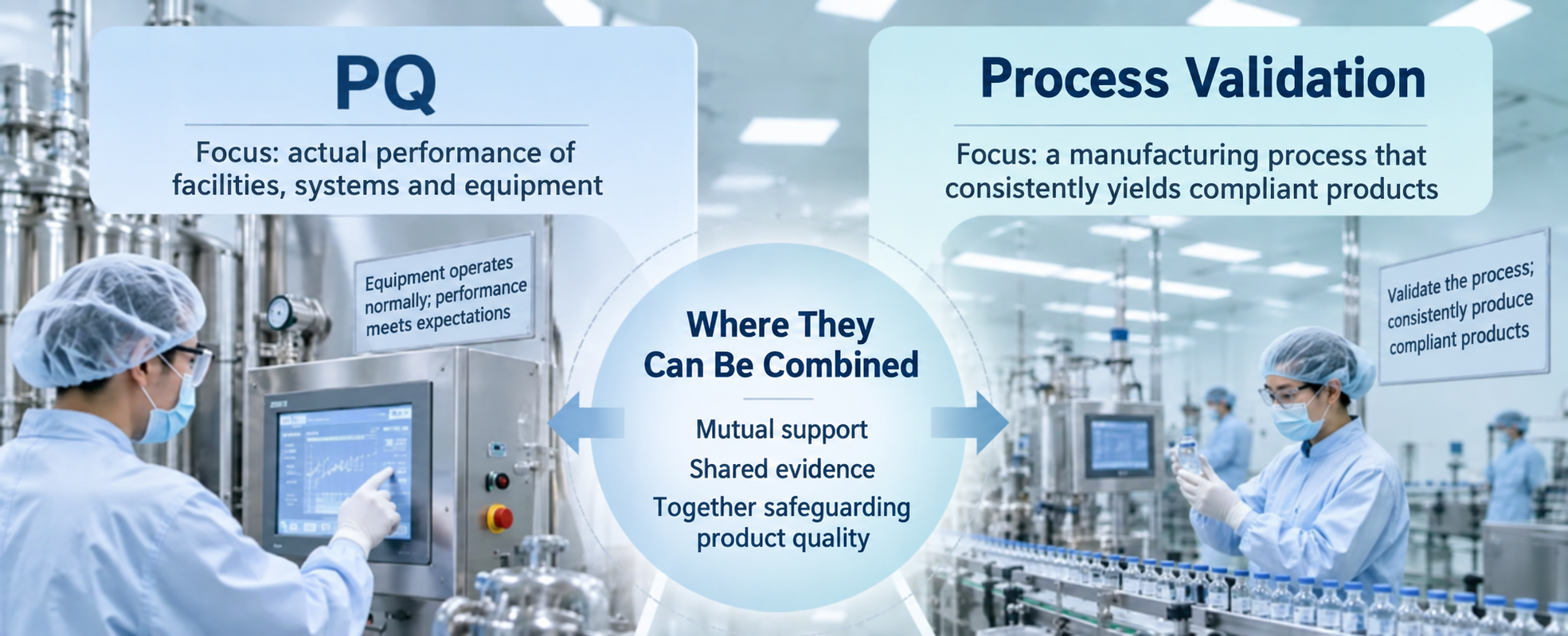
Process validation involves more than one piece of equipment. It considers how process parameters, materials, operators, equipment, sampling, and product quality work together across the manufacturing process.
The boundary is not absolute. The GMP Annex explicitly allows PQ to be combined with OQ or process validation in some circumstances. The aim is to obtain sufficient, traceable evidence for the questions that matter—not to produce four completely separate reports for their own sake.
Do The Four Stages Always Need Four Separate Reports?
A company may choose to maintain one protocol and report for each stage. That can be a sensible document structure. It does not mean the regulations require every project to be split into four wholly independent activities.
The GMP Annex bases the scope and extent of qualification and validation on risk assessment. It also permits PQ to be combined with OQ or process validation in certain cases. Document structure and activity design should therefore reflect the system, its risks, project complexity, and the company’s validation strategy.
Documents can be combined, and activities can be integrated where justified. What matters is that combining them does not leave a critical question without evidence.
Why Does The Sequence Still Matter?
Even when documents or activities are combined, the four questions follow a clear logic:
- URS: Define what the user needs.
- DQ: Show that the design meets those needs.
- IQ: Show that the installation matches the approved design.
- OQ: Show that the installed system works across its intended range.
- PQ: Show that it performs effectively and consistently in use.
Each conclusion gives the next stage a sound starting point.
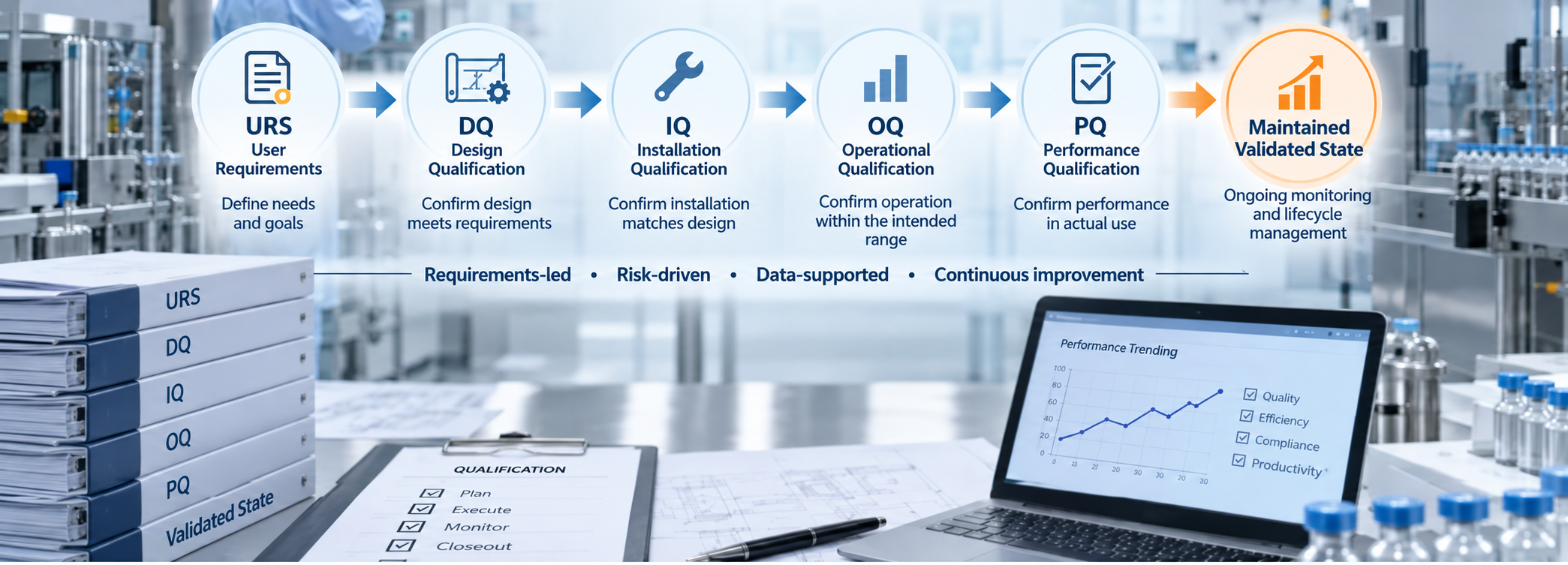
For qualification or validation performed in stages, the Annex generally requires approval of the preceding report, or approval that the activity met its predefined objectives, before the next stage begins. It also allows conditional approval when an unmet criterion or unresolved deviation has been assessed and found to have no significant impact on the next stage.
The practical rule is straightforward: before moving forward, understand the status of the previous stage and whether any open issue could affect the next conclusion.
If The Stages Repeat The Same Tests, Revisit The Questions
To assess a qualification plan, start with the question assigned to each stage rather than the number of pages in the protocol:
- DQ: Why will this design meet the approved user requirements?
- IQ: What proves the installation on site matches the approved design?
- OQ: What proves the system works across the intended operating range?
- PQ: What proves it can reliably achieve the required performance under intended conditions of use?
If all four protocols are answering essentially the same question, the stage logic may need work. Conversely, combined activities or reports can still form a complete qualification package when each of these questions is supported by adequate evidence.
Conclusion
The hardest part of DQ, IQ, OQ, and PQ is not memorizing four abbreviations. It is knowing exactly what you intend to prove at each point:
- DQ: The design meets user requirements.
- IQ: The installation meets the approved design and technical requirements.
- OQ: The installed system operates correctly within its intended range.
- PQ: It performs effectively and consistently under intended conditions of use.
Together, these stages form a chain of evidence: needs become a suitable design; the design is installed correctly; the installation operates as intended; and actual use delivers consistent performance.