
DQ, IQ, OQ And PQ In GMP: How Pharmaceutical Qualification Really Works
By fimachinery
In pharmaceutical engineering projects, qualification and validation are often presented as a simple sequence:
URS → DQ → FAT → SAT → IQ → OQ → PQ → Process Validation
This sequence provides a useful overview. However, it can also create the impression that every project must follow exactly the same steps, with a separate protocol and report for each stage.
That assumption leads to several common misconceptions:
- “A project is noncompliant without a standalone DQ report.”
- “Every piece of equipment needs a complete, separate IQ, OQ and PQ.”
- “FAT and SAT are engineering tests, so their results cannot support qualification.”
- “PQ always requires three consecutive batches using actual product.”
- “CSV means carrying out DQ, IQ, OQ and PQ on a computerized system.”
- “Once the supplier has tested the equipment, the manufacturer has no further qualification responsibilities.”
These statements oversimplify the purpose of GMP qualification.
The central objective is to establish approved, traceable evidence that facilities, utilities, equipment and computerized systems are suitable for their intended use—and to maintain that suitability throughout their lifecycle.
Understanding how the stages relate to one another helps project teams build stronger evidence, avoid unnecessary testing and focus resources on product quality, patient safety and data integrity.
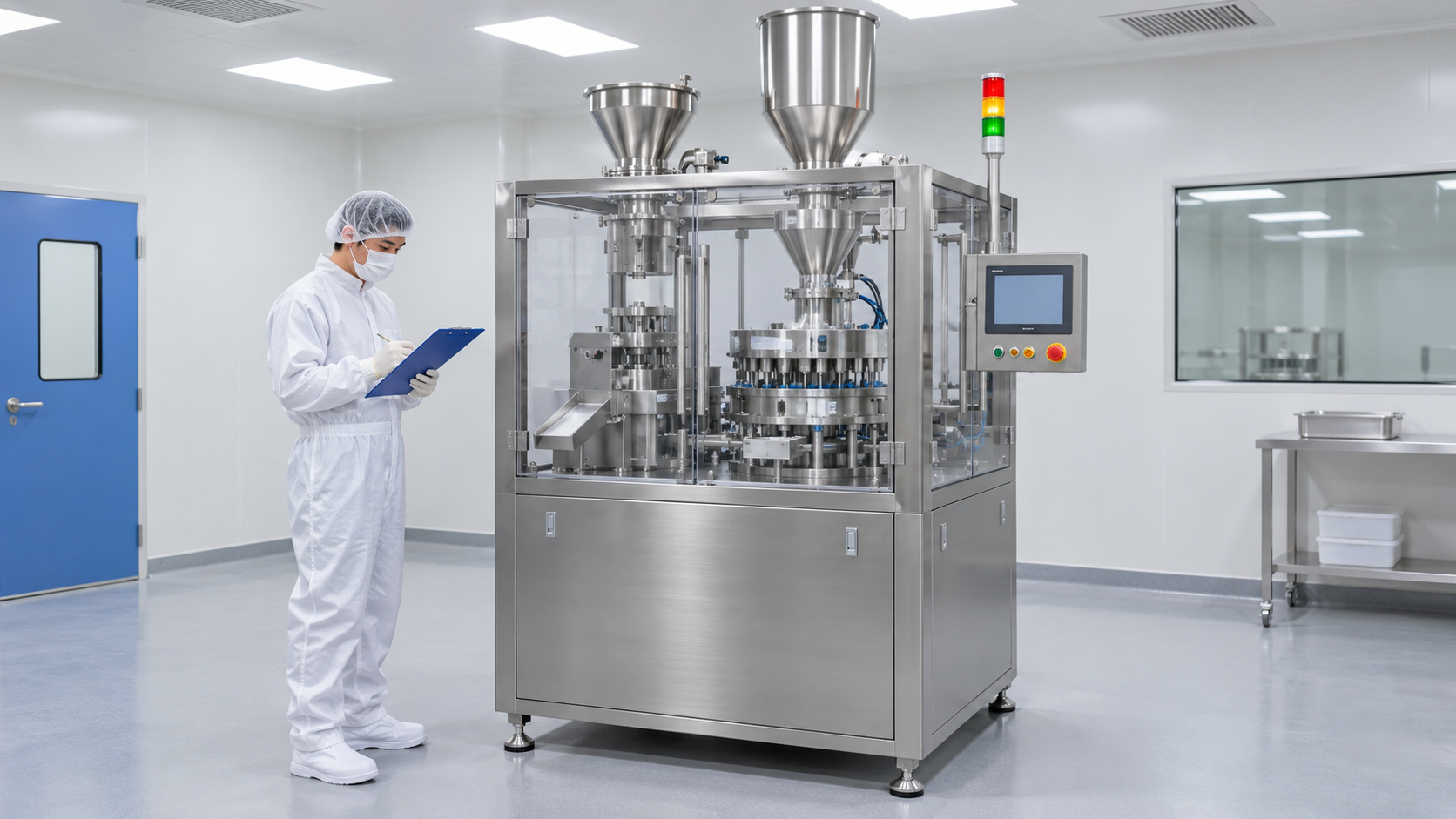
1. Commissioning, Qualification And Validation: What Is The Difference?
CQV stands for Commissioning, Qualification and Validation. These activities are closely connected, but each answers a different question.
Commissioning: Does The System Work As Engineered?
Commissioning establishes that a system has been installed and can operate in accordance with its engineering design.
Typical activities include:
- Checking electrical connections and motor rotation.
- Testing piping for leaks and verifying valve orientation.
- Checking instrument signals and control loops.
- Confirming communication between PLCs, DCS platforms and field devices.
- Verifying connections to water, electricity, compressed air and steam.
- Completing startup checks and water trials.
Supplier testing, FAT, SAT, mechanical completion checks and loop testing may all form part of commissioning.
The main question is:
Can the system start up and operate correctly from an engineering perspective?
Qualification: Is The System Suitable For Its Intended GMP Use?
Qualification establishes that facilities, utilities and equipment have been appropriately designed, installed and tested for their intended use.
It may cover cleanrooms, HVAC, pharmaceutical water, clean steam, process gases, production equipment, laboratory instruments, storage systems and associated infrastructure.
The main question is:
Does the system meet approved requirements and perform appropriately for its intended purpose?
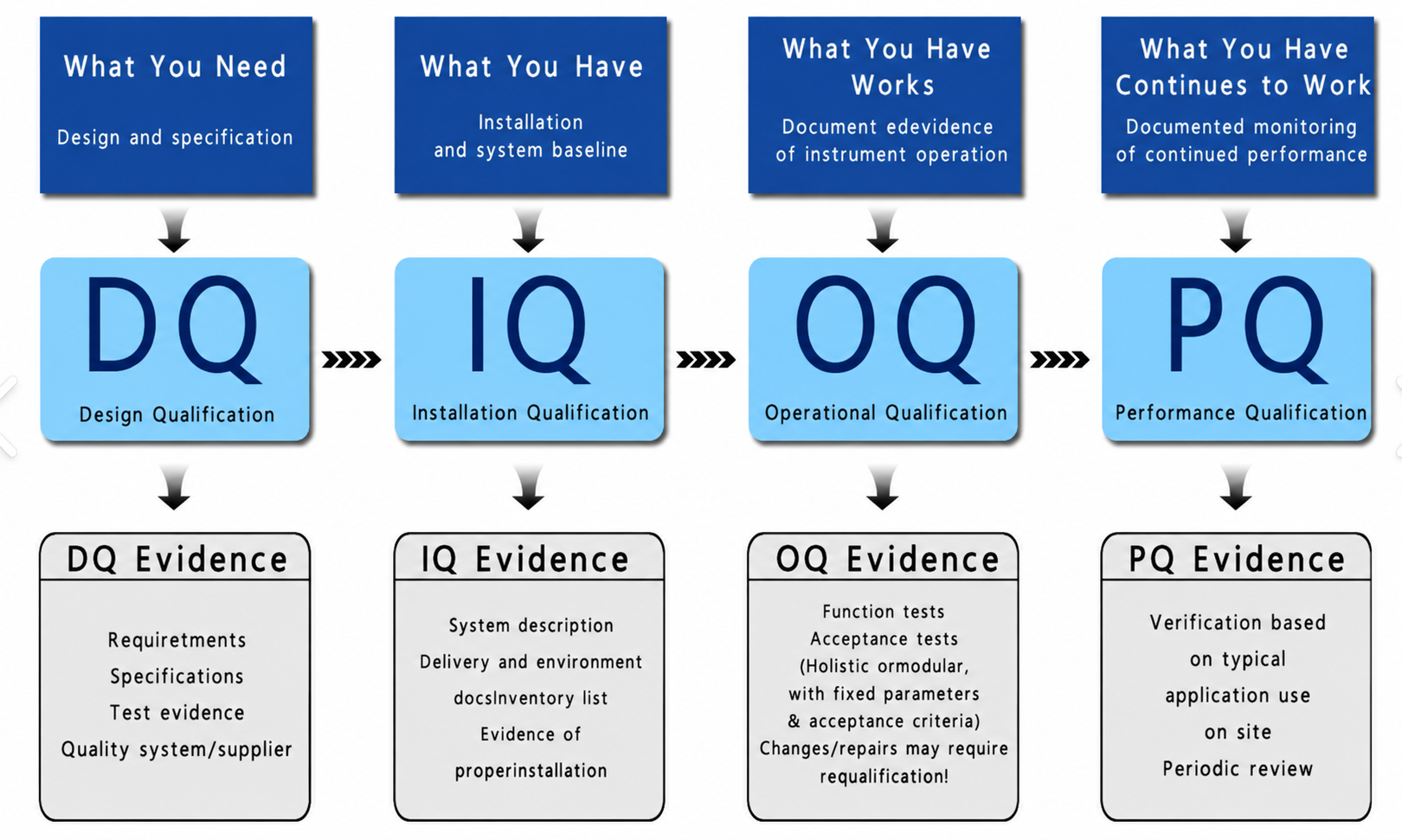
DQ, IQ, OQ and PQ are commonly used stages within this qualification lifecycle.
Validation: Can The Process Consistently Deliver The Required Result?
Validation focuses on processes and activities, including manufacturing, cleaning, analytical methods, transport and computerized system use.
The main question is:
Can the process consistently and reproducibly achieve its predefined requirements under specified conditions?
A useful distinction is:
Commissioning establishes engineering functionality. Qualification establishes suitability for use. Validation establishes consistent process performance.
2. Start With Intended Use And The URS
Qualification begins by defining what the system needs to do.
The User Requirements Specification (URS) provides the reference against which design decisions, installation checks and performance tests can be assessed.
A practical lifecycle approach includes:
- Defining intended use.
- Establishing user requirements.
- Assessing system impact and quality risks.
- Developing a qualification and validation strategy.
- Collecting evidence that requirements have been met.
- Maintaining control through monitoring, calibration, maintenance and change management.
EU GMP Annex 15 identifies the URS as a reference throughout the validation lifecycle and calls for the scope and extent of qualification and validation to be supported by justified, documented risk assessment.
Before deciding which qualification documents to prepare, consider:
- Could the system affect product quality or critical process parameters?
- Does it generate, process or retain GxP data?
- Could failure cause contamination, mix-ups or data loss?
- Which functions are critical to quality?
- What evidence is needed to demonstrate that the identified risks are controlled?
These questions establish the basis for an appropriate testing strategy.
3. DQ: Demonstrating That The Design Meets Requirements
Design Qualification (DQ) evaluates whether the proposed design can meet the URS, intended use and applicable GMP requirements.
DQ is most valuable during design and procurement, before major manufacturing, software configuration or construction activities begin.
What Should DQ Assess?
Depending on the system, design review may address:
- Process capacity and equipment sizing.
- Suitability of product contact materials.
- Cleanability, sterilizability, drainage and maintenance access.
- Personnel, material and waste flows.
- Instrument ranges, accuracy and installation locations.
- Alarms, interlocks and fail-safe arrangements.
- Automation and critical process controls.
- Electronic records, audit trails and access controls.
- Electronic signatures, where applicable.
- Sampling and calibration access.
- Network, storage, backup and recovery architecture.
- Resolution of design deviations.
DQ should make it possible to trace critical requirements to the design features intended to satisfy them.
Is A Separate DQ Report Always Necessary?
Design suitability needs documented assessment. The documentation structure can vary with the project, applicable requirements and the company’s quality system.
Possible formats include:
- A dedicated DQ protocol and report.
- A documented GMP design review.
- A URS-to-design traceability matrix.
- Design review records supported by risk assessment.
- An integrated design qualification package.
A routine drawing approval or supplier statement that equipment is “GMP compliant” does not, by itself, establish design suitability.
The records should show who reviewed the design, which requirements were assessed, what deviations remained and how the design was approved.
DQ establishes that the proposed system is capable, in principle, of meeting its intended purpose.
4. FAT And SAT: Building Evidence Before And After Delivery
Factory Acceptance Testing
Factory Acceptance Testing (FAT) is normally performed at the supplier’s premises before shipment.
Typical checks include equipment configuration, major components, material certificates, control logic, HMI screens, recipes, user permissions, alarms, interlocks and key performance functions.
FAT can identify problems while the supplier still has ready access to manufacturing resources and technical specialists.
Site Acceptance Testing
Site Acceptance Testing (SAT) takes place after delivery, installation or reassembly.
It typically checks that:
- Transport has not affected equipment condition or functionality.
- Site utilities are correctly connected.
- Interfaces with adjacent systems operate correctly.
- Equipment starts and runs in the site environment.
- Outstanding FAT issues have been addressed.
- Site-specific functions have been tested.
The need for FAT and SAT, and their depth, should reflect equipment complexity, supplier capability, transport risks and the extent of site assembly.
A simple balance may need a different acceptance strategy from a customized freeze dryer, filling line, bioreactor or automated process skid.
Can FAT And SAT Results Support IQ And OQ?
Yes, where their use is justified and the evidence is suitable.
EU GMP Annex 15, Section 3.6, allows appropriate FAT or other-stage checks to support subsequent qualification without repetition where transport and installation have not affected the functionality tested.
Before relying on supplier or acceptance test data, assess whether:
- The tests address relevant qualification requirements.
- Protocols and acceptance criteria were defined before execution.
- Personnel were appropriately trained.
- Test instruments had suitable calibration.
- Original records are complete and traceable.
- Deviations were recorded and assessed.
- Appropriate quality review took place.
- Subsequent transport, installation or software changes affected the results.
- Additional testing is needed for site-specific conditions.
The suitability of the evidence determines whether it can be used. The document title alone does not.

5. IQ: Verifying The Installed System
Installation Qualification (IQ) establishes that the system has been installed in accordance with approved specifications, manufacturer requirements and applicable standards.
Typical IQ checks include:
| Area | Examples |
|---|---|
| Equipment identification | Equipment name, model, serial number and location |
| Components and materials | Critical components, product contact materials and certificates |
| Utilities | Electrical supply, grounding, UPS, water, steam, gases, vacuum and cooling connections |
| Piping | Materials, routing, slope, weld records and relevant installation details |
| Instrumentation | Instrument identification and calibration status |
| Software and infrastructure | Software, firmware, operating system, database and network configuration |
| Documentation | P&IDs, as-built drawings, operating manuals and maintenance instructions |
| Operational readiness | Required procedures, training and maintenance arrangements |
Delivery inspections, equipment photographs and calibration certificates may support IQ, but they need to be assessed against approved requirements.
The depth of IQ should be proportionate to the system’s quality impact. A purified water system requires more extensive installation evidence than a simple, low-risk laboratory support device.
Ordinary office equipment with no relevant impact on product quality or GxP data would generally fall outside GMP qualification scope.
IQ establishes that the correct system, in the correct configuration, has been properly installed and is ready for operational testing.
6. OQ: Demonstrating Control Across The Operating Range
Operational Qualification (OQ) evaluates whether the installed system operates as intended throughout its specified operating range.
Typical tests address:
- Startup, shutdown and normal operation.
- Parameter settings and control accuracy.
- Upper and lower operating limits.
- Alarms, interlocks and emergency stops.
- Power failure and recovery.
- Relevant fault conditions and safe states.
- User permissions and access restrictions.
- Data recording, reports and audit trails.
- Backup and restoration.
- Interfaces and data transfer.
- Recipe management and critical inputs and outputs.
- Scientifically justified worst-case conditions.
A system may operate correctly at its usual setpoint while failing at a boundary condition or during a fault. OQ should challenge the functions needed to detect, prevent or manage those failures.
Why Do SAT And OQ Often Overlap?
Both may test alarms, control loops, communication, permissions and equipment movements.
The difference lies in their purpose and governance. SAT generally supports site acceptance and engineering completion. OQ establishes evidence against GMP requirements, quality risks and approved acceptance criteria.
Planning the two together can reduce unnecessary repetition while preserving appropriate review and control.
Does Every Function Need The Same Testing Depth?
Testing should reflect risk.
Functions affecting critical quality attributes, critical process parameters, contamination control, patient safety or GxP data integrity deserve greater attention.
Low-risk convenience functions may be supported by simpler checks or appropriate engineering evidence.
OQ establishes that the system operates under control across its intended range and responds appropriately when conditions change or faults occur.
7. PQ: Demonstrating Performance Under Intended Use Conditions
Performance Qualification (PQ) establishes that a system can consistently fulfill its intended purpose under actual or suitably representative conditions of use.
The required evidence depends on the system.
Cleanrooms And HVAC
Performance assessment may include temperature, humidity, pressure differentials, airborne particles, microbiological conditions and recovery performance under relevant occupancy and equipment conditions.
Pharmaceutical Water Systems
Assessment may cover water quality at points of use, chemical and microbiological performance, sanitization, circulation, operating patterns and seasonal variation.
Sterilization Equipment
Performance studies may assess representative loads, heat distribution, heat penetration, cold spots, biological indicators or other appropriate challenges, and repeatability.
Laboratory Instruments
Relevant performance evidence may include system suitability, reference standard testing, method qualification or validation, and precision, accuracy or reproducibility data.
Method-related evidence should cover the instrument’s intended use within a defined qualification strategy.
Computerized Systems
Evidence of performance in use may come from user acceptance testing, business process testing, end-to-end scenarios, interfaces, reports and master data or recipe verification.
A separate phase titled “PQ” is not the only possible way to organize this evidence.
Does PQ Always Require A Separate Protocol?
EU GMP Annex 15, Sections 3.13–3.14, recognizes that PQ may, in some cases, be performed with OQ or process validation. It also permits qualified substitutes or simulated products with demonstrated equivalent behavior.
Where activities are combined, the strategy should clearly identify how intended-use performance is demonstrated.
A fixed requirement for three actual-product batches should not be applied automatically to every equipment PQ. The test conditions, number of runs and materials need a justified basis appropriate to the system and applicable requirements.
8. Equipment PQ, Process Validation And PPQ Are Different
These terms are closely related, but their scope differs.
| Term | Main Focus |
|---|---|
| Equipment PQ | Whether a specific item of equipment or system performs its intended task under relevant use conditions |
| Process validation | Whether the manufacturing process consistently produces product meeting predefined quality requirements throughout its lifecycle |
| Process Performance Qualification (PPQ) | Demonstrating the performance of the commercial manufacturing process as part of process qualification |
The FDA’s process validation guidance describes three lifecycle stages:
- Process Design
- Process Qualification
- Continued Process Verification
PPQ forms part of Stage 2. It brings together qualified facilities, utilities and equipment with trained personnel, the commercial manufacturing process and its control procedures.
Successful equipment PQ supports confidence in an individual system. PPQ evaluates how the manufacturing process performs as a whole.
Using “PQ” for both without defining the scope can create confusion over responsibilities, protocols and release decisions.
9. CSV: Validating The Computerized System’s Intended Use
Computerized System Validation (CSV) establishes documented evidence that a computerized system fulfills its intended use, supports data integrity and meets applicable requirements throughout its lifecycle.
Systems may include:
- PLC, DCS and SCADA platforms.
- Laboratory Information Management Systems (LIMS).
- Manufacturing Execution Systems (MES).
- Electronic batch records.
- Chromatography data systems.
- Environmental monitoring systems.
- Warehouse and temperature monitoring systems.
- Interfaces, middleware and supporting infrastructure.
CSV should address both system functionality and the business processes that depend on it.
Must CSV Use Separate DQ, IQ, OQ And PQ Documents?
The evidence can be organized in several ways, depending on system type, risk and the quality system.
Examples include:
- Requirements, configuration review, installation testing, functional testing and user acceptance testing.
- URS, supplier assessment, risk assessment and business process testing.
- Infrastructure qualification combined with application validation.
- Software testing integrated into equipment qualification.
- Supplier testing supplemented by site testing and user acceptance.
The underlying questions remain consistent:
- Is the proposed solution suitable?
- Is the system correctly installed and configured?
- Do its functions and controls work?
- Can users complete the intended business processes correctly?
The documentation should make those answers clear, including where software and equipment testing are integrated.
10. Essential Controls And Flexible Project Decisions
Project teams have flexibility in how they structure qualification. That flexibility needs to operate within the pharmaceutical quality system.
Essential Controls
A sound qualification and validation program should include:
- An approved strategy: Define scope, responsibilities, methods, documentation and acceptance criteria.
- Risk-based scope: Assess quality impact rather than using equipment cost as a proxy for criticality.
- Predefined criteria: Establish acceptance criteria before testing.
- Deviation management: Record, investigate and assess failures while retaining original data.
- Traceability: Connect critical requirements and risks to design, tests and conclusions.
- Appropriate oversight: Ensure evidence is reviewed and approved by authorized personnel.
- Lifecycle control: Maintain the qualified state through change control, calibration, maintenance, monitoring and review.
Acceptance criteria should never be adjusted simply to make an observed result pass. Any necessary change requires scientific justification, documentation and appropriate approval.
Decisions That Can Be Tailored
With suitable justification and approval, a project may determine:
- Whether to use separate or combined protocols.
- How to document design qualification.
- Whether FAT and SAT are appropriate.
- Which supplier test results can support site qualification.
- Whether IQ/OQ or OQ/PQ can be combined.
- Whether performance evidence can be generated during process validation.
- Which representative materials and test conditions are appropriate.
- How much testing each function requires.
- What requalification is needed after a change.
Combining documents does not remove technical prerequisites or stage release decisions.
The FDA’s process validation guidance also distinguishes its recommendations from legally enforceable requirements and allows alternative approaches that satisfy applicable laws and regulations.
11. The Qualification Lifecycle At A Glance
| Stage | Main Question | Typical Evidence | Relationship To Other Activities |
|---|---|---|---|
| URS | What must the system do? | User requirements and acceptance criteria | Provides the lifecycle reference |
| DQ | Can the design meet those requirements? | Design reviews, calculations and traceability records | May be integrated into controlled design review |
| FAT | Does the equipment meet relevant requirements before shipment? | Supplier test records and document reviews | Suitable evidence may support later qualification |
| SAT | Does the delivered system function correctly at the site? | Site acceptance and interface tests | Can be coordinated with IQ/OQ |
| IQ | Is the system correctly installed? | Installation checks, certificates and as-built records | May be combined with OQ where appropriate |
| OQ | Does it operate under control across its specified range? | Functional, boundary, alarm and interlock tests | May use suitable earlier evidence or be combined with PQ |
| PQ | Does it perform consistently under intended use conditions? | Representative operating and performance data | May be coordinated with OQ or process validation |
| PPQ | Does the commercial manufacturing process perform reproducibly? | Process, sampling and batch performance data | Builds on qualified facilities, utilities and equipment |
| Lifecycle monitoring | Does the qualified or validated state remain effective? | Trends, reviews, maintenance, calibration and change assessments | Continues throughout operational use |
12. What An Effective CQV Program Looks Like
Weak CQV programs often generate large volumes of documentation with limited connection between the records.
Common problems include:
- Requirements that do not match the tests performed.
- Design deviations left unresolved.
- Repeated FAT, SAT and OQ tests without a clear reason.
- Unclear boundaries between equipment PQ and process validation.
- Duplicate equipment, automation and CSV documentation.
- Failed results obscured by successful retests.
- Qualification strategies written after equipment delivery.
- Changes implemented without assessing their impact.
- No effective plan for maintaining the qualified state.
An effective program connects requirements, risks, design decisions, test results and operational controls.
Begin With Requirements
Each test should have a clear purpose linked to a requirement, identified risk or applicable obligation.
Plan Commissioning And Qualification Together
Engineering and quality teams should agree early on how testing can generate suitable evidence for qualification.
Match Testing To Risk
Concentrate effort on the functions that affect product quality, patient safety and data integrity.
Preserve The Logic When Combining Stages
A combined protocol still needs to demonstrate installation readiness, operational control and intended-use performance, as applicable.
Maintain Manufacturer Accountability
Suppliers can prepare protocols, perform tests and provide records. The pharmaceutical manufacturer remains responsible for assessing whether the evidence is sufficient and whether the system can be released for GMP use.
Maintain Control After Qualification
Qualification conclusions depend on continuing maintenance, calibration, monitoring, deviation management, change control, periodic review and requalification where needed.
Conclusion: Build A Traceable Evidence Chain
DQ, IQ, OQ and PQ provide a structured way to demonstrate that pharmaceutical facilities, equipment and systems are suitable for use:
- URS defines the requirements.
- DQ evaluates whether the design can meet them.
- IQ verifies the installed configuration.
- OQ demonstrates controlled operation.
- PQ demonstrates performance under intended use conditions.
- Process validation establishes consistent manufacturing performance.
- Lifecycle controls maintain confidence as systems operate and change.
The documentation structure can vary. The need for reliable evidence remains.
A well-designed CQV program makes it possible to explain why each critical requirement is satisfied, how each significant risk is controlled and why any combined activities or reduced testing are justified.
Together, these records answer the question at the heart of pharmaceutical qualification:
What evidence gives us confidence that this facility, equipment or system can consistently support the manufacture of quality medicines?