
High Speed Tablet Press: How To Choose A Production Setup
A high speed tablet press can produce a large number of tablets in a short time, but the highest figure on a specification sheet is rarely the number that leaves a production line. Powder has to enter each die consistently. Every tablet still has to meet its weight, thickness, strength, and appearance requirements. The press also has to work at a pace that upstream feeding and downstream handling can sustain.
The useful question is therefore not simply how fast the turret can turn. It is whether the complete process can make acceptable tablets at the output your operation needs. That distinction shapes the choice of press, tooling, feeding arrangement, and controls.
What Makes A Tablet Press “High Speed”?
There is no universal speed threshold that turns a rotary press into a high speed model. Output depends on the number of stations on the turret, turret speed, and how many tablets are formed during each rotation. Tablet size, material behavior, and the required quality limits also affect the usable operating speed.
In a rotary press, powder or granules enter the dies as the turret moves. The material is metered, compressed between upper and lower punches, then ejected. A pre-compression stage can help remove air before the main compression stage. At higher speeds, the available time for filling and compression becomes shorter. A press may be mechanically capable of a given speed while a particular formulation cannot run there reliably.
For that reason, compare a supplier’s rated capacity with the output demonstrated using your material and tooling. A stable run at a slightly lower speed may deliver more good tablets over a shift than a faster run interrupted by weight variation, sticking, or frequent adjustments.
Single-Sided And Double-Sided Designs
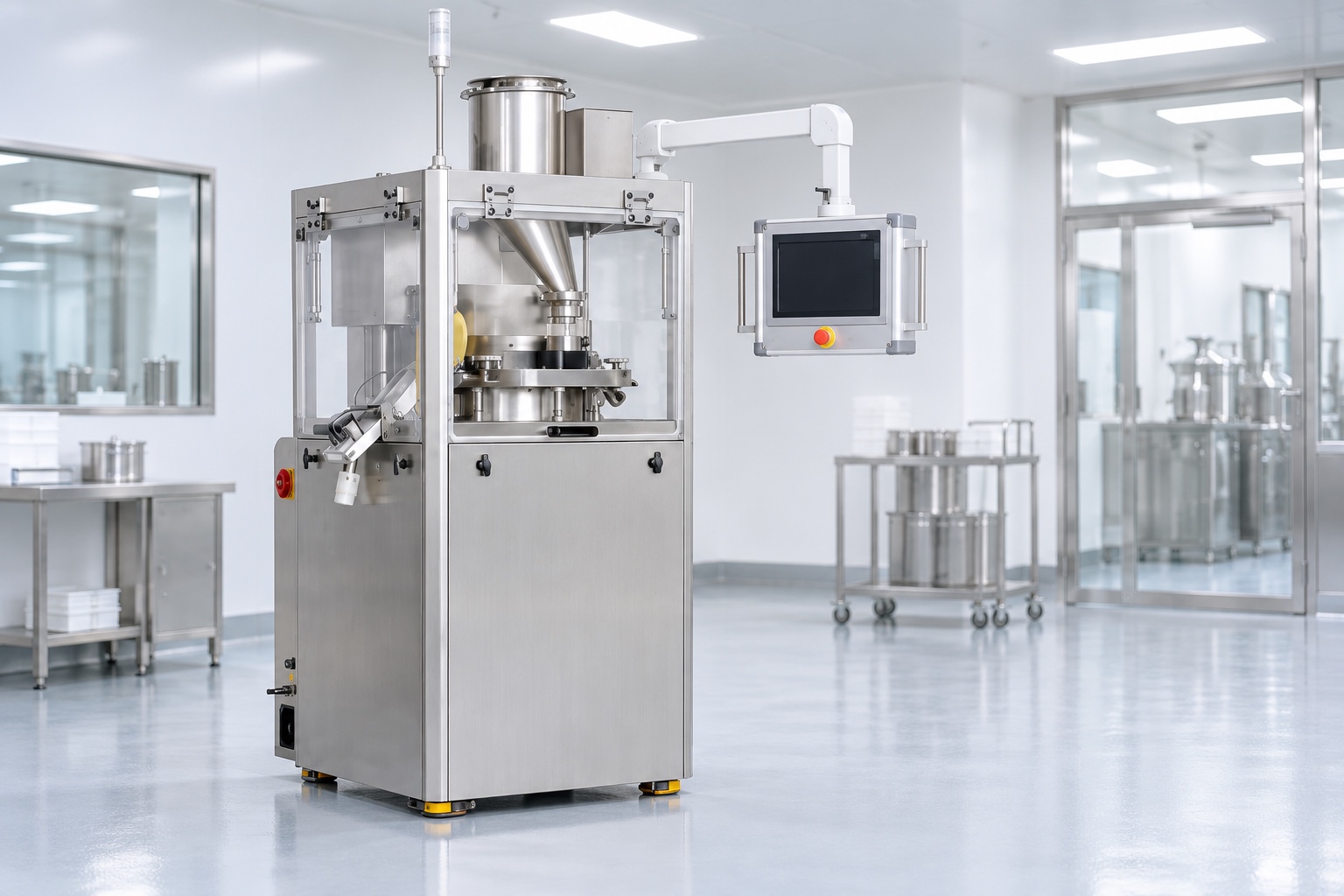
A single-sided rotary press has one tablet production path around the turret. Fimachinery’s FI-265HTP and FI-370HTP series are examples of single-sided high speed designs. Their catalog describes filling, dosing, pre-compression, main compression, and ejection within one turret rotation. This layout can be a practical starting point when the required output and tablet range fit a single production path.
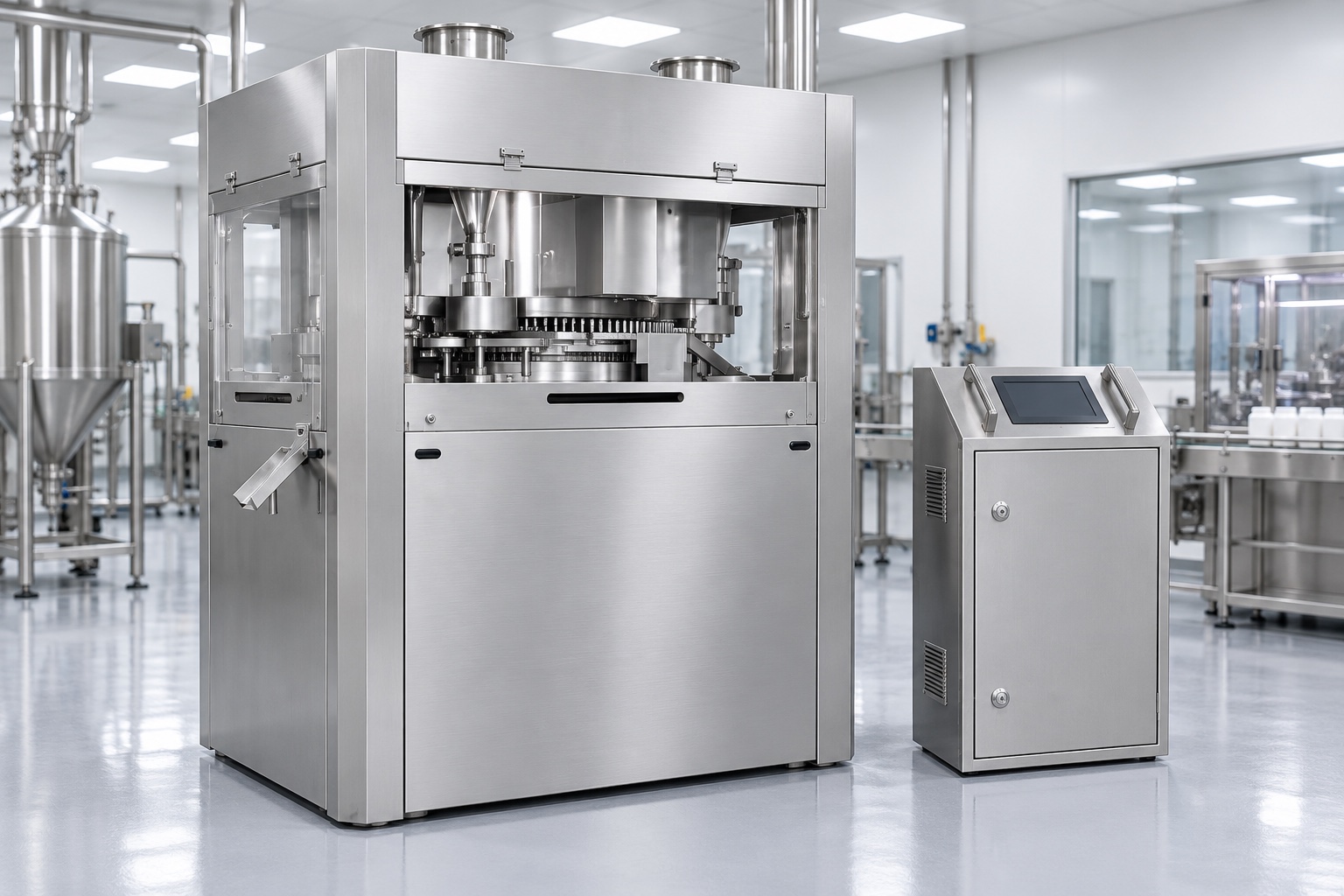
A double-sided press uses two production paths in one turret rotation. Fimachinery’s FI-1060HTP series is a double-sided high speed example. The extra path supports higher potential output, but it also adds feeding, discharge, access, cleaning, and control considerations. The right comparison is the sustained number of acceptable tablets from the full line, along with changeover and maintenance effort.
Do not confuse “double-sided” with “double-layer.” Double-sided describes where compression occurs around the turret. A double-layer tablet contains two separately fed material layers. Fimachinery’s FI-720HTP series is described as a single-sided press that can be configured for single- or double-layer tablets. If layers are part of the project, ask specifically about layer feeding, layer weight control, sampling, separation, and rejection logic.
Start With The Tablet And The Material
Define the tablet before comparing machine speeds: intended diameter and shape, target weight and thickness, acceptable variation, and the mechanical strength and appearance required for handling and use. Then describe the blend or granules that will enter the press. Flow, bulk density, compressibility, and any tendency to segregate or stick are as important as the target hourly quantity.
A blend that flows poorly may not fill the dies uniformly as turret speed rises. Low-density or segregation-prone material may need more filling time, a different feeder, a lower speed, or changes upstream. If tablets cap or laminate, more main compression force is not automatically the remedy. Pre-compression, dwell time, punch geometry, and formulation conditions may all need investigation.
Tooling is another early check. Confirm the punch standard, station count, maximum tablet diameter, filling depth, and the tablet shapes your project needs. These values differ among models and configurations. A machine’s largest stated diameter and fastest stated output should not be assumed to apply to the same tablet at the same time.
Calculate The Output The Line Must Actually Deliver
Work backward from the quantity of accepted tablets needed per shift. Allow for sampling, rejected tablets, material replenishment, brief stops, cleaning, and product changes. Then check whether the upstream process can feed the press steadily and whether tablet dedusting, inspection, coating, or packaging can keep up.
For example, a press with ample theoretical capacity still loses productive time if granules arrive intermittently or a downstream unit stops. A higher nominal press speed does not fix those bottlenecks. The line should be evaluated as one connected process, with clear responses to low feed, blocked discharge, and other routine interruptions.
Ask for a trial using representative material at the proposed production speed. Record the sustained output and the percentage of tablets accepted, rather than relying on a short peak-speed demonstration. Check tablet weight, thickness, strength, appearance, and any product-specific quality tests during startup, steady operation, and restart. Those observations reveal more about practical capacity than the maximum turret speed alone.
Check The Machine Around The Press
The physical installation matters as much as the main cabinet. Confirm the route through doors and corridors, floor loading, utility connections, dust extraction, and enough space to open guarding, remove tooling, clean, and maintain both sides of the equipment. For a double-sided press, access to each feeding and discharge path deserves particular attention.
Control requirements should be written down before selecting options. Decide which alarms, process measurements, user permissions, records, and interfaces are needed for the intended product and market. The word “automatic” alone does not establish that a press has closed-loop tablet weight control, automatic rejection, or the data functions your site expects.
How To Make The Final Choice
Shortlist presses against a written set of tablet, material, output, quality, space, and control requirements. Compare the exact proposed configurations, then verify the promising option through representative trials and agreed acceptance criteria. Fimachinery’s single-sided and double-sided high speed series provide different ways to meet production needs; the suitable choice depends on the tablet and the line it must serve.
A good high speed tablet press is the one that repeatedly delivers compliant tablets at the required net rate, with a process your team can operate, clean, and maintain confidently.