
Tablet Making Machine: How To Choose The Right Press
A tablet making machine sounds like a straightforward purchase until the first product trial. Two presses may both turn powder or granules into tablets, yet behave very differently with the same formulation. One may be convenient for small experiments; another may support continuous production but demand more careful feeding, tooling, cleaning, and process control. The useful starting point is the tablet you need to make and the conditions under which you need to make it.
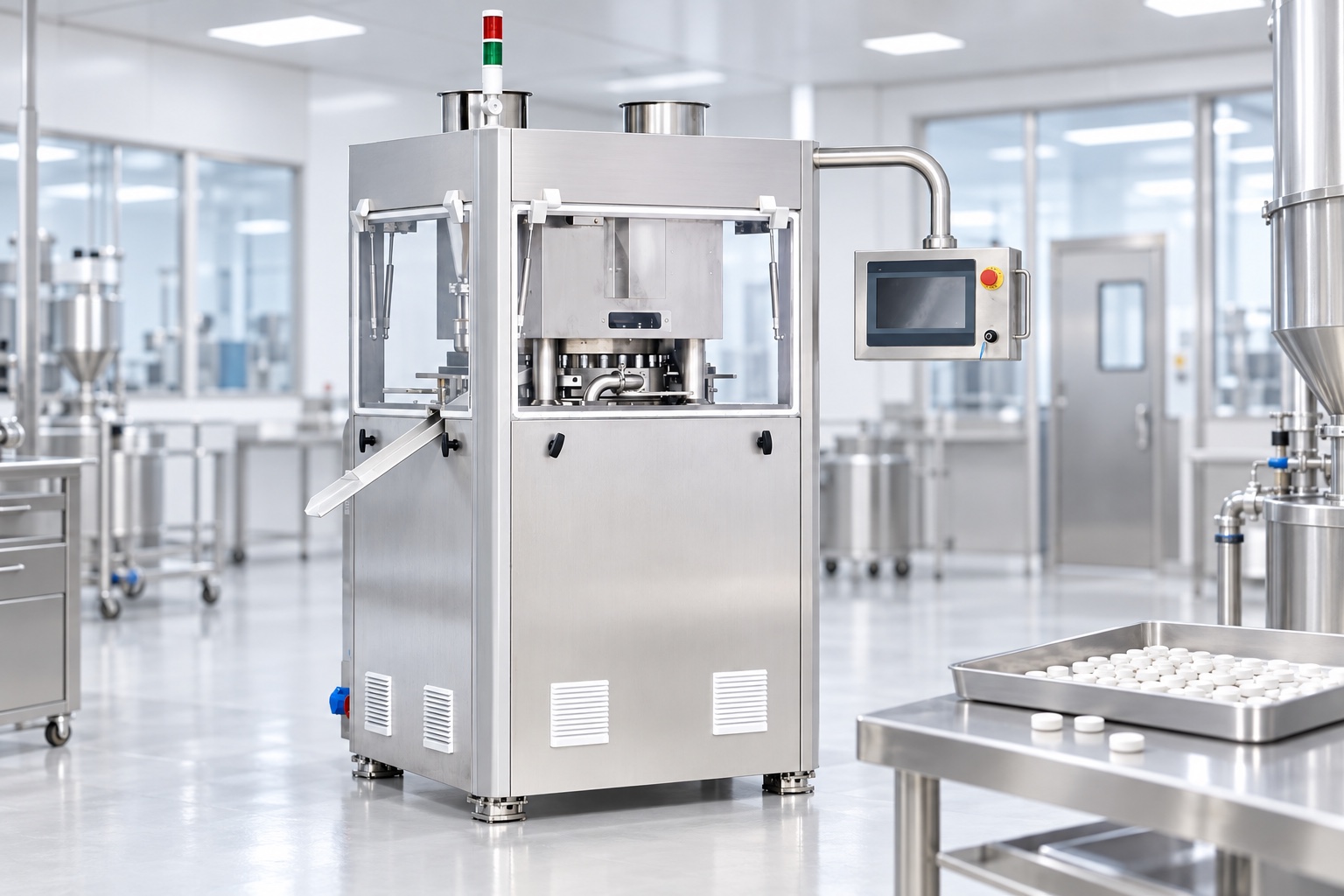
What Does A Tablet Making Machine Actually Do?
For a compressed tablet, the core machine is a tablet press. Material enters a die cavity, an upper and lower punch compress it, and the finished tablet is ejected. In a rotary press, several punch and die sets travel around a turret, repeating filling, metering, compression, ejection, and discharge. Some machines add a separate precompression stage before main compression. A single-punch press uses one punch and die set for each cycle.
That distinction matters when someone asks for a “pill maker machine.” The desired product might be a compressed tablet, a capsule, or another dosage form. Even when the product is clearly a tablet, the press may be only one part of the process. The material may also need mixing, granulation, drying, feeding, dedusting, inspection, coating, or packaging. Defining the product and the full process boundary prevents a quotation for a press from being mistaken for a complete tablet line.
Start With The Tablet And The Batch
Before choosing a machine size, describe the material and the tablet. Record the intended weight, diameter, shape, thickness, and whether the tablet is single-layer or multilayer. Note the batch size, target net output, and any limits on dust, moisture exposure, cleaning, or material handling. For pharmaceutical work, the required records, controls, and qualification scope also belong in the initial specification.
The material itself can change the answer. A powder that flows unevenly may not fill each die consistently. A formulation that sticks to the punch face may need investigation of moisture, temperature, lubrication, tooling surface, and compression conditions. These issues cannot be settled by a catalog output figure. A representative trial with the intended material is far more informative.
Single-Punch Or Rotary: Match The Work, Not The Label
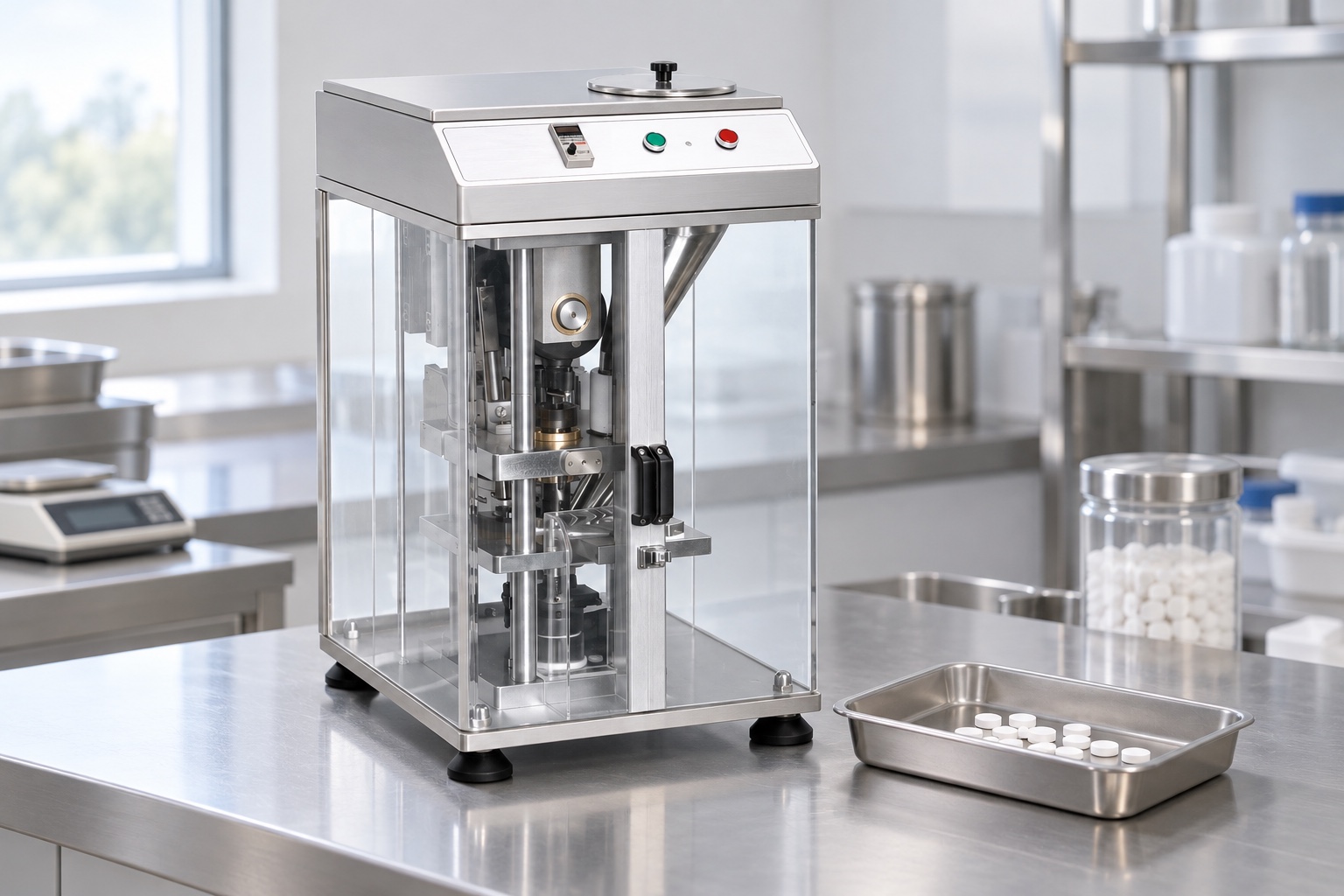
A single-punch machine is a practical choice when the task is small-scale feasibility work or a limited quantity of tablets. The compression cycle is easy to observe, and tooling changes are relatively direct. Fimachinery's FI-1STP is a single-punch model in its tablet equipment range. The trade-off is lower throughput and, in many single-punch setups, less extensive automatic monitoring than a production rotary press.
A rotary pill press machine carries multiple punch and die sets around a turret. It is the more relevant architecture when tablets must be produced continuously at a larger scale. Fimachinery lists FI-226TP and FI-420TP rotary series, alongside higher-speed FI-265HTP, FI-370HTP, FI-720HTP, and FI-1060HTP series. Those names identify different equipment families; they do not by themselves establish which machine suits a particular formulation or what sustained output it will achieve.
The decision is not simply “small versus fast.” If you plan to transfer a formula from development to production, compare tooling, filling behavior, compression speed, dwell time, and ejection conditions. Settings from a single-punch trial cannot simply be copied to a rotary press, because the material experiences a different feeding and compression cycle.
Why Rated Speed Is Only A Starting Figure
Rotary press output depends on the number of effective stations, turret speed, and compression paths. Yet the usable rate also depends on how reliably material enters the dies, whether tablets meet quality requirements, how many units are rejected, and whether downstream equipment can keep up. Increasing turret speed shortens the time available for filling and compression. A machine's highest stated output is therefore not the same as its proven net output with your product.
Ask for a trial at the speed and duration that reflect your production plan. Watch for changes over time, not just an attractive first sample. Check tablet weight variation, thickness, mechanical strength, friability, appearance, and any product-specific tests such as disintegration or dissolution. If the project calls for them, examine compression and ejection trends as well. Stable tablet weight alone cannot prove that every ingredient is distributed uniformly.
What A Useful Machine Trial Should Reveal
A worthwhile trial begins with a documented material sample, tooling drawing, and agreed acceptance criteria. Record the material batch, moisture condition, particle characteristics, tooling, feed settings, turret speed, fill depth, precompression and main compression settings where applicable, and the results from the finished tablets. This gives a basis for explaining a poor result instead of merely adjusting pressure until a tablet looks intact.
If weight fluctuates, check whether the pattern is random, linked to a particular station, or concentrated during startup. If tablets stick or show damaged edges, look at the material, tooling condition, ejection, and discharge path together. A trial should also expose practical work: how the press is cleaned, how tooling is changed, how dust is collected, and how tablets are separated during startup or after an interruption.
Turn The Trial Into A Clear Purchase Specification
Once the product has been tested, compare machines against the same written requirements. Confirm the punch and die format, tablet size range, achievable net output with the representative material, required utilities, operator access, cleaning method, and any monitoring or reject functions that are actually included. If automatic weight control, individual-station monitoring, or data records matter, ask for each function explicitly rather than relying on the word “automatic.”
For a line project, specify the interfaces around the press as carefully as the press itself. Upstream supply must keep the feeder stable; downstream dedusting, inspection, coating, or packaging must handle the tablet stream. The slowest stage will govern the line's usable throughput.
The right tablet making machine is the one that can repeatedly make your specified tablets at the required quality and net rate, with a cleaning and control approach your team can operate. Share the tablet drawing, material characteristics, batch size, and target output with Fimachinery before narrowing the model choice. A focused trial will answer more than a comparison of maximum speeds.