
Pill Press Machine: Choosing A Tablet Press That Fits
A pill press machine may look like a straightforward way to turn powder into tablets, but the machine alone does not determine whether a batch will run well. A press that makes a good tablet slowly in a demonstration may struggle at production speed, while a fast machine can still deliver poor output if the material does not feed or compress consistently. The useful starting point is the tablet you need to make and the conditions under which you need to make it.
In pharmaceutical equipment, “pill press” usually refers to a tablet press or tablet compression machine. It compresses a measured amount of powder or granules inside a die using upper and lower punches. If the intended product is a filled capsule or a traditional formed pill, that is a different equipment question. Clarifying the dosage form first prevents a vague machine name from driving the purchase.
Single-Punch Or Rotary: Choose By The Work
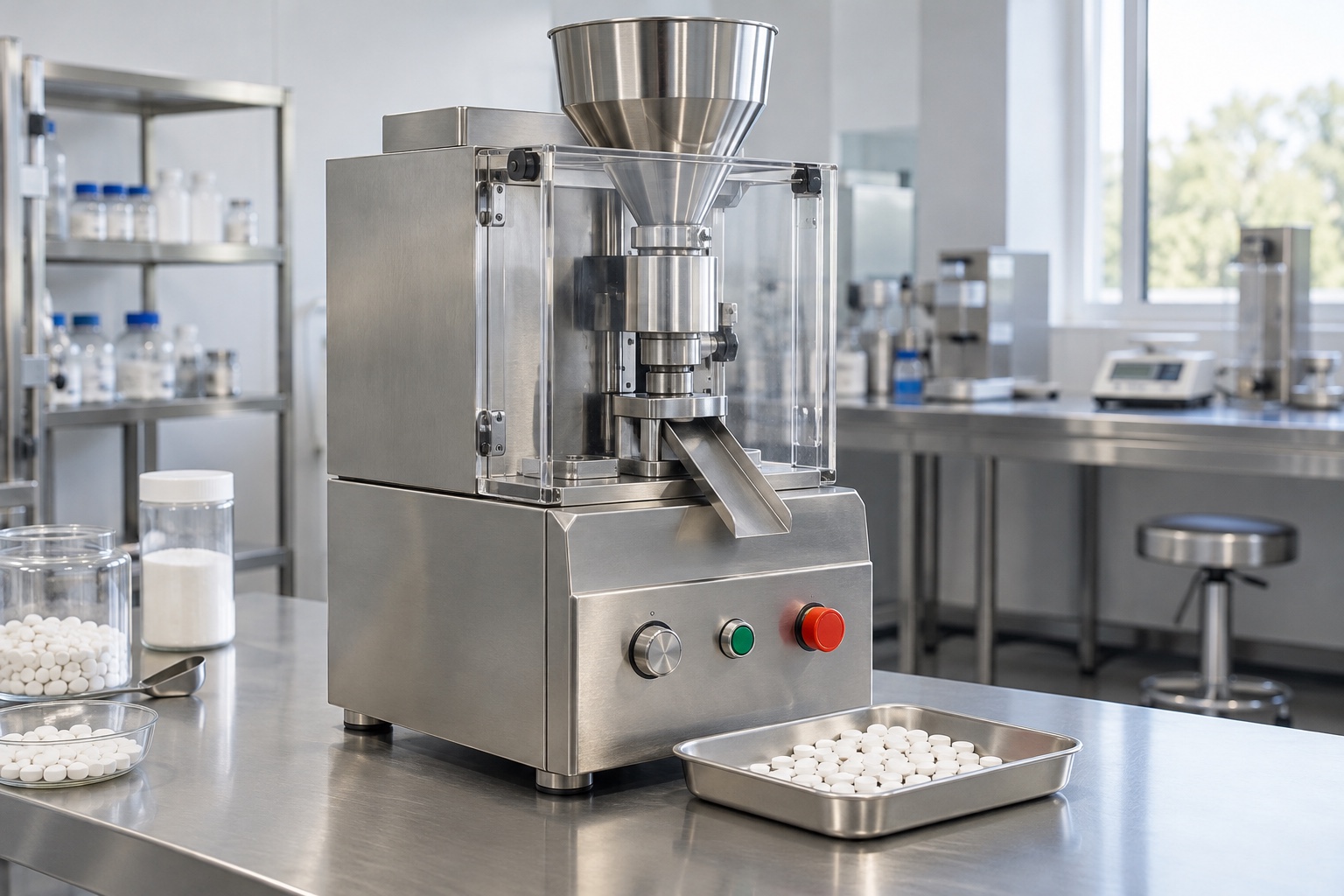
A single-punch press uses one set of upper punch, lower punch and die to produce one tablet per cycle. Its relatively simple mechanism makes it useful for feasibility trials, teaching, development and low-volume tasks. It can also make changes easier to observe. It should not be judged as a small version of a production rotary press: feeding conditions, compression speed, data capture and sustained output may differ substantially.
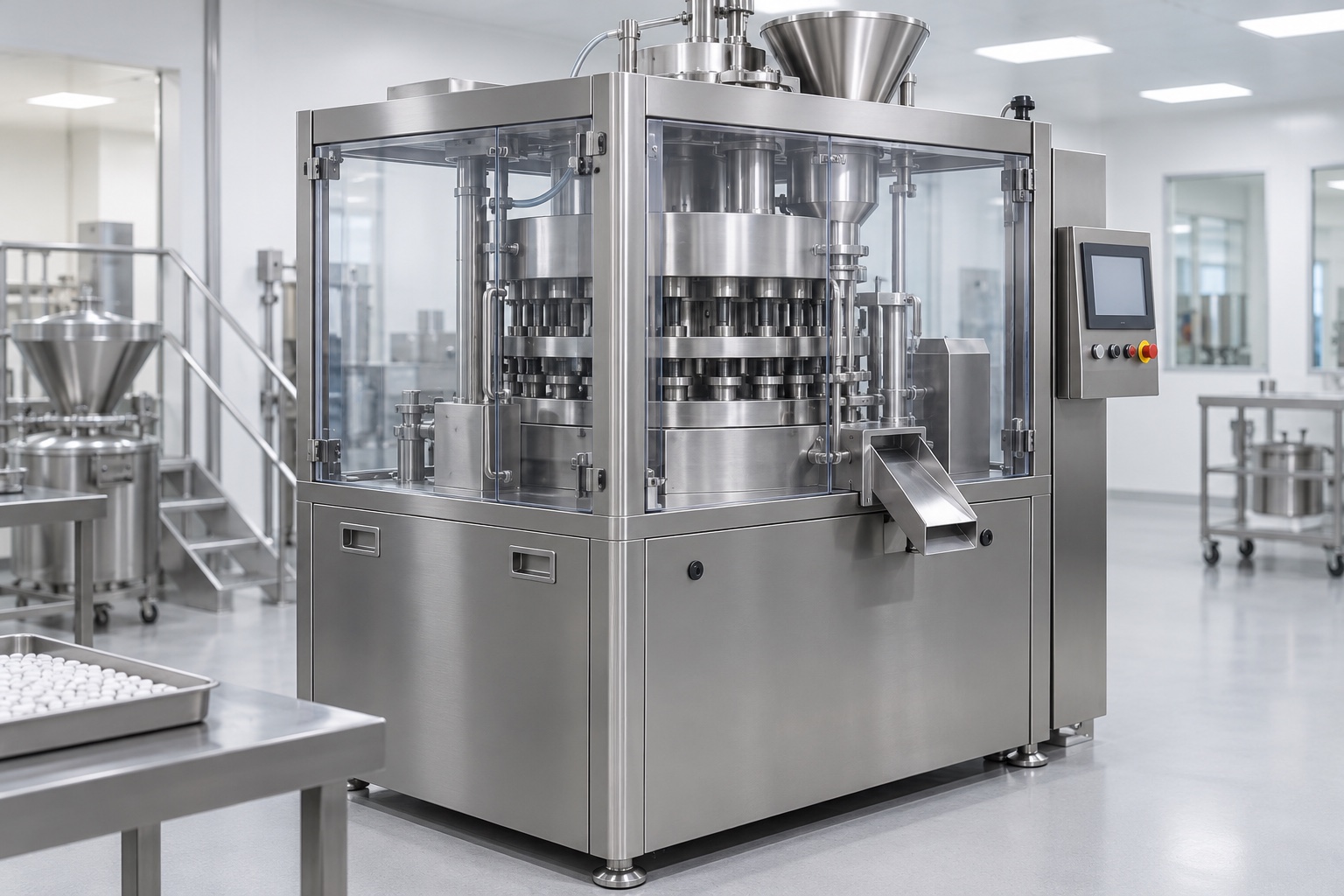
A rotary tablet press carries multiple sets of punches and dies around a turret. Each station passes through filling, metering, compression, ejection and tablet discharge. Depending on the model, the cycle may also include precompression. This arrangement supports a continuous stream of tablets, but the number of stations and the advertised maximum speed are only part of the capacity story. Feeding, powder behavior, inspection, rejected tablets, cleaning and downstream handling all affect usable output.
Write Down The Tablet Before Comparing Machines
Start with the target tablet diameter, shape, weight and whether it has a score, logo or multiple layers. Add the intended batch size, net tablets needed per shift and the products expected to share the equipment. Then describe the feed material: is it a free-flowing granule, a fine powder, or a blend that changes with moisture or handling? Those differences affect how consistently the die fills and how the compact behaves when pressure is released.
The user requirement should also cover the production room, electrical supply, dust handling, cleaning method, operator access, required records and the destination market. A request for an “automatic” press is too broad unless it specifies which tasks must be automatic. Continuous cycling, weight feedback, sampling, defect rejection and cleaning are distinct functions; availability must be confirmed for the quoted model and configuration.
Ask About Net Output, Not Just A Speed Figure
Rotary press capacity is often expressed using turret stations, rotation speed and compression paths. That calculation gives a theoretical rate. It does not include start-up, sampling, rejects, stoppages, changeover or the speed at which a particular formulation still meets its quality targets. A double-sided press can create two compression paths per revolution, but that does not mean every product can run at twice the accepted output of a single-sided one.
Request a trial with representative material at a proposed operating speed. The trial should record the tooling, feed and compression conditions alongside tablet weight, thickness, strength, friability and appearance. For a pharmaceutical product, the applicable product quality requirements may also include content uniformity, disintegration or dissolution. A short trial proves only what was actually tested; it does not establish long-run performance on its own.
Tooling And Quality Control Belong In The Comparison
The punch tip and die cavity determine much of a tablet’s physical form. A tooling quotation should identify the upper punches, lower punches and dies, as well as the tablet drawing and the machine with which they must work. Similar-looking tooling is not automatically interchangeable across presses. Key dimensions, orientation, working length, die fit and permitted loads need to be checked against the specific turret and machine version.
Quality control is equally concrete. Stable tablet weight is useful, but weight alone cannot prove uniform active content if a blend separates during feeding. Ask which process values the press actually measures, which alarms or rejects it can perform, and how those functions are tested. Average compression force, for example, may hide a problem at one turret station. Monitoring and rejection claims should be tied to a defined test rather than inferred from a touchscreen or an “automatic” label.
Make Acceptance Part Of The Decision
Before ordering, agree on the machine configuration, tooling, documentation and acceptance tests. A factory acceptance test can check the agreed functions, safety interlocks, alarms, controls and a representative material run before shipment. At the installation site, the equipment and utilities still need to be checked in their actual setting. Production performance must then be confirmed under the intended product and operating conditions.
The strongest pill press machine choice is the one that can be explained in terms of a specific tablet, representative material, realistic net output and an agreed quality test. If a supplier’s proposal cannot connect those four points, ask for the missing evidence before comparing its price or headline speed with another press.