
What Is A Tablet Press? Parts, Process, And Types
A tablet press turns a measured portion of powder or granules into a solid tablet by compressing it inside a die. If you are comparing equipment for a new product, the useful question is not simply how hard the machine can press. It is whether your material can fill the die consistently, form a sound tablet, and leave the machine without damage.
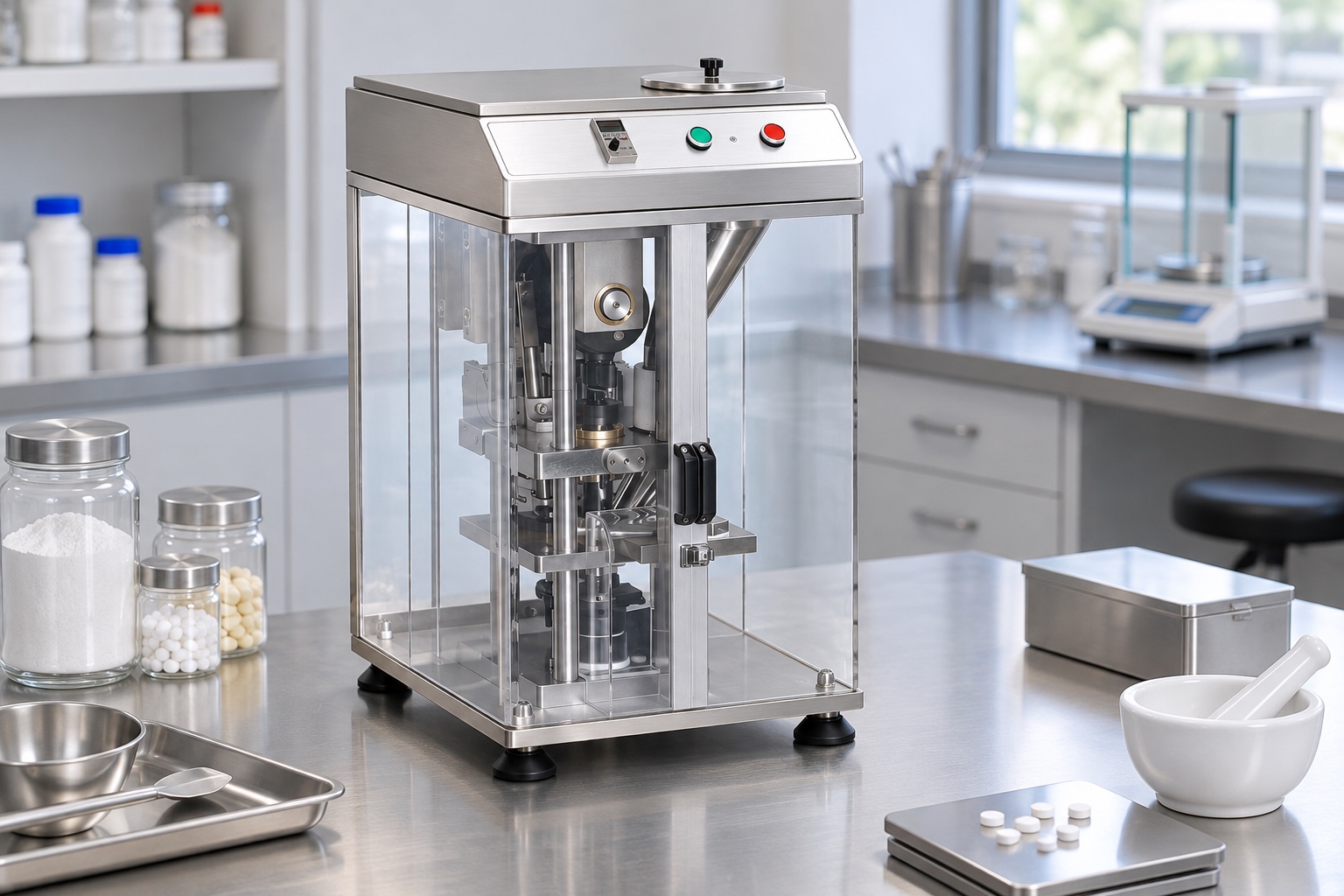
The basic forming unit has three pieces: an upper punch, a lower punch, and a die. The die defines the tablet's outline. The punches move toward one another to compact the material, then the lower punch lifts the tablet out. A hopper and feeding system bring material to that forming unit; cams, rollers, or other drive mechanisms coordinate its movement. That is the core of what is a tablet press, whether the equipment has one station or many.
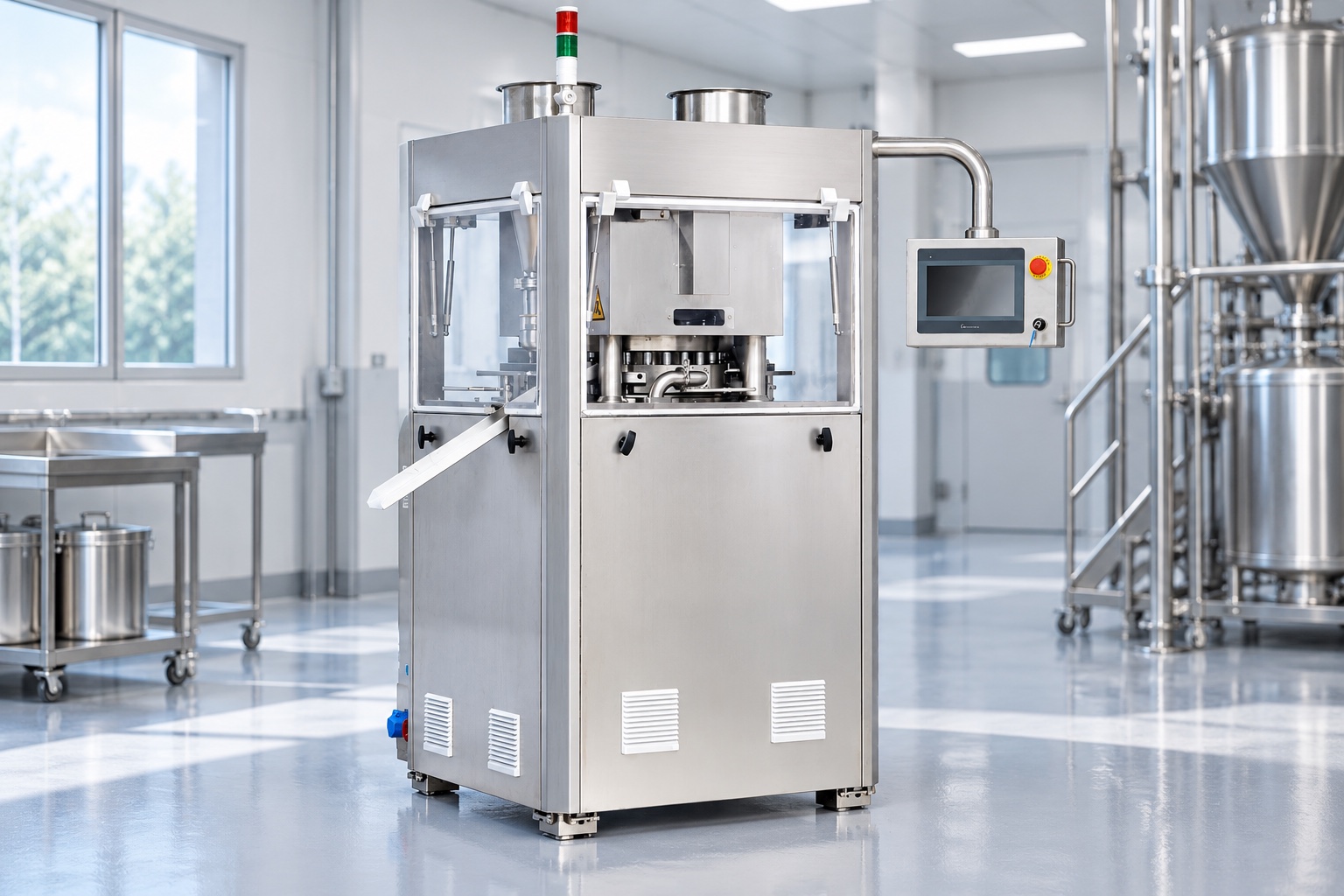
How Does A Tablet Press Work?
In a typical cycle, material enters the die cavity above the lower punch. The machine meters the amount retained in the cavity, compresses it between the punches, releases the load, and raises the finished tablet for discharge. On a rotary press, several punch and die sets travel around a turret and repeat this sequence continuously. Some rotary machines add a lighter precompression stage before the main compression to help the powder bed rearrange and release trapped air. That stage depends on the machine's configuration.
Filling matters as much as pressing. Lowering the bottom punch creates more room in the die, but the resulting tablet weight also depends on bulk density, flow, and how completely the cavity fills. A material that bridges in the hopper or feeds unevenly can produce weight variation even when the fill setting stays fixed. Increasing turret speed may shorten the time available for filling, so a higher theoretical output does not always produce more acceptable tablets.
During main compression, the punches compact the powder bed. The chosen force works together with the material's compressibility, lubrication, and time under load. More force is not a universal fix: the resulting tablet still has to meet its own requirements for weight, thickness, strength, appearance, and performance. After the load is released, the tablet can spring back slightly. The lower punch then raises it to die level, and a take-off blade guides it toward the discharge chute.
The Parts You Can Identify On A Machine
Start at the material path. A hopper holds the prepared blend. A feed shoe or feeder directs it into the die. The upper and lower punches, together with the die, shape the tablet. On a rotary model, the turret carries multiple tooling sets past the filling, compression, and ejection areas. Cams guide punch movement; compression rollers apply load; the ejection cam and take-off blade move the finished tablet out of the press.
These names help when you inspect a machine, but similar-looking presses can have different feeder designs, tooling standards, controls, and cleaning boundaries. A touchscreen alone does not establish that a press measures force at every station, adjusts tablet weight automatically, or rejects individual tablets. Those functions need to be confirmed in the specification for the exact model and configuration.
Single-Punch Or Rotary: Which Type Fits The Job?
A single-punch press makes a tablet with one punch and die set in each cycle. Its mechanism is relatively easy to observe and adjust, which makes it useful for early trials, teaching, and low-volume tasks. The trade-off is lower output and, often, less process monitoring than a production rotary press. A successful small trial is a starting point for scale-up, not proof that the same settings will work on a faster machine.
A rotary tablet press carries many tooling sets on one turret. As each station passes the feeder and compression area, tablets emerge in a continuous stream. Rotary equipment spans small research machines through production models; “rotary” alone does not tell you its capacity or control level. A single-sided rotary press has one main compression path. A double-sided design commonly uses two paths around the turret to increase output per revolution. Neither term tells you whether the press can make two-layer tablets, which requires separate filling and control capabilities.
Where Does The Press Fit In Tablet Production?
The press forms tablets from material prepared for compression. Depending on the formulation, that preparation may include blending and lubrication or a separate granulation process. The need for granulation comes from the material and process, not from the machine's name. After pressing, tablets may pass through dedusting, inspection, coating, counting, or packaging equipment. Those are separate operations, even when the line connects them closely.
This distinction is useful when someone asks for a “pill machine.” They might mean a tablet press, a capsule filling machine, or an entire manufacturing line. A tablet press makes a compressed solid tablet. A capsule filler places material inside a preformed capsule shell. A tablet counter handles products that have already been made. Clarifying the dosage form and the operation prevents an equipment comparison from starting in the wrong category.
What Should You Check Before Choosing One?
Begin with the tablet and material: intended shape and size, target weight, blend flow, compressibility, sensitivity to sticking or ejection, and the quality checks the finished product must pass. Then define the production task: batch size, acceptable net output, operating schedule, and any expected changeovers. These details reveal whether a simple trial press, a research rotary machine, or a production rotary press deserves closer evaluation.
Next, compare the exact tooling, filling range, pressure capability, feeder, access for cleaning, dust control, safety features, and available process data. Check how the press will connect to upstream supply and downstream equipment. A high stated tablets-per-hour figure is only a machine rating; the useful measure is the rate of acceptable tablets that the full process can sustain.
For a project discussion with Fimachinery, a sample tablet drawing, representative material information, target output, and the required inspection and documentation needs are more useful than a request for the “best” tablet press. They give the equipment discussion a concrete product and operating context.