
How Do You Fill Empty Capsules In Production?
In industrial production, filling an empty capsule means much more than placing material inside a shell. A two-piece hard capsule has a body that receives the fill and a cap that must be separated, brought back into position, and locked. A dependable line also has to keep shells correctly oriented, deliver a repeatable dose, remove faulty units, and check the finished capsules. The practical answer to how do you fill empty capsules is therefore a controlled machine cycle, supported by the right shell, formulation, and in-process checks.
Confirm The Capsule And Formulation First
Start with the intended capsule size, shell material, closure design, and target fill. Gelatin and HPMC hard capsules can behave differently during feeding and separation. Size alone does not define the finished dose: the mass that fits in a capsule also depends on the material's bulk density and how the dosing system handles it. Powder flow, compressibility, and cohesion matter as much as the nominal capsule volume.
The filling method must match the material. Powder, granules, pellets, and small solid units do not necessarily use the same dosing hardware. A standard powder setup should not be treated as a liquid filler simply because its hopper can hold a liquid. For a production trial, record the shell specification, material condition, target net fill, and the acceptance checks before adjusting the machine.
The Automatic Filling Cycle
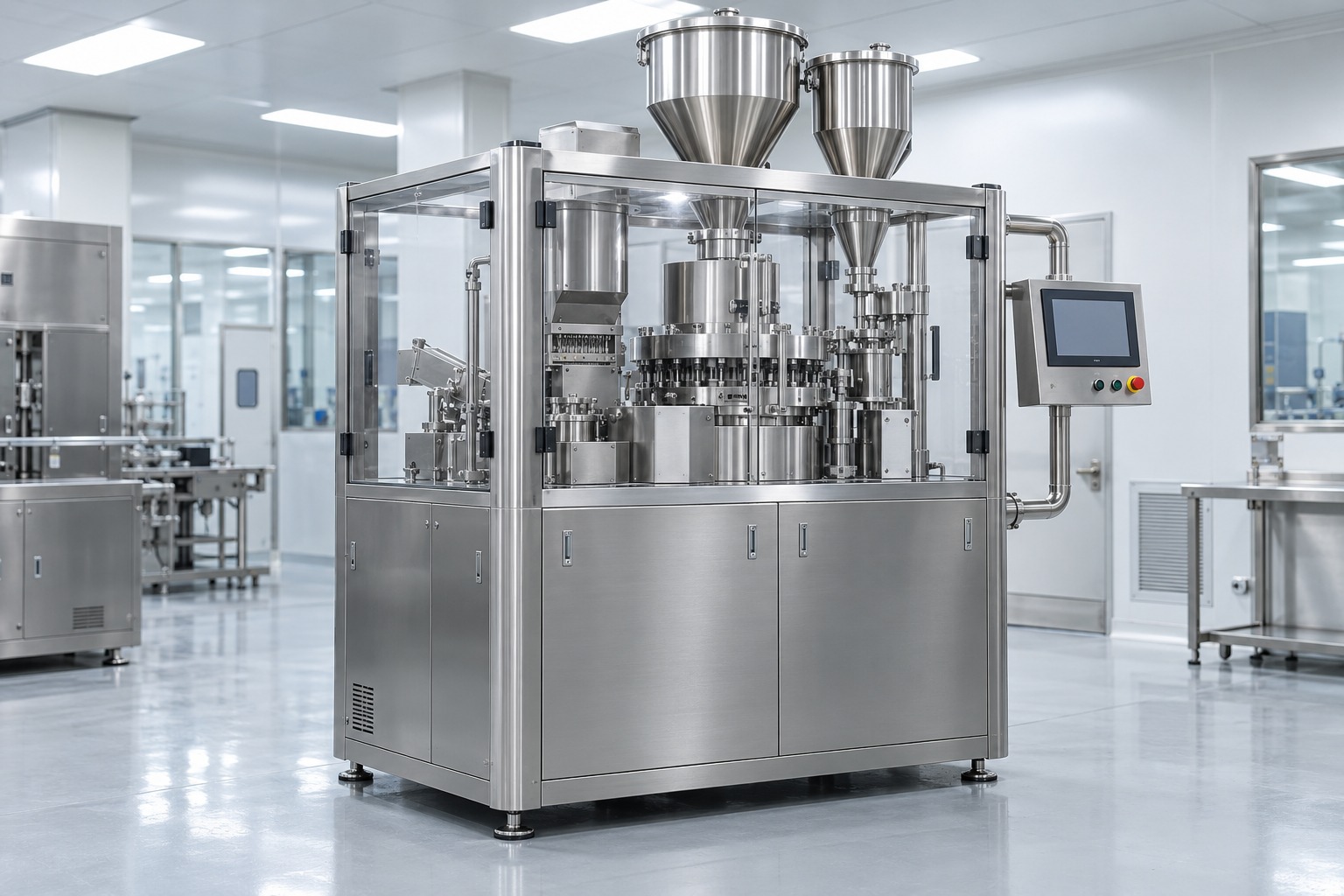
A fully automatic hard capsule filler feeds empty shells from a hopper and orients them so the caps and bodies enter the correct machine positions. At the separation station, the two parts are pulled apart. An empty position, a shell that fails to separate, or a damaged shell must be identified before it can become a finished product.
The open bodies then reach the dosing station. In a tamping-disc powder system, successive tamping actions form a powder plug that is transferred into each capsule body. The measured result depends on the powder bed, dosing components, and powder properties, so settings that worked for one material batch should be checked again when the material changes. Fimachinery's NJP-1200, for example, uses a multi-station cycle with powder dosing, defect rejection, capsule locking, discharge, and mold-hole cleaning. Its powder station compacts material in five stages before transfer.
After dosing, the machine realigns the bodies with their caps, presses them to the specified locked position, and ejects the finished capsules. It then clears the empty mold holes for the next cycle. Locking depth matters: a loose cap can separate later, while excessive pressure can deform or crack the shell.
Where Semi-Automatic Equipment Fits
Semi-automatic production keeps the key filling operations mechanized while an operator transfers capsule rings or trays between stations. A typical cycle orients the shells, separates caps from bodies, moves the bodies to a dosing station, then recombines and locks the filled capsules in batches. This is still equipment-led industrial production, with defined tooling, setup, and quality checks.
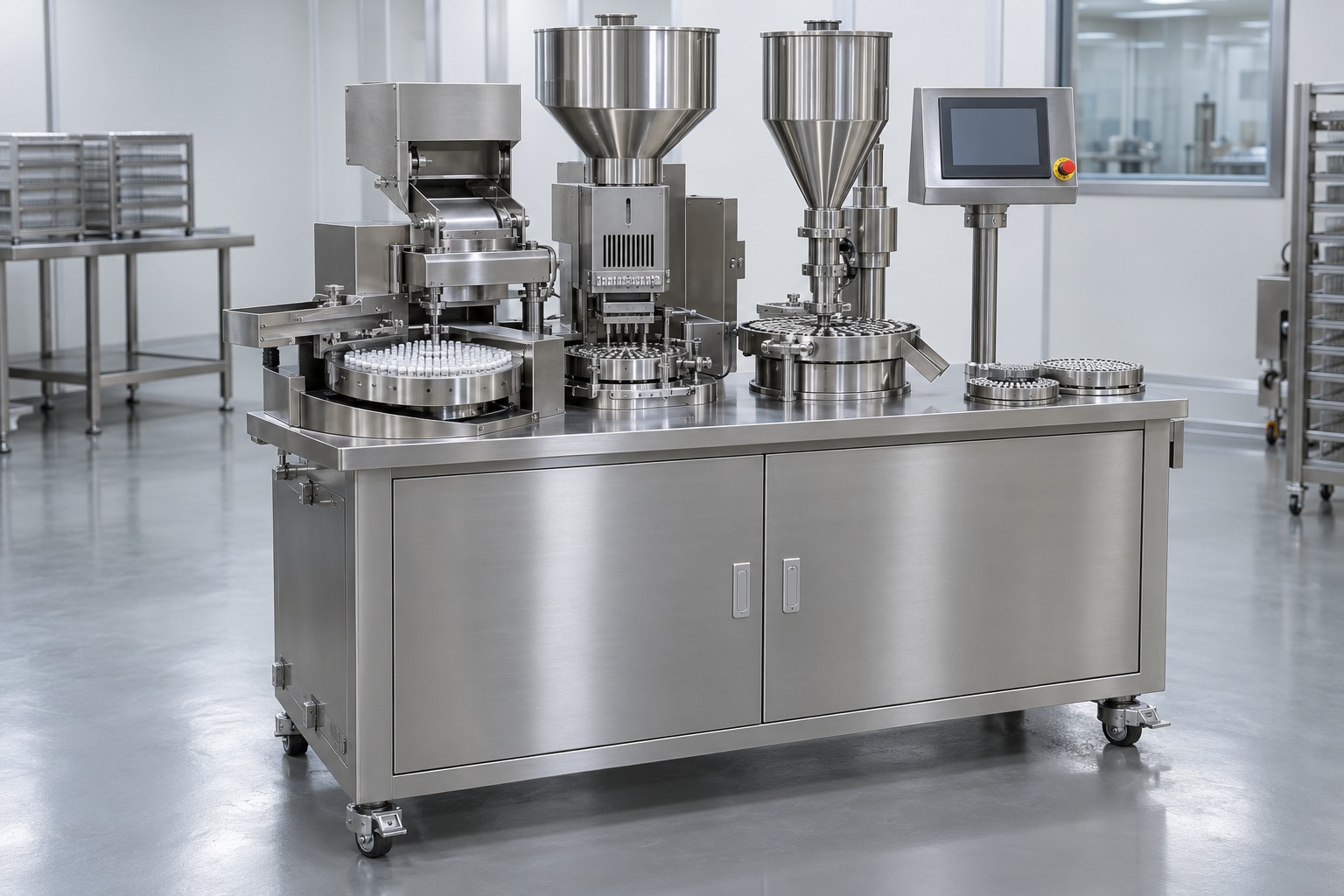
Fimachinery's FI-SCF series is a semi-automatic powder capsule filling range that performs capsule positioning, separation, filling, and locking. It can suit a plant that needs batch flexibility and can staff the transfer between stations. For higher continuous output, Fimachinery also offers fully automatic powder capsule filling models, including the FI-1200CF series. Compare these options using qualified net output over a full run, not a brief machine-speed demonstration: loading, transfers, sampling, rejects, and changeovers all affect the usable total.
Check What The Machine Actually Filled
A filled-looking capsule is not proof of the correct dose. For powder products, net fill can be estimated by subtracting the weight of the corresponding empty shell from the filled capsule's weight. Shell weight variation and the sampling method affect that calculation. Products with low-dose ingredients, multiple components, or a risk of segregation may need content testing as well as weight checks.
Inspect the closure and exterior, too. Look for empty capsules, loose caps, cracked or deformed shells, trapped powder at the joint, and powder residue outside the shell. Confirm that the machine detects and removes rejected capsules from the accepted stream. At start-up, after a refill or stop, and during recovery, isolate or assess capsules made before the process is stable according to the site's validated procedure.
If Results Drift, Check The Cause Before Increasing Speed
Poor separation can begin with shell condition, humidity exposure, incorrect change parts, vacuum settings, or dirty filters. Variable fill can come from changes in powder flow or bulk density, unstable material level, or dosing settings. Repeated loose caps point to the closure setup or shell fit. These are process signals, not reasons to keep turning up the machine and hoping the next tray will pass.
For an industrial run, the useful question is whether the same shell and formulation produce acceptable capsules continuously at the planned rate. Confirm the size-change parts, material feed, separation, dosing, locking, rejection, and cleaning steps together. That gives a production team a sound basis for choosing a semi-automatic or fully automatic Fimachinery capsule filler and for keeping its output consistent from batch to batch.