
How To Fill Pill Capsules In Industrial Production
In a production setting, filling hard capsules is a coordinated machine cycle. Empty shells must be oriented and separated, a measured quantity of material must enter each body, and the cap must lock without damaging the shell. A line can look busy while still producing inconsistent capsules, so the useful question is not just whether the machine runs. It is whether the filled capsules meet the product's defined checks over a sustained run.
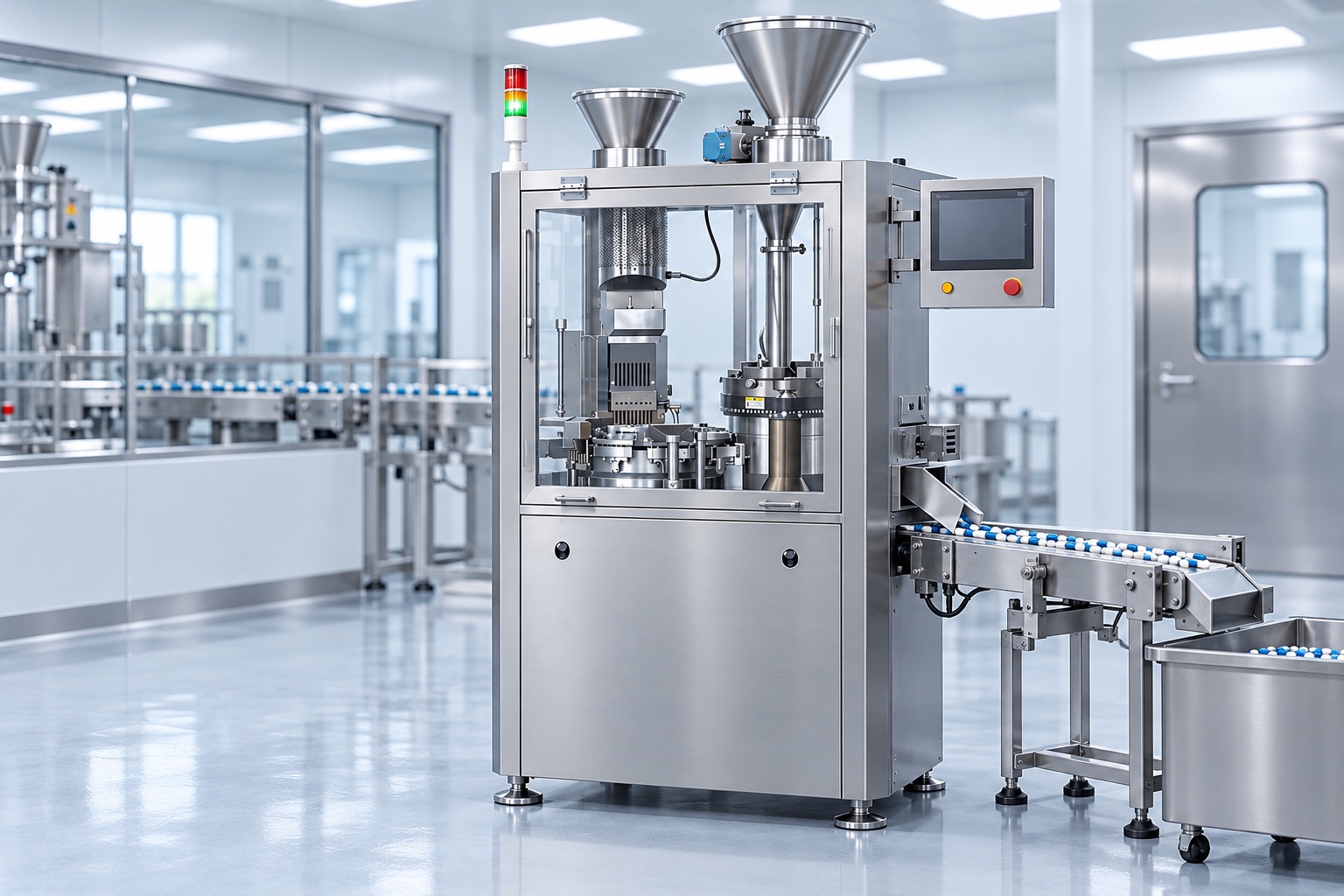
For anyone asking how to fill pill capsules at scale, the starting point is a two-piece hard capsule and equipment matched to the material inside it. Fimachinery offers automatic powder capsule fillers in its FI-CF range and semi-automatic powder machines in the FI-SCF series. The right setup depends on the shell, formulation, required output, and controls the product needs.
Prepare The Shell, Material, And Machine Format
A hard capsule has a longer body for the fill and a shorter cap that closes over it. Before a run, confirm the shell size and material, then fit the matching machine parts. A size change can involve more than a control-panel setting: modules, guides, filling components, and locking positions may all need attention. Trial capsules should separate, fill, and close cleanly before full production begins.
The fill material needs its own assessment. Powder flow, bulk density, compressibility, cohesion, particle size, and static behavior can all affect how consistently a measured volume becomes a measured mass. A formulation that worked in one batch may require fresh checks after a material change. Keep the material and shell specifications tied to the approved product procedure rather than assuming a machine setting alone guarantees the dose.
How An Automatic Capsule Filler Completes The Cycle
Empty capsules feed from a hopper into an orientation system, which places each cap and body in the correct position. At the separation station, vacuum or a mechanical device opens the two pieces. A missing, damaged, or unsplit shell should be identified and removed according to the machine's configured rejection process before it becomes a filled defect.
The open bodies move to the dosing station. For powder, a tamping-disc system can form a powder plug through successive compression steps and transfer it into the capsule body. The dosing-disc geometry, powder bed, tamping depth, and powder properties influence the resulting fill. Other materials call for different metering methods: pellets may use a measured chamber, while tablets or minitablets require counting and presence checks. A powder machine should not be treated as a universal filler for liquids or solid units.
After dosing, the body and cap realign and the locking station closes them to the required position. Finished capsules are ejected, while the machine clears the empty pockets for the next cycle. Locking too lightly can leave loose caps; forcing the closure can deform or split a shell. That is why the closing stage needs its own inspection, even when the fill weight is on target.
Where A Semi-Automatic Machine Fits
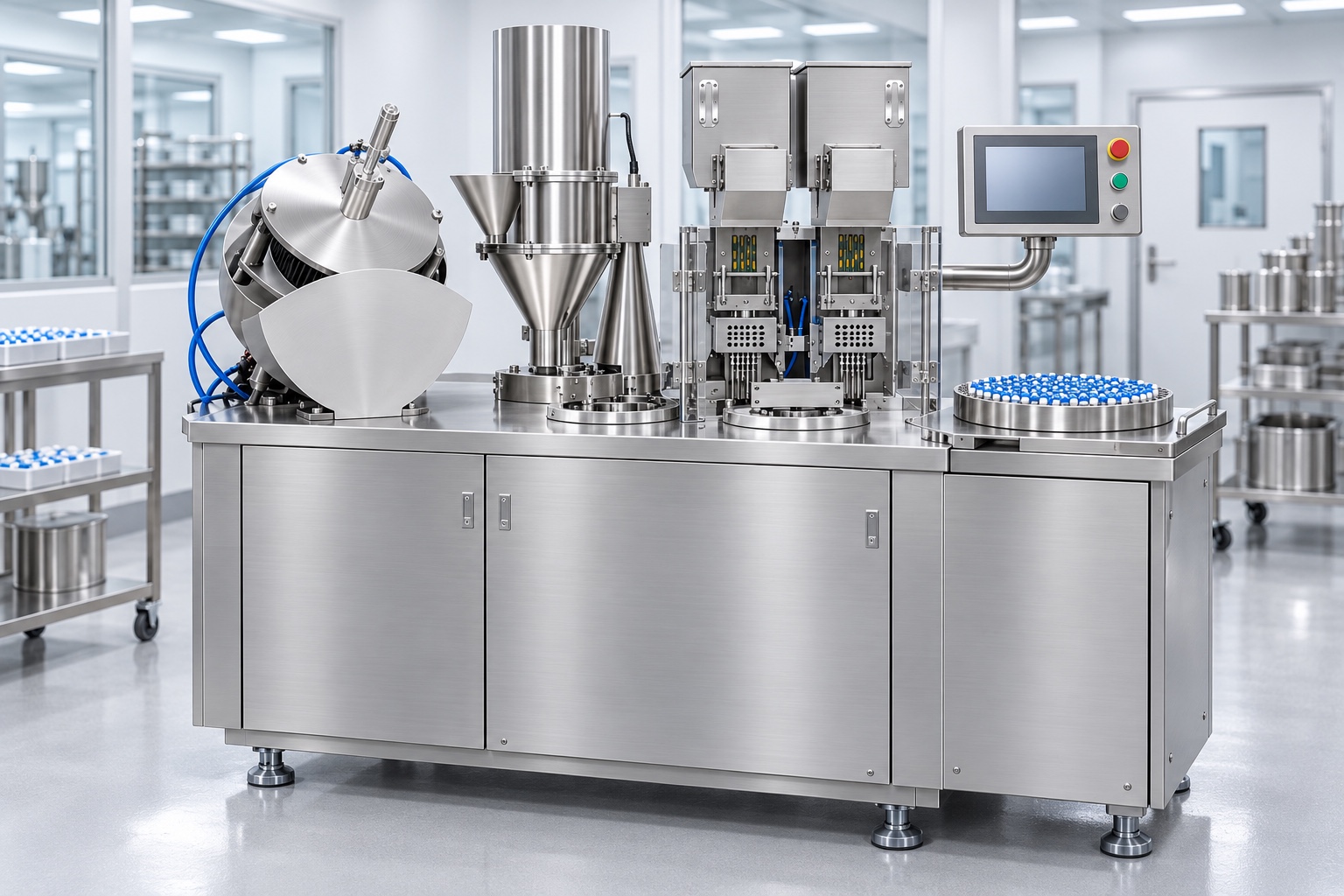
Fimachinery's FI-SCF series provides a semi-automatic route for powder capsules. The equipment handles capsule positioning, separation, filling, and locking. An operator transfers the capsule ring or tray between machine stations and manages the batch flow; the dosing operation remains machine-assisted. This makes the station sequence and transfer rhythm part of the production plan.
For a semi-automatic setup, evaluate the actual number of acceptable capsules produced over a complete operating period. Shell size, powder behavior, station balance, changeover, cleaning, and rejected units all affect net output. The same principle applies to an automatic line: a headline machine rate is less useful than sustained, qualified production with the intended shell and material.
Check The Capsules That Leave The Machine
Start with appearance and closure. Look for missing or loose caps, cracks, dents, powder trapped at the seam, empty shells, and residue on the outside. A capsule polisher or sorter may be added downstream; Fimachinery's FI-2CP, for example, combines polishing with the separation of light, empty, and broken capsules. Polishing improves the outside of a capsule, but it does not establish that the fill inside is correct.
Net fill weight is assessed by comparing the filled capsule mass with an appropriate empty-shell mass. Because empty shells vary, the sampling and pairing method matters. Review both the average and the spread of individual results rather than relying on a batch average alone. Where active content could vary independently of total weight, the product's specified content test is needed as well. Visual inspection and weight checks answer different questions.
During a run, trend defects and fill results by time and station. If cap-and-body separation begins to fail, check the vacuum path, separation position, and shell condition. If fill weight drifts, investigate powder feed, material behavior, and dosing settings. If closed capsules are loose or crushed, check the locking alignment and position. Stop and resolve an abnormal condition before treating additional output as acceptable.
Choose The Process Around The Product
An equipment discussion is more productive when it starts with a real shell, real material, target fill, and acceptance method. Test the complete sequence: shell feed, separation, dosing, closure, ejection, rejection, cleaning, and the response to missing shells or material. Record the good capsules produced across a representative run, together with defects and stoppages.
That approach gives a practical answer to how to fill pill capsules in industrial production. Use a matched automatic or semi-automatic filler, confirm each stage of the cycle, and judge the process by the quality of the capsules it consistently delivers. Fimachinery's FI-CF and FI-SCF equipment provide two production paths; the formulation and required controls determine which path is suitable.