
How To Fill Capsules With Herbs For Industrial Production
A herbal capsule batch can run smoothly at startup and still develop uneven fill weights after a refill or a change of raw-material lot. For manufacturers, learning how to fill capsules with herbs means establishing a repeatable process around the powder, capsule shell and dosing system. The practical sequence is to characterize the prepared herbal blend, confirm capsule and tooling compatibility, establish stable machine feeding and dosing, then verify fill weight, closure and sustained output.
Fimachinery offers the FI-SCF semi-automatic powder capsule filling series and FI-CF fully automatic powder capsule filling models, including FI-800CF and FI-1200CF. These provide different levels of automation for industrial production. Choosing between them starts with how the actual formulation behaves during a representative production trial.
Understand The Herbal Material Before Setting The Machine
The name of a herb tells you little about its filling behavior. A milled botanical powder and a dry extract can differ in particle size, bulk density, moisture response and adhesion. Fibrous material, low-density powder and lot-to-lot variation deserve particular attention when developing a herbal capsule process.
Begin with the blend that will actually enter production. Record its material lot, particle-size characteristics, bulk density and moisture condition, together with the target fill weight. For a multi-ingredient formulation, assess blend uniformity as well as flow. These observations give the machine trial a useful baseline and help explain why the same settings may produce different results with a new lot.
Watch how the blend feeds during the trial. Powder that accumulates in the hopper or reaches the dosing area unevenly needs investigation before the filling settings are repeatedly changed. Adjusting the machine to compensate for every material fluctuation makes it harder to identify the underlying cause.
Match Capsule Size To The Tested Fill Weight
Capsule size defines an available volume. It does not establish a universal weight for every herbal powder. The amount a formulation can reliably occupy depends on its density and its behavior under the selected dosing and compaction conditions.
Test the proposed shell with the actual blend and target weight. Confirm that the machine can fill and close it consistently at the intended operating conditions. If the target cannot be achieved reliably, review capsule size, formulation and dosing conditions together before committing to a production setup.
Shell material also matters. Gelatin and HPMC shells can behave differently during feeding, separation and locking. A shell change should therefore include checks of machine handling and finished-capsule quality, even when the nominal capsule size remains the same.
Use the manufacturer's complete change-part set for the chosen machine and capsule size. Check the specified positioning, dosing and locking components rather than assuming that replacing the capsule-holding parts alone completes the changeover.
Choose Semi-Automatic Or Fully Automatic Filling
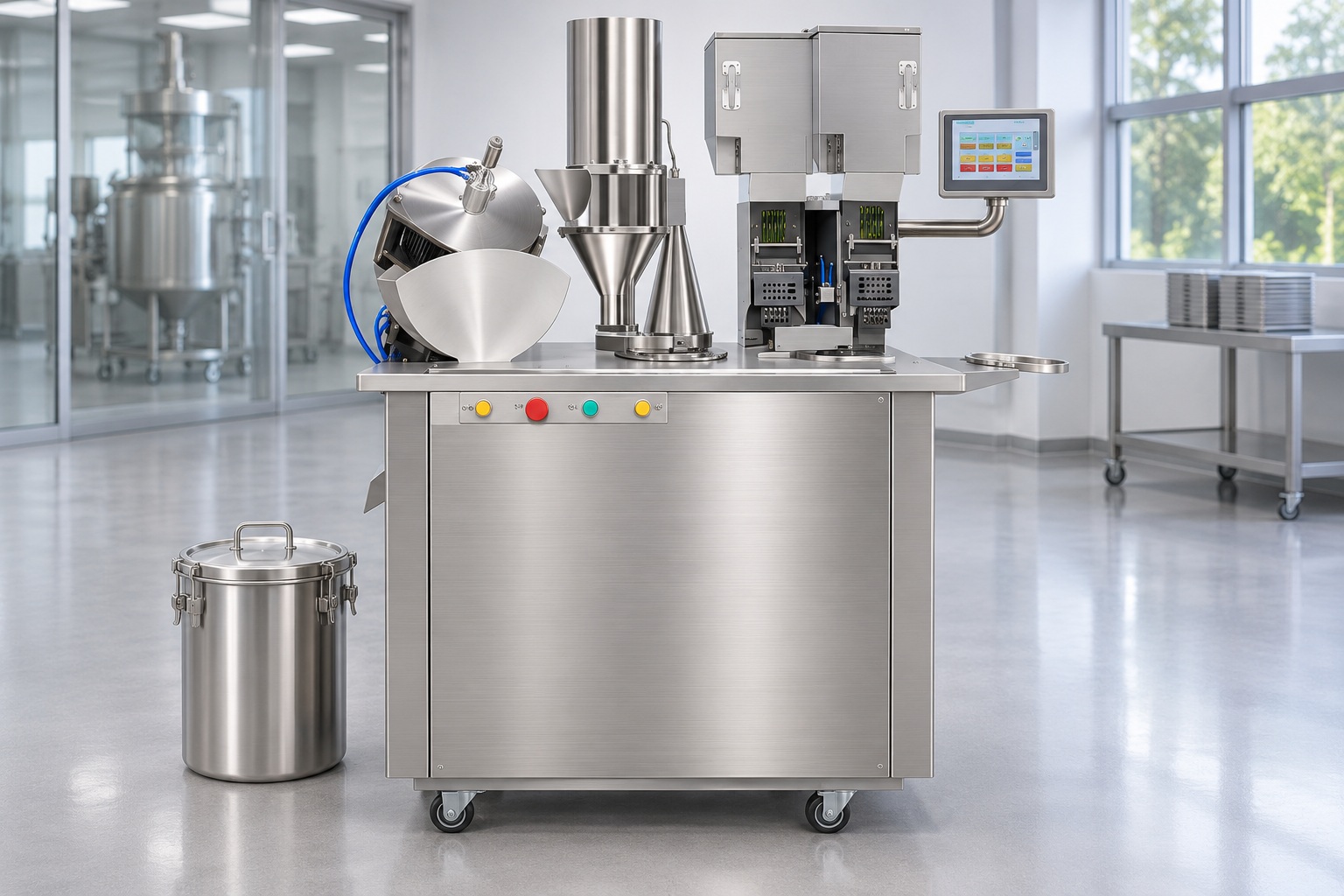
The FI-SCF series supports capsule positioning, separation, filling and locking for smaller industrial batches. It is an option to evaluate when production involves multiple formulations or frequent changeovers. Assess its practical output over a complete operating period, including replenishment, checks, changeover and cleaning.
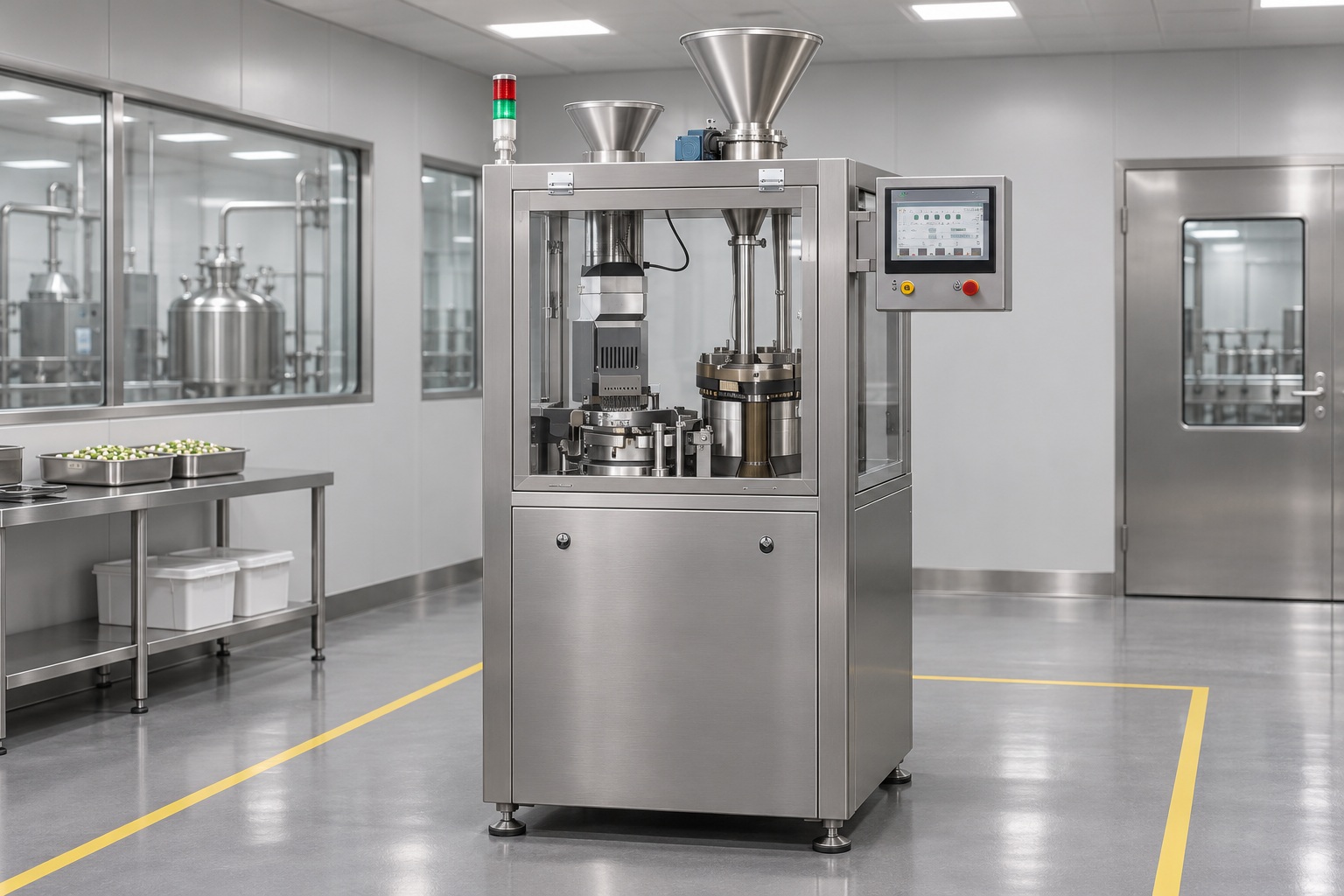
For larger production campaigns, Fimachinery's FI-800CF and FI-1200CF fully automatic powder capsule filling machines combine capsule feeding, separation, powder filling, rejection, locking, finished-capsule discharge and die-hole cleaning in an automatic cycle. A trial should establish how these functions perform with the proposed herbal blend and shell.
A herbal capsule machine should be selected by sustained acceptable output. Compare the number of conforming capsules produced over an agreed trial duration, along with stoppages, rejects and powder loss. A short demonstration with an easy-flowing material cannot establish the performance of a different commercial formulation.
When transferring a process from semi-automatic to fully automatic equipment, develop the filling conditions on the receiving machine. Differences in the powder bed, dosing action, compaction and available filling time mean that the previous settings cannot simply be copied.
Establish A Stable Filling Cycle
Before adding powder, confirm the machine's cleaning status, capsule size, shell material, change parts and dosing assembly. Check the required vacuum, compressed air, dust extraction and protective functions against the machine instructions and approved batch procedure.
An empty-shell run allows the team to check feeding, orientation, cap-and-body separation, rejection, locking and discharge before introducing the formulation. After a changeover, use the manufacturer's permitted setup mode to confirm that the installed parts move without interference.
Introduce the blend at a controlled operating speed and establish stable feeding and powder-bed conditions. Then adjust the relevant dosing settings while recording the resulting fill weights. Change one relevant condition at a time and allow the process to settle before judging the result.
Increase speed only after the capsule path, fill weight and closure are stable. Recheck them at the intended production rate. Startup, replenishment, falling material level and restart after a stop can produce different conditions from steady running; define how the affected capsules will be checked, segregated or rejected.
For teams evaluating how to fill capsules with turmeric, the same trial method applies to the actual turmeric formulation. Results from another botanical blend do not establish its achievable fill weight, settings or production rate.
Check Fill Weight And Capsule Closure Separately
Use net fill weight to evaluate the amount of formulation in each capsule, accounting for the shell through an appropriate weighing method. Finished gross weight alone includes shell-weight variation and can make the filling result harder to interpret.
Review individual results as well as the average. Samples taken across the agreed trial should show whether the process remains consistent through refills, short stops and changes in material level. Record the spread of results and any capsules outside the product's acceptance limits.
For multi-component herbal blends, consistent weight does not by itself demonstrate consistent ingredient distribution. The product's analytical strategy should address composition where required. Machine adjustment and product testing answer different questions.
Inspect closure independently. Look for loose caps, cracks, deformation, powder trapped at the cap-and-body joint and abnormal finished length. A capsule with an acceptable fill weight can still have a closure defect.
If downstream polishing and sorting are included, evaluate their performance with the filled capsules. Fimachinery's FI-2CP combines polishing with sorting of light, empty and broken capsules. That function supports the production process, while the product's fill-weight and composition checks remain separate requirements.
Plan Cleaning And Changeover Around The Herbal Blend
Adhesive or moisture-sensitive residues can make changeover more demanding. Include the powder hopper, dosing components, capsule-holding parts, discharge path, dust-extraction connections and difficult-to-reach product-contact areas in the cleaning procedure.
Use a cleaning method compatible with the material and machine components, and confirm drying before reassembly. For shared equipment, evaluate residual material and cross-contamination according to the products involved. Visible cleanliness alone may not demonstrate that the required residue limits have been met.
Inspect change parts, seals and product-contact surfaces during reassembly. Maintain vacuum and extraction filters as specified, because blockage can affect capsule separation, hole cleaning and powder control. Before returning the machine to production, confirm alignment, movement, dosing and closure with the checks required after the changeover.
Define What A Successful Production Trial Must Prove
Give Fimachinery the intended capsule size and shell material, representative herbal blend, target fill weight, batch size and required production schedule. Include the available utilities, cleaning expectations and downstream equipment so that the trial reflects the proposed installation.
Agree on a trial duration and acceptance criteria before testing. Record the machine configuration, material lot, operating settings, refill events, stoppages, rejects and conforming net output. Include challenges to the specified detection, rejection and protective functions rather than observing normal operation alone.
The resulting records should show whether FI-SCF semi-automatic equipment or a fully automatic powder capsule filling model can support the required production plan. They also provide a basis for setting the operating range and identifying what needs to be checked when the herbal material, shell or batch conditions change.