
How To Fill Gelatin Capsules On An Industrial Line
An industrial gelatin capsule filling process starts with preformed two-piece shells. The machine separates each cap from its body, meters the filling into the body, closes the capsule and discharges it for further inspection and handling. Reliable production depends on keeping those operations consistent throughout the batch.
For a production team deciding how to fill gelatin capsules, the practical challenge is matching the shell, powder and machine settings. A line may separate empty capsules correctly yet produce variable fill weights once powder is introduced. It may also reach its target speed while losing usable output through damaged shells or loose caps. Each stage needs its own checks.
Confirm The Shell And Filling Before Setting The Machine
This process uses hard gelatin capsules with a separate cap and body. The filling machine handles shells that have already been manufactured. It does not form the gelatin shell during filling.
Confirm the capsule size, supplier specification and locking design before choosing the format parts. Capsules with the same nominal size still need to be checked for feeding, separation and closure when the shell supplier or material changes.
Storage and production conditions matter, too. Low humidity can increase brittleness in some gelatin shells, while high humidity or moisture-sensitive formulations can contribute to softening, sticking or dimensional changes. Use the shell supplier's storage conditions and establish an operating range that suits both the shell and the formulation. A single humidity setting should not be applied to every gelatin capsule project.
For powder filling, evaluate flow, bulk density, particle size and compaction behavior. The capsule's internal volume alone does not determine how much powder it will hold. A change in powder density or its ability to form a stable plug can change the fill weight even when the machine settings stay the same.
Match The Level Of Automation To The Production Schedule
Fimachinery's FI automatic powder capsule filling range includes models such as the FI-800CF and FI-1200CF. The automated cycle coordinates capsule feeding, separation, powder filling, rejection, locking, discharge and hole cleaning. For sustained industrial output, the selection should consider the formulation and downstream handling alongside the filling machine itself.
The FI-SCF series provides a semi-automatic option for industrial batches. Its equipment carries out capsule positioning, separation, filling and locking through dedicated stations. Production planning should account for the balance between these stations, batch size and changeover frequency.
Choose between these arrangements using representative capsules and powder. Compare acceptable finished output over a defined run, including stops, rejects and cleaning requirements. The highest machine speed is only useful if the line maintains the required fill and closure quality.
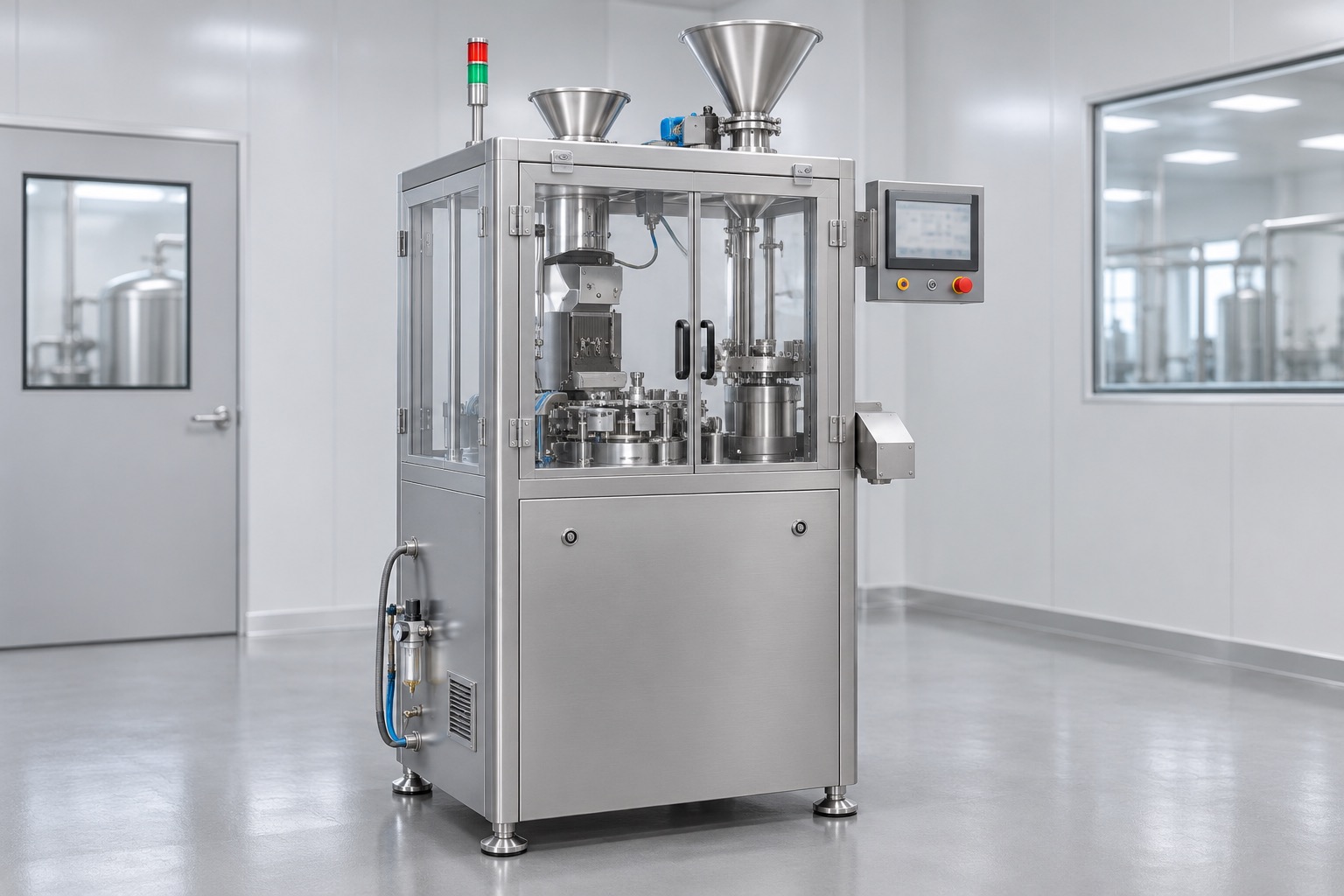
Prepare The Machine For The Selected Capsule Format
Before loading product, confirm that the capsule format parts, dosing components and cleaning status match the batch. Inspect vacuum, dust extraction, compressed air where required, and the machine's protective systems.
A capsule size change can affect more than the upper and lower segments. Depending on the machine, the change may also involve orienting parts, forks, guides, locking components, dosing discs and filling rods. Use the parts list for the specific model and configuration rather than assuming that one replacement component completes the changeover.
After installation or maintenance, trained personnel should check the mechanical cycle in the mode permitted by the equipment instructions. Any abnormal resistance needs investigation before production continues. Then run empty shells to confirm feeding, orientation, separation, closure and discharge before introducing powder.
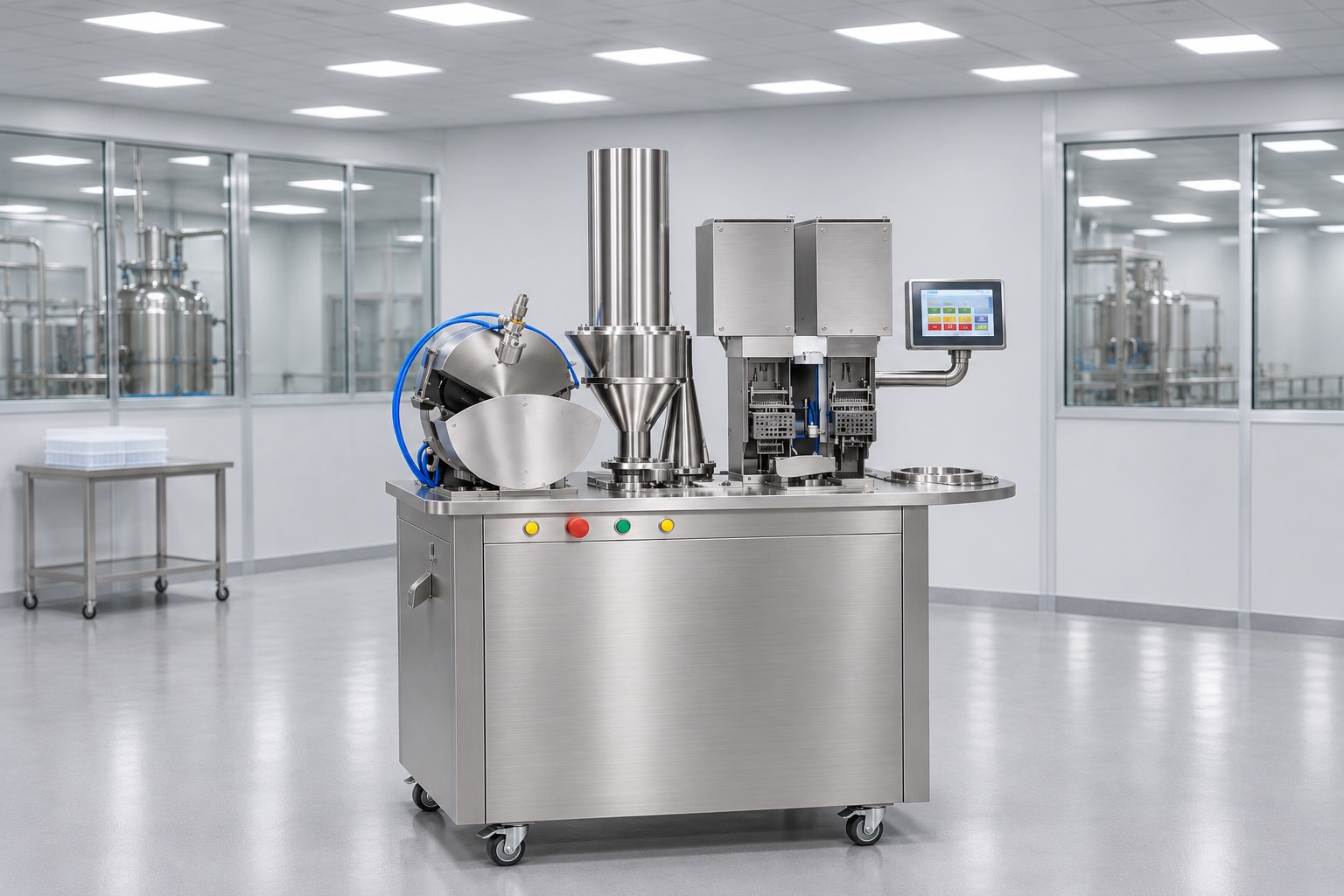
Feed, Orient And Separate The Gelatin Shells
Empty capsules travel from the capsule hopper into the orienting mechanism and then into the upper and lower segments. These segments hold the cap and body in position while the separation system opens the shell.
Consistent separation leaves an open capsule body ready to receive its fill. Unseparated or deformed capsules need to be removed through the machine's configured rejection process.
When separation becomes unreliable, inspect the shell condition, format alignment, vacuum path and filters. Increasing vacuum alone may not solve the problem. Excessive vacuum or poor alignment can damage the shell, while insufficient vacuum or a blocked line can leave the cap and body joined.
If a new shell batch begins to crack or stick, check its storage history and the room conditions as well as the machine. Repeatedly changing machine settings can conceal a shell problem without resolving it.
Establish Stable Powder Metering
Knowing how to fill capsules with powder means understanding how the selected dosing system forms and transfers each portion. In a tamping-disc arrangement, powder enters holes in a dosing disc, filling rods progressively compact it into plugs, and those plugs are transferred into the capsule bodies.
The dosing disc, powder-bed height, filling-rod settings and powder properties work together. The goal is a portion that transfers reliably and meets the required fill weight. Increasing compaction is not a universal fix for low or variable weight.
Establish a stable powder supply before adjusting the dose. Keep the feed level and powder bed within the range established during trials. Change one relevant setting at a time and compare the resulting samples. If weight drifts as the hopper empties, investigate feeding and powder behavior before continually correcting the dosing settings.
Measure net fill weight using an appropriate empty-shell correction. Total capsule weight includes the shell, whose own weight can vary. Record the sampling method so that results from different points in the run can be compared meaningfully.
Close The Capsule And Check Its Condition
After filling, the upper and lower segments realign. The locking mechanism pushes the cap and body to the required closed position, and the finished capsule leaves the machine.
Check the closed length and the relationship between the cap and body. Loose caps, splits, dents and powder caught at the joint can indicate problems with alignment, locking settings, shell condition or powder handling. Set the closure against the shell specification and the machine instructions.
Recheck closure after a format change or a change in shell supply. An acceptable weight reading cannot confirm that the capsule is mechanically sound.
Keep Downstream Handling Separate From Fill Verification
Fimachinery's capsule equipment range also includes polishing and sorting options. These can remove exterior dust and, with the appropriate configuration, separate light capsules, empty shells or fragments.
Polishing does not verify every capsule's fill weight. Likewise, a sorting air setting needs to be checked against the actual product: a setting that removes empty shells may also reject acceptable capsules if it is unsuitable for that shell and fill.
Plan the transfer from the filler to polishing, inspection and packaging so that downstream restrictions do not interrupt the main machine. Evaluate usable output across the connected equipment rather than relying on the nominal speed of one unit.
Confirm The Process With A Representative Production Trial
Use the intended gelatin shells, formulation, format parts and operating conditions for the trial. Observe feeding and separation, measure net fill weight and its variation, inspect locking and shell damage, and record rejects and interruptions over the agreed run.
Include the start of the batch, steady operation, restarts and the batch end in the sampling plan. These conditions can expose problems that a short stable run misses. Weight checks establish filling consistency; product-specific quality testing is still needed to establish the required finished-product quality.
For a Fimachinery equipment discussion, provide the shell size and supplier specification, powder characteristics, target fill weight, batch size, output requirement and planned downstream equipment. Those details allow the automatic or semi-automatic configuration to be evaluated against the production task and give the trial clear conditions to prove.