Where Can I Buy A Capsule Filling Machine For Production?
“Where can I buy a capsule filling machine?” is a sensible question, but the production job should shape the answer. An industrial filler must handle your actual capsule shell and formulation, deliver an acceptable fill, and fit the way your line runs. A machine listing can show a model and a maximum output, but it cannot tell you whether the quoted configuration will work with your material or what support comes with the purchase.
There are several sensible buying routes: approach an equipment supplier through its official product and contact pages, work with an authorized local distributor, or ask a line integrator to source and coordinate the filler with surrounding equipment. Whichever route you choose, the seller, equipment manufacturer, commissioning team, and spare-parts provider should be named in writing. That gives you a clear answer to both where to buy and who will be responsible after delivery.
Start With A Supplier You Can Verify
An official product page is a useful starting point for an inquiry, not proof that every advertised feature is included in your quotation. Fimachinery lists the FI-SCF series for semi-automatic powder capsule filling. Its product materials describe capsule positioning, separation, filling, and locking. The FI-CF range covers fully automatic powder filling. These are different production arrangements, so ask for the exact model, current revision, included stations, and available capsule-size parts before comparing offers.
You can also purchase through a distributor or a system integrator when local commissioning or integration is important. In that case, confirm the relationship between the contract seller, brand owner, actual manufacturer, installer, and service provider. Request the legal names and addresses that will appear on the contract, machine nameplate, invoices, and technical documents. If an intermediary claims authorization, ask for a current document that identifies the relevant product range and territory.
Some buyers consider a used or refurbished machine. Its lower initial price should be weighed against missing change parts, mechanical wear, unsupported controls, incomplete documentation, and the work needed to requalify it for your process. Record the serial number and machine configuration before treating a used offer as comparable with a new one.
Define The Capsule And The Production Target
Before requesting prices, specify the empty-shell supplier, shell material, capsule size, color, and locking design. State whether the fill is powder, granules, pellets, tablets, or another material. A powder machine is not automatically suitable for a liquid or combination product. For a powder project, provide the target net fill mass, acceptable variation, material flow behavior, batch size, number of shifts, and required net output.
Automation level needs the same care. A semi-automatic filler can suit controlled production batches and frequent changeovers when its station transfers and staffing fit the schedule. A fully automatic machine coordinates more operations within a continuous cycle, but its practical output still depends on stable shell and powder supply, rejects, cleaning, and downstream capacity. Ask each supplier to describe what the operator does at every stage, rather than relying on the words “automatic” or “semi-automatic” alone.
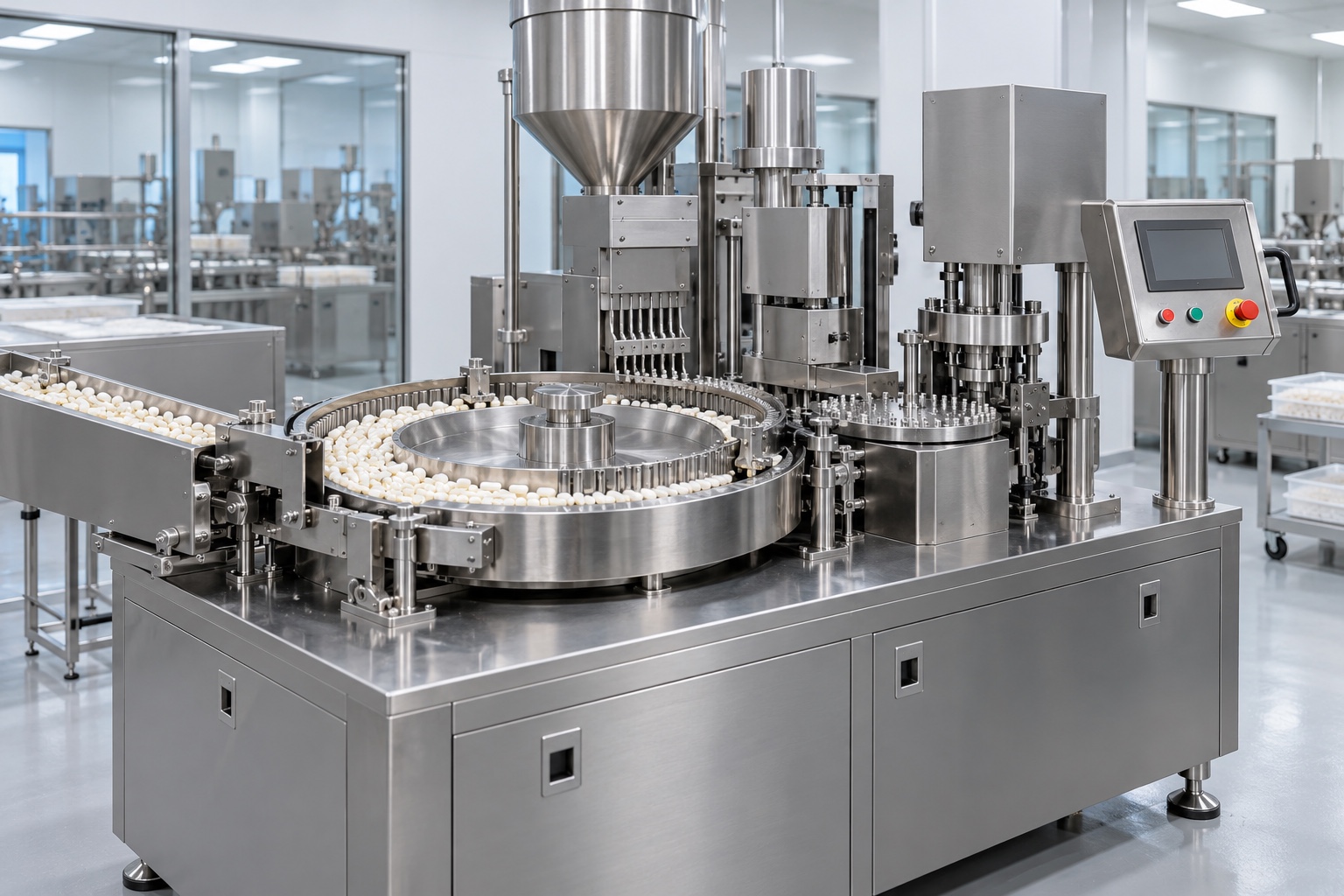
The site matters too. Provide available floor space, access for maintenance and cleaning, electrical supply, compressed air, vacuum, dust extraction, and any line interfaces. A machine that fits on a layout drawing may still need more room for loading, change parts, safe access, and service work.
Ask For Quotes On The Same Basis
Send the same written requirements to every supplier. A useful quotation identifies the base machine, dosing arrangement, capsule-size change parts, product-contact materials, controls, required utilities, and any exclusions. It should also separate optional equipment such as shell loading, powder transfer, vacuum, dust collection, polishing, inspection, checkweighing, and downstream conveying. Do not assume these are included because they appear in a brochure photo.
Ask for a document list with operating and maintenance manuals, drawings, spare-parts lists, material records where required, and any agreed qualification support. Define installation, training, warranty coverage, service location, response route, and parts lead times. If a supplier promises a particular output or fill-weight result, put the test conditions and acceptance criteria in the technical agreement.
Comparing headline machine prices alone can hide the real cost. Change parts for additional capsule sizes, spare parts, site preparation, freight, commissioning, cleaning time, and future service may materially change the project total. Compare offers against the same scope and calculate cost using acceptable capsules at a sustainable production rate, not the highest advertised speed.
Request A Trial With Representative Material
A short demonstration with easy-flowing test powder cannot prove that your formulation will fill consistently. Agree on a trial using the intended shell and a representative material, or document why a substitute is necessary. Define the trial speed, duration, sampling plan, net fill-mass limits, capsule defects, reject handling, and cleaning or changeover checks before the run.
During the trial, observe shell orientation and separation, powder feed, dosing, locking, and discharge. Look beyond an average fill-weight number. Variation across the run, loose caps, cracked shells, powder on the outside, and unplanned stops all affect whether the equipment can meet the production requirement. If the supplier cannot test your actual formulation, make the limits of the demonstration explicit and reserve the final process assessment for the installed line.
Put Acceptance And Support In The Contract
Before placing an order, agree on the factory acceptance test, site acceptance test, documentation package, shipping scope, installation, training, and treatment of failed acceptance items. A factory test checks the agreed machine before shipment; installation and site interfaces still need to be checked after delivery. For regulated production, the buyer must also plan the applicable qualification work using its own process and acceptance criteria.
The service agreement should say who answers a fault report, which parts are held locally, what remote help is available, and when an engineer can attend the site. Confirm the warranty start point and exclusions. A short warranty statement without parts, labor, travel, and response details leaves too much of the operating risk undefined.
The purchase should lead to a verified supplier and a testable specification. If Fimachinery's powder-filling range fits your project, its official contact page provides a direct inquiry path. Send the capsule, material, output, site, and acceptance requirements with the inquiry so the reply can be evaluated as an equipment proposal rather than a generic catalog quote.