
How Do You Fill Capsules In Industrial Production?
Industrial capsule fillers load a specified mass of powder into each two-piece hard capsule before locking it closed. The machine orients the empty shells, separates each cap from its body, doses powder into the body, then rejoins the two parts and discharges the capsule. Capsule size determines how much space is available. The powder and the dosing system determine how many milligrams go into that space. Capsule filling process training guide
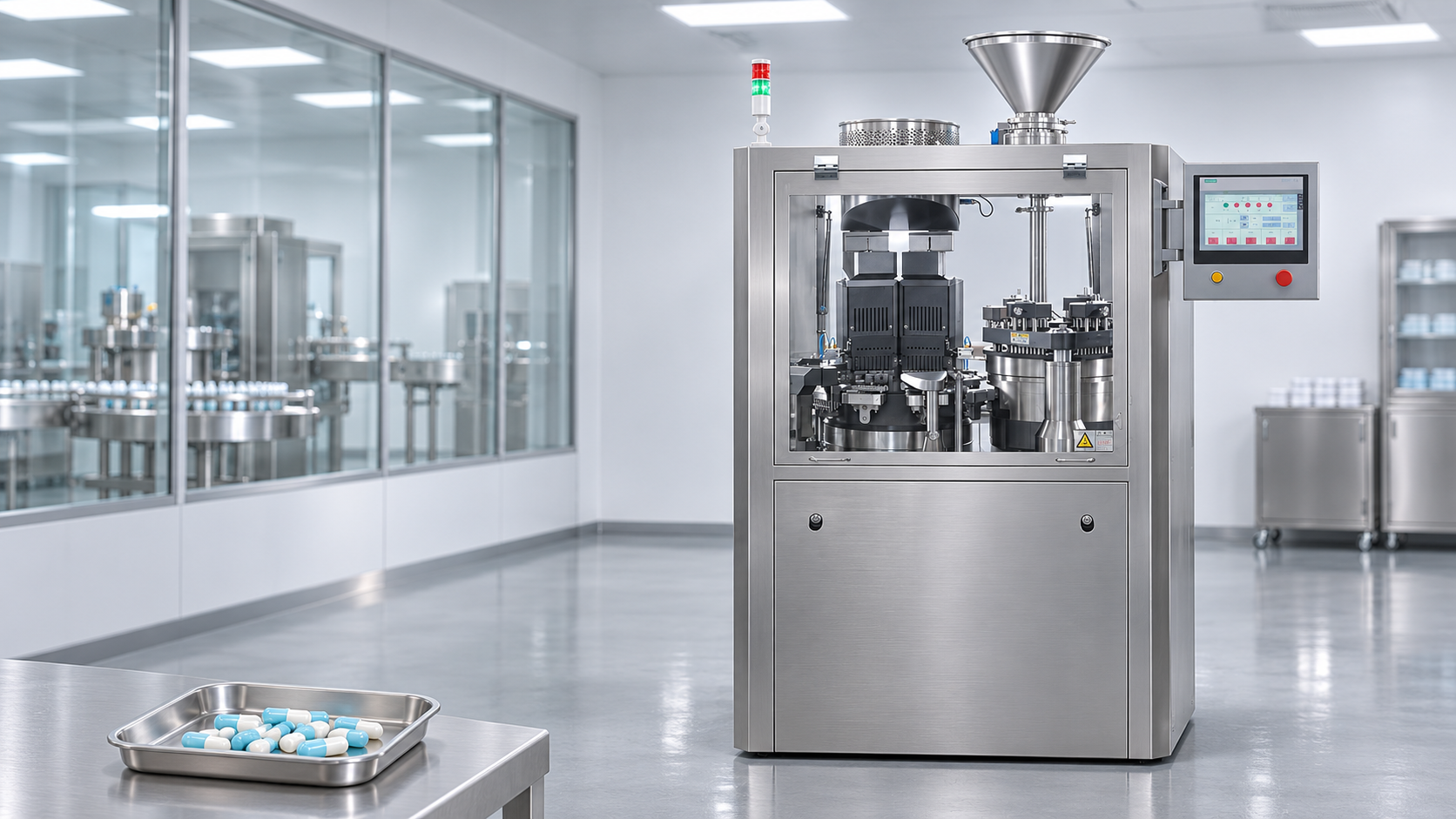
Orient The Shells And Separate The Caps
Empty capsules feed from a hopper into an orienting mechanism, which lines them up and guides them into tooling matched to their size. In a vacuum separation system, the upper tooling holds the wider cap while vacuum draws the body into the lower tooling. The open body moves to the filling station, and the upper tooling holds the cap for closure.
If more shells start arriving unopened, check the separation vacuum, filter and lower tooling holes. The dosing system can meter the correct amount of powder and still miss the capsule if the body never opens. Capsule separation and defect guide
Meter The Powder Before Filling The Capsule Body
In a dosing-disc filler, a bed of powder sits above the disc. As the disc indexes, its holes pass under several sets of tamping pins. The pins compress the powder that enters each hole, and the bed replenishes the holes between tamping steps. At the transfer station, a pin pushes the resulting powder plug into the aligned capsule body. Hole diameter and disc thickness set the available metering volume. Pin penetration affects how tightly the powder packs. Capsule filling machine verification procedure, Section 4
Same volume, different fill weight. Suppose two blends each occupy 0.40 mL in the same dosing hole. At packed densities of 0.60 g/mL and 0.75 g/mL, they would deliver 240 mg and 300 mg per capsule if both transfers were complete. A blend that flows poorly can also replenish the dosing holes unevenly, so the fill weight varies from capsule to capsule. After a formulation change, check powder bed height and feed stability, then use a trial run to see how tamping pin settings affect both average fill weight and variation. Study of fill weight and variation in automatic capsule filling
Lock The Cap And Discharge The Capsule
The closing station aligns the cap with the filled body and presses the two parts together until they lock. The machine then ejects the capsule. Check closed length and appearance even when net fill weight meets the specification. If capsules repeatedly split or fail to lock, check tooling alignment and closing-station settings. If defects coincide with high fill weights, check whether the fill is encroaching on the space needed for the cap and body to engage. Capsule closure defects and in-process checks
Compare Semi-Automatic And Fully Automatic Transfer
In a common semi-automatic layout, the machine performs orientation, separation, filling and locking. The operator transfers the capsule holding rings between stations. Include that transfer time and any time spent waiting between stations when measuring batch output. FRONTIER lists a maximum output of 50,000 capsules per hour for its FI-SCF series. FI-SCF Semi-Automatic Capsule Filling Machine · Semi-automatic station layout
A fully automatic filler moves the capsules between stations as part of the machine cycle. On an indexing rotary machine, different groups of capsules can undergo separation, filling or locking during the same cycle. FRONTIER’s FI-2500CF integrates capsule feeding, separation, powder filling, rejection, locking and discharge. Its listed maximum output is 150,000 capsules per hour. To compare throughput for a specific formulation, run the intended powder and shells at the target speed and count accepted and rejected capsules over the same time interval. FI-2500CF Fully Automatic Capsule Filling Machine
Check Net Fill Weight And Closure In A Production Trial
Weigh each finished capsule, empty it, and then weigh the shell from that same capsule. Subtract the shell weight from the gross weight to get the net fill weight. If capsule weights cluster away from the target, check the dosing setup first. If the average is close to target but individual weights vary widely, check powder feed and how consistently the dosing holes refill. For drug products, assess dosage-unit uniformity using the applicable product method. USP <905> hard capsule net weight procedure
Record capsule size, formulation and running speed alongside net fill weights, closed lengths, visible defects and accepted output. If fewer capsules pass at a higher speed, those records show whether to investigate the dosing station, the closing station or interruptions between stations.