
How An Automatic Capsule Filling Machine Works: Dosing Discs And Dosators
A fully automatic hard capsule filling machine separates each empty shell into its cap and body, transfers a measured portion of powder into the body, and locks the two pieces together. With an independent dosing system, the machine measures the powder before it enters the shell. A capsule can reach its target fill weight with space left inside. The capsule and the powder follow separate paths until they meet at the filling station. Capsule Filling Training Manual, Chapter 2
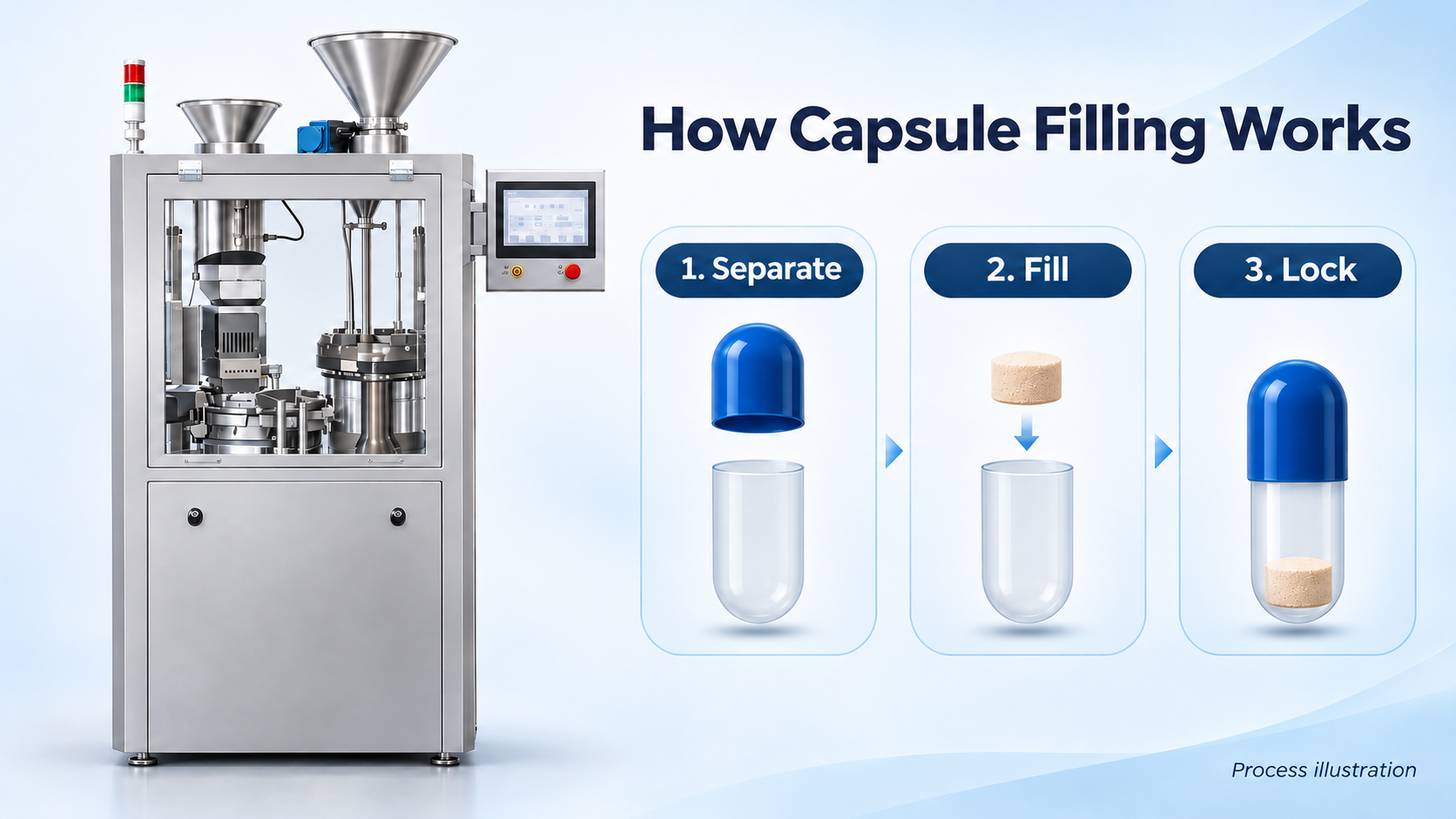
How Empty Capsules Are Oriented And Separated
On an intermittent-motion machine, the turret advances by one fixed increment, then stops. During that pause, one station opens a group of empty shells while another fills a group of open bodies and a third locks filled capsules. Each capsule passes through the stations in sequence, while the machine works on several groups at once.
Empty shells feed from the hopper into guides that orient them cap up and body down. The upper segment retains the wider cap while vacuum draws the narrower body into the lower segment. The lower segment then moves out from under the upper one to expose the open body for filling. If the shell stays closed, the dosing mechanism has no open body to fill. Hard Capsule Filling Process Example
How Dosing Discs And Dosators Meter Powder
Dosing disc and tamping pins. Powder sits above a perforated disc. A support plate closes the bottom of the holes at the tamping positions. As the disc indexes, successive sets of pins press powder into each hole to build a plug. At the transfer station, a push rod drives that plug through the hole and into the aligned capsule body below. The hole diameter and disc thickness define its geometric volume. The powder bed and tamping depth help determine how much powder the hole actually holds. Capsule Filling Training Manual, Section 2.4 and Figure 2.2
Piston dosator. An open-ended tube dips into the powder bed. The piston position sets the depth of the chamber at the tube tip. The piston can compact the powder into a plug that stays in the tube as it lifts out of the bed. The dosator carries the plug over an open capsule body, where the same piston pushes it out. You can tell the mechanisms apart by watching what carries the plug. In one system, it travels in a disc hole. In the other, it travels inside the tube. Dosator Compaction and Ejection Study
Why Fill Weight Can Change With The Same Tooling
The same hole can deliver a different number of milligrams after a formulation change. The mass depends on how readily the powder enters the metering cavity and how densely it packs. In one dosing disc study, powder bed height had a greater effect on fill weight for some of the excipients tested, while the tamping pin setting mattered more for one granulated material. A separate dosator study filled size 3 capsules with six powders and found associations between fill weight and particle size, air permeability, and compressibility. Use the previous settings as a starting point and verify net fill weight with the new formulation. Dosing Disc Study and Dosator Study
What Happens At Rejection, Locking, And Discharge
The FI-CF cycle has a reject station that removes shells whose caps and bodies failed to separate. To know whether a line also checks individual capsule weights, confirm that it has a weighing system and check whether the reported value is gross capsule weight or net fill weight.
After filling, the lower segment returns beneath the upper segment. A push rod brings the body and cap together until they lock. At discharge, an ejector lifts the closed capsule out of its tooling. The empty segment then passes through a cleaning station to clear residual powder before it takes another group of shells. FI-CF Station Diagrams
How To Trace A Defect During A Trial
| What You See | Where To Check First |
|---|---|
| The cap is still on the body after separation. | Check shell orientation and seating in the segment. If both are correct, check the vacuum separation system and tooling fit. |
| Shells open correctly, but net fill weight fluctuates. | Check powder feed stability. If the plugs vary before transfer, look at dosing. If plugs are consistent but powder is left behind or spills as they enter the bodies, look at transfer. |
| Net fill weight is stable, but capsules have loose caps or pinched edges. | Compare samples before and after locking. If damage first appears after locking, check the alignment of the upper and lower segments and the closing action. |
Gross capsule weight includes the shell. To determine the net fill weight of one capsule, follow the applicable sampling procedure, weigh the intact capsule, and subtract the weight of that same shell after emptying it. Net fill weight measures the total material inside. For pharmaceutical products, assess the uniformity of the active ingredient per capsule using the applicable standard and product specification. USP <905> Uniformity of Dosage Units FAQ