
Rotary Tablet Press Machine: Working Principle And Output
A rotary tablet press machine carries multiple sets of upper punches, lower punches and dies around a rotating turret. Each set passes through filling, compression and ejection while other sets occupy different stages of the cycle. This arrangement enables continuous tablet production. Understanding how these movements connect also explains why turret speed affects output, tablet weight and tablet quality. Ghent University research on the tableting process
This article covers conventional single-layer rotary tableting. It explains the role of each stage and how to read station count, turret speed and compression force together.
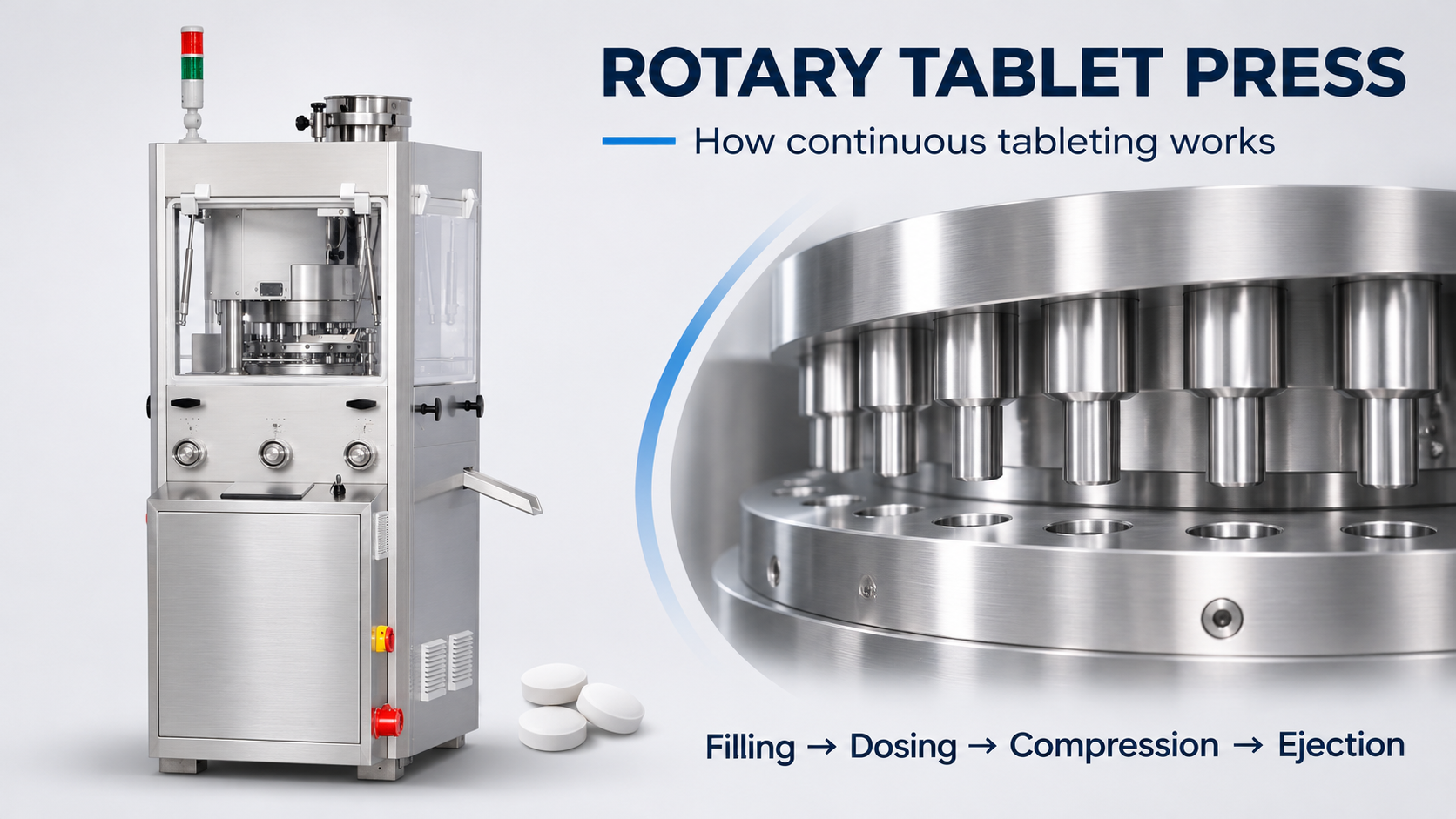
The Turret Carries The Tooling Through Each Stage
One upper punch, one lower punch and one die form a tooling station. The die defines the tablet’s cross-sectional outline. The punches move within it to create the space for filling and compress the material.
The turret moves each station around the machine. Fixed cam tracks guide the punches vertically, and compression rollers apply load through the punch heads. A common configuration with precompression and main compression follows this sequence:
| Stage | Tooling And Material Movement | Purpose |
|---|---|---|
| Filling | The lower punch descends as the die passes beneath the feeder. | Load powder or granules into the die cavity. |
| Dosing | The lower punch rises to the dosing position and excess material is removed. | Set the quantity entering compression. |
| Precompression And Main Compression | The punches pass through the respective compression rollers. | Reduce entrapped air, then complete tablet formation. |
| Ejection | The upper punch withdraws and the lower punch lifts the tablet out of the die. | Release the tablet before the next cycle. |
These stages must work together. Main compression cannot replace material missing from filling. Precompression and main compression also perform different functions; two compression events alone do not establish tablet quality. Ghent University: filling, compression and ejection
Tablet Weight Depends On Filling, Not Fill Depth Alone
Rotary presses fill and dose by volume. In the same die, a deeper dosing position generally provides more space for material. Equal volumes, however, do not necessarily contain equal masses. Incomplete filling and changes in powder packing both affect the result.
The maximum fill depth in a specification sheet therefore cannot be converted into a universal maximum tablet weight. A different formulation can produce a different weight even when die dimensions and depth settings remain unchanged.
Feeder settings matter too. In a paddle-equipped force feeder, paddle speed must work with turret speed. Faster paddles may improve filling at higher turret speeds. Under other conditions, they can increase powder densification and change the mass held within the same dosing volume.
A study using microcrystalline cellulose, anhydrous dicalcium phosphate and their mixtures examined turret speed, paddle speed, fill depth and dosing depth together. Beyond the filling capacity of a particular combination, filling yield declined and tablet weight variation could increase. The study explains these interactions; it does not establish a universal operating speed for every formulation. Pharmaceutics: systematic study of rotary die filling
Check both average weight and individual tablet variation. An acceptable average can conceal inconsistent filling, especially after a speed increase.
Higher Speed Shortens Filling And Compression Time
A faster turret sends more stations through ejection each hour. It also gives each die less time beneath the feeder. Material must enter the cavity within that shorter interval.
Compression has a time constraint as well. On conventional fixed-roller equipment, increasing turret speed shortens the relevant compression times when tooling and machine geometry remain unchanged. Dwell time usually means the interval during which the punch head flat contacts the compression roller, rather than the duration of the entire compression cycle. Ghent University: compression timing and dwell time
Formulations respond differently. Some retain sufficient strength at shorter compression times; others become more susceptible to strength loss or capping. Comparing machines by rpm alone also misses a geometric difference: different turret pitch-circle diameters can produce different punch peripheral speeds at the same rotational speed.
Research with ibuprofen and cilostazol powder mixtures found different sensitivities to tableting speed. A rotational speed verified on a laboratory press therefore should not automatically be treated as an equivalent condition on a production machine. Chemical and Pharmaceutical Bulletin: tableting speed and powder deformation
During speed trials, assess filling and tablet formation together. Recording hourly output alone leaves the associated quality changes unexamined.
Station Count, Speed And Force Answer Different Questions
For a single-tip configuration producing one tablet per station per turret revolution, theoretical output is:
Theoretical Output (Tablets/Hour) = Station Count × Turret Speed (rpm) × 60
For example, a hypothetical 30-station press running at 40 rpm would produce 30 × 40 × 60 = 72,000 tablets/hour before accounting for rejects and interruptions.
If the machine completes two independent tablet-making cycles per revolution, or uses multi-tip tooling, include the appropriate multiplier. Precompression and main compression form the same tablet, so their presence does not double output.
| Specification | What It Describes | What To Check Alongside It |
|---|---|---|
| Station Count | The number of tooling sets installed in the turret. | Tablet dimensions and the output arrangement for that tooling configuration. |
| Maximum Turret Speed | The machine’s rotational speed limit. | Whether the intended formulation fills and forms consistently at that speed. |
| Maximum Main Compression Force (kN) | The force limit of the main compression system. | Tooling load limits, tablet dimensions and required compaction conditions. |
| Maximum Fill Depth | The maximum available filling depth. | Powder packing, target weight and the available dosing range. |
Watch the units. Kilonewtons (kN) measure force; megapascals (MPa) measure force per unit area. For a simplified circular flat-faced punch, the same force applied over a different face area gives a different nominal compaction pressure. Comparing kN values without considering punch face area can therefore be misleading.
Do not assume all listed maxima apply simultaneously. Check the model, tooling and operating conditions before treating maximum tablet diameter, fill depth and speed as one usable setup.
Use Formulation Trial Records To Establish Accepted Output
A specification sheet describes equipment limits. Stable production needs verification with the intended material.
A study spanning pilot- and production-scale presses included formulation, press type, press speed and feeder speed in a tablet weight variability model. Its findings support a practical point: operating conditions depend on the combination of formulation and equipment. Copying a speed setting alone does not guarantee the same result. Pharmaceutics: tablet weight variability at pilot and production scale
- Fix the comparison conditions. Record material batch, tooling specification, target tablet weight, turret speed, feeder speed and compression settings. Without them, differences between trials are difficult to interpret.
- Measure average tablet weight and its variation. Similar averages do not establish equivalent filling consistency.
- Check thickness, breaking force and visible defects together. For drug products, assess the additional quality attributes required by the product specification.
- Separate total tablet count, rejects and downtime, then calculate accepted output over the specified interval.
If tablet weight falls after a speed increase, investigate feed supply and die filling first. If weight remains stable while strength or capping deteriorates, investigate compression conditions and material speed sensitivity. These observations guide the investigation; one result alone does not establish the cause.
A rotary tablet press produces continuously because multiple stations complete filling, dosing, compression and ejection in a coordinated cycle. When assessing output, require the records to answer both questions: how many tablet-making cycles did the turret complete per hour, and how many resulting tablets met the product’s quality requirements?